Tokyo (VNA) – Vietnam and Japan can strengthen cooperation in the semiconductor industry to meet both side’s demand, said Assoc. Prof. Dr Le Duc Anh of the University of Tokyo while mentioning Japan's semiconductor strategy and opportunities for bilateral cooperation.
Anh said Japan's semiconductor strategy centres on four priorities – strengthening economic security and supply chain resilience; building capabilities in next-generation technologies such as advanced logic, memory, 3D integration, chiplets and advanced packaging; combining semiconductors with artificial intelligence; and leveraging the country's strengths in materials, manufacturing equipment, testing and reliability while retraining its workforce.
Japan is aware that no country can single-handedly manage the entire semiconductor supply chain, so cooperation with partners like the US, Europe, and Asian countries including Vietnam forms a crucial part of Japan's strategy, he said.
Regarding the five joint semiconductor research projects linking leading universities in Vietnam and Japan, Anh said their greatest value lies in shifting Vietnam from learning semiconductor theory to training talent through practical research. He noted that semiconductor engineers must gain hands-on experience through solving technological problems, operating advanced equipment, working under strict research standards and taking responsibility for the quality of research outcomes.
The projects cover fundamental areas linked with important development directions of the semiconductor industry, including 3D integrated circuits based on CFET structures, high-mobility materials and transistors, materials for sensors and renewable energy, secure AI-on-chip systems using RISC-V architecture, and wide-bandgap materials for power electronics. Running for about 42 months, they include dedicated components to develop young researchers, contributing to Vietnam's goal of training around 250 doctoral-level semiconductor specialists.
The projects allow Vietnamese doctoral students and young scientists to participate throughout the research process, from identifying scientific problems and designing experiments to fabrication, testing, data analysis, international publication and intellectual property development. More importantly, they also access research organising methodology of Japan's leading laboratories in terms of quality management, data recording, laboratory safety and university – industry collaboration, which are skills hard to be fully obtained through theory learning.
Training human resources through joint research projects will help considerably reduce the time needed for gaining experience, the expert said.
Anh added that the programme also promotes joint doctoral supervision, long-term researcher exchanges, shared facilities and joint research groups. However, he stressed that Vietnam must also strengthen its capacity to receive and build on the programme's outcomes. Besides, it is necessary to boost investment and devising favourable financing mechanisms for key domestic institutions and laboratories to be equipped with appropriate facilities, standardised processes, operating standards and data management systems matching those of their Japanese partners, so that returning researchers can continue their work, establish research teams, train future generations, and have stable funding sources to work.
If implemented effectively, the projects will help establish core research teams, joint laboratories and a long-term Vietnam–Japan research network, strengthening Vietnam's independent research capability, technology absorption and participation in the global semiconductor value chain. Their greatest value, he said, lies in developing a generation of experts capable of leading research, training talent and creating technologies suited to Vietnam's development needs.
Commenting on FPT's first commercial chip exports to Japan and its agreement with Restar to distribute 10 million FPT-designed chips across the Asia-Pacific region between 2026 and 2028, Anh described the achievement as an important milestone showing Vietnamese firms are moving beyond providing manpower and design services to developing their own branded semiconductor products accepted by international markets.
He noted that the first shipment, comprising power management chips for multifunction printers, successfully met Japan's stringent requirements for electrical performance, reliability, and supply chain standards. The achievement also demonstrates Vietnam's ability to target promising market segments such as power management chips, controller chips, IoT devices and products based on mature manufacturing technologies.
The expert cautioned, however, that the agreement concerns distribution across the Asia-Pacific region rather than Japan alone. While it reflects Vietnamese firms' growing capabilities in chip design, commercialisation and compliance with international standards, sustainable competitiveness will depend on developing a broader product portfolio, expanding the customer base, generating recurring revenue, ensuring reliable supply and strengthening intellectual property./.
See more
Expert proposes 3 strategies for Vietnam to develop strategic technology products
Dr Ta Anh Phuong, CEO of Seinetime, a French technology start-up specialising in data personalisation and artificial intelligence (AI) solutions, said Vietnam's strategic technology goods should pass a global relevance test and strive to achieve strategic indispensability, making them products that international corporations actively seek to incorporate into their operations.
ICISE urged to strengthen role in advancing Vietnam's science
Deputy Prime Minister Ho Quoc Dung expressed his hope that Professor Tran Thanh Van, the Rencontres du Vietnam Association and ICISE would continue serving as bridges between Vietnam and the international scientific community, attracting leading researchers and making practical contributions to the country's scientific and technological progress.
Gia Lai province hosts 10th Vietnam School on Neutrinos
During the event, participants receive both fundamental and advanced training in particle physics and neutrino science through lectures covering neutrino physics, the Standard Model, particle and radiation detectors, reactor neutrino experiments, high-energy neutrino astronomy, supernova neutrinos, and major international projects such as Super-Kamiokande, T2K and Hyper-Kamiokande.
Data resources key to transforming Vietnam’s growth model
Experts said an efficient data market will ensure that data flows to sectors where it generates the greatest economic value, thereby improving the economy's overall efficiency.
Vietnam tops Southeast Asia in AI learning on Gemini: Google
Academic queries account for 17% of all prompts submitted by Vietnamese users, well above the regional average of 11%, cementing Vietnam’s position as the region’s top adopter of AI for education.
Vietnam designates October 15 as National Digital Citizen Day
Under the newly issued resolution, citizens have the right to control the use of their personal data, access digital services and receive legal protection in the digital environment.
Top leader unveils people-centred vision for new development model
Vietnam's growth model, long fueled by low-cost labour, resource extraction, contract manufacturing, expanded investment, and capital accumulation, has run out of road. The country now needs a sweeping reform agenda to shift from extensive growth to a model driven by productivity, knowledge, science and technology, innovation, and digital transformation.
Digital governance transforms life in border commune of Dong Nai city
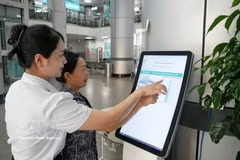
A year after adopting the two-tier local administration model, Bu Gia Map, a remote border commune in the southern city of Dong Nai with a significant ethnic minority community, has experienced notable improvements in public administration, making digital public services more accessible to residents and boosting governance efficiency.
Experts recommend risk-based data governance to strengthen legal protection
In the first quarter of 2026, more than 6.9 million accounts were exposed, double the figure recorded in the same period last years. Stolen personal data has frequently been exploited in sophisticated online scams, particularly impersonation schemes targeting victims through fake relatives or acquaintances.
Interactive "Cyber Security Wall" exhibition spreads digital safety awareness in Hanoi
Through a series of display areas, visitors can explore notable scientific and technological achievements of the People's Public Security Force in safeguarding national security in cyberspace. The exhibition also provides information on common forms of online fraud and cyber scams, along with practical guidance on how to identify and prevent them.
Vietnam approves roadmap to build “Make in Vietnam” civil cryptography ecosystem
The initiative aims to establish and perfect mechanisms and policies to encourage greater participation from enterprises, organisations, training institutions and individuals in developing civil cryptography technology.
Experts call for strengthening innovation ecosystem through closer collaboration
According to the State Agency for Technology and Innovation under the Ministry of Science and Technology, Vietnam is now home to nearly 4,000 start-ups and enterprises operating in the fields of science, technology and innovation, supported by a workforce of more than 30,000 highly skilled professionals.
Deputy PM orders nuclear push as atomic energy institute marks 50 years
VINATOM is targeting not just research strength but strategic national entity status, accompanying the country in building a modern nuclear industry.
New decree offers major incentives for high-tech R&D
The decree, which took effect on July 1, gives priority to investment in high-tech R&D, including research into innovative and core technologies; efforts to decode, master and improve high technologies; and the application, testing and refinement of advanced technologies.
Vietnam shapes AI ecosystem following 18-month implementation of Resolution 57
Eighteen months after the launch of Resolution 57, a national AI ecosystem is gradually taking shape, bringing together institutions, data resources, computing infrastructure, technology enterprises, human resources and application markets.
Three strategic technology products expected to deliver breakthroughs in 2026
With strong leadership from the Party and the State, together with the determination of ministries, sectors, and localities, Vietnam will achieve important initial milestones in strategic technology development within this year
Vietnam accelerates STEM workforce development for strategic technologies
Vietnam’s challenge is not merely to train more engineers or scientists, but to cultivate a generation capable of mastering, improving and eventually creating core technologies.
PM urges faster development of national databases, strategic technologies
The PM stressed that ministers must take direct responsibility for the implementation of assigned tasks and ensure the quality and progress of database development.
National digital architecture framework must ensure nationwide interoperability: PM
PM Le Minh Hung stressed that the national digital architecture framework should provide a unified, shared and interoperable architecture for the entire political system, from the central to grassroots levels, while connecting government systems with citizens and businesses.
Vietnam’s digital overhaul starts to deliver: French newswire
Inforadar noted that Vietnam has progressively streamlined its regulatory framework to clear institutional bottlenecks while putting in place mechanisms designed to spur innovation and technology adoption. The process has also pivoted from a resource-heavy approach to one focused on practical results, with stricter monitoring of projects’ progress.