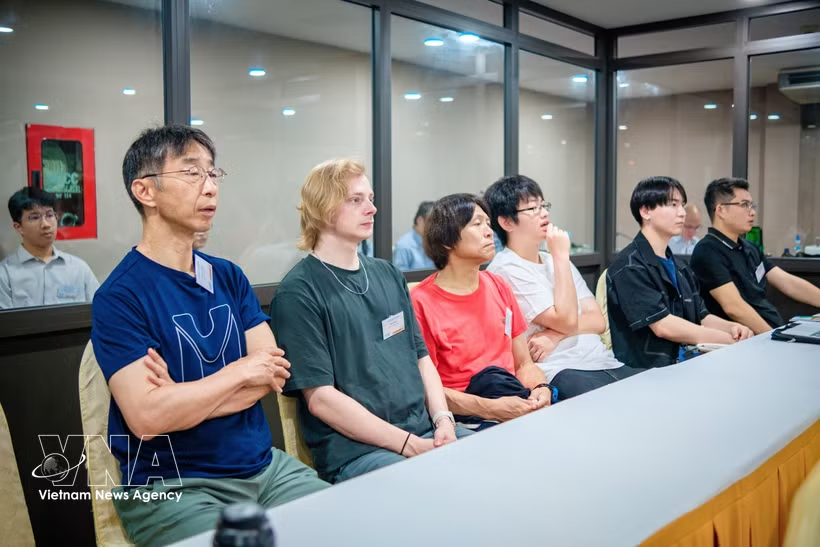
Gia Lai (VNA) – More than 40 scientists, young researchers and students from seven countries gathered in Gia Lai province on July 15 for the 10th Vietnam School on Neutrinos (VSON10).
The annual programme, jointly organised by the Rencontres du Vietnam and the International Centre for Interdisciplinary Science and Education (ICISE), brings together participants from Italy, the UK, Russia, India, Japan, Malaysia and Vietnam.
During the event, participants receive both fundamental and advanced training in particle physics and neutrino science through lectures covering neutrino physics, the Standard Model, particle and radiation detectors, reactor neutrino experiments, high-energy neutrino astronomy, supernova neutrinos, and major international projects such as Super-Kamiokande, T2K and Hyper-Kamiokande.
The programme also explores future neutrino experiments and nucleon decay research.
Beyond theoretical lectures, the programme offers participants a comprehensive overview of state-of-the-art neutrino detection technologies, such as particle radiation detectors, cosmic-ray measurement systems, and other emerging techniques. They also gain hands-on experience in neutrino interaction simulations, analysing and classifying interaction events using data from the Super-Kamiokande detector, operating a basic cosmic-ray measurement system at the ICISE Centre, and exploring the role of neutrinos in cosmology and high-energy astrophysics.
According to the organisers, the VSON has steadily expanded over the past decade, attracting participants not only from Vietnam but also from Japan, the US, India, Southeast Asia and Europe. What began as a relatively new research field in Vietnam has helped establish a domestic neutrino research community, with many former participants going on to pursue graduate studies and research at leading universities and institutes worldwide before joining major international scientific projects.
This year's event coincides with a breakthrough in neutrino physics. The Super-Kamiokande experiment has announced the first evidence of the Diffuse Supernova Neutrino Background (DSNB) at 99.5% confidence, one of the experiment's most significant scientific goals over the past several decades.
The discovery is expected to provide valuable insights into the history of star formation and the processes of nucleosynthesis across the universe.
Currently, the Institute for Interdisciplinary Research in Science and Education (IFIRSE) under ICISE is the only institution in Southeast Asia to officially participate in the Super-Kamiokande experiment, underscoring Vietnam's increasingly prominent position within the international neutrino physics community./.