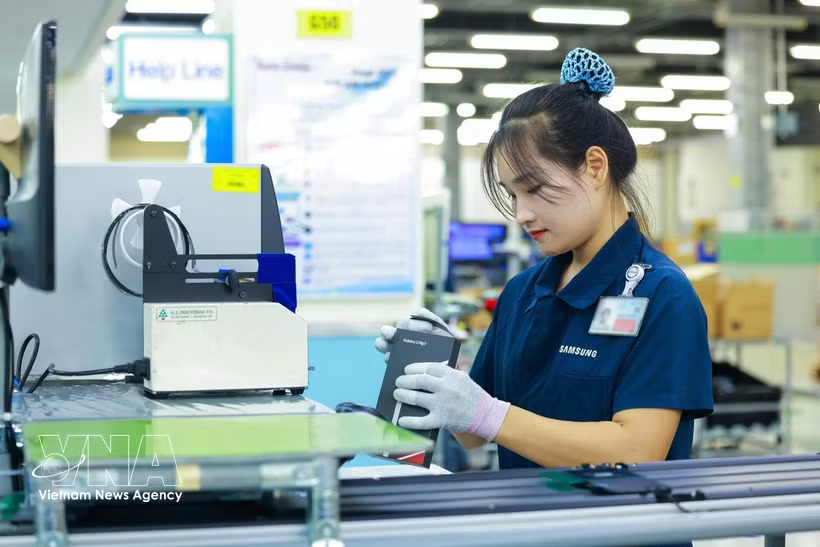
Seoul (VNA) – Samsung is stepping up efforts to nurture high-quality technology talent in Vietnam as part of its long-term strategy to build a global workforce for artificial intelligence (AI) and semiconductor industries.
The strategy recently drew attention after Hoang Huong Giang, one of Vietnam's top performers in the 2026 national high school graduation examination, chose to pursue a degree in computer science at the Korea Advanced Institute of Science and Technology (KAIST) on a four-year Samsung scholarship.
Giang, a student at the High School for the Gifted under the Hanoi National University of Education, achieved a perfect SAT score of 1,600, an IELTS score of 8.0, and was among the country's top scorers in the A01 examination group, which combines Mathematics, Physics and English.
Experts say her case reflects Samsung's long-term strategy of identifying and developing promising young talent in key technology fields, such as AI, semiconductors, big data and the Internet of Things (IoT).
At the core of this strategy is the Samsung Innovation Campus (SIC) programme, launched in 2019 and now operating in about 40 countries. The initiative provides young people with training in AI, IoT, coding, big data and other digital technologies.
Vietnam has been identified as one of Samsung's key markets for developing high-tech human resources. In April, Samsung Vietnam launched the 2026 Samsung Innovation Campus programme in Bac Ninh in cooperation with the National Innovation Centre (NIC) and High Tech Vietnam.
For the first time, the programme includes semiconductor technology alongside courses on AI, IoT and big data.
Samsung plans to partner with about 20 universities and colleges to train more than 2,200 students this year, supporting Vietnam's goal of producing 50,000 semiconductor engineers by 2030. The company said it will offer training from basic to advanced levels while also preparing instructors to expand the programme's reach.
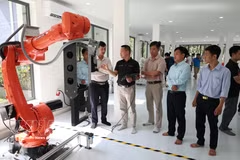
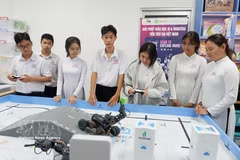
Samsung has also established technology training centres in Vietnam equipped with STEM laboratories, XR/VR practice rooms and semiconductor design simulation facilities.
In June, the company signed a cooperation agreement for 2026–2028 with the University of Engineering and Technology under the Vietnam National University, Hanoi, the Posts and Telecommunications Institute of Technology, and the Hanoi University of Science and Technology. The partnership covers training, research, scholarships, internships and recruitment.
Under the agreement, Samsung will provide scholarships worth about 17 billion VND (over 646,500 USD) for outstanding undergraduate and postgraduate students in information technology, AI, electronics, telecommunications, multimedia and cybersecurity. Since 2012, the company has invested around 180 billion VND in university partnership programmes in Vietnam.
Samsung is also expanding AI training programmes in other countries, while its Solve for Tomorrow initiative has attracted more than three million students in 68 countries./.
See more
Vietnam approves roadmap to build “Make in Vietnam” civil cryptography ecosystem
The initiative aims to establish and perfect mechanisms and policies to encourage greater participation from enterprises, organisations, training institutions and individuals in developing civil cryptography technology.
Experts call for strengthening innovation ecosystem through closer collaboration
According to the State Agency for Technology and Innovation under the Ministry of Science and Technology, Vietnam is now home to nearly 4,000 start-ups and enterprises operating in the fields of science, technology and innovation, supported by a workforce of more than 30,000 highly skilled professionals.
Deputy PM orders nuclear push as atomic energy institute marks 50 years
VINATOM is targeting not just research strength but strategic national entity status, accompanying the country in building a modern nuclear industry.
New decree offers major incentives for high-tech R&D
The decree, which took effect on July 1, gives priority to investment in high-tech R&D, including research into innovative and core technologies; efforts to decode, master and improve high technologies; and the application, testing and refinement of advanced technologies.
Vietnam shapes AI ecosystem following 18-month implementation of Resolution 57
Eighteen months after the launch of Resolution 57, a national AI ecosystem is gradually taking shape, bringing together institutions, data resources, computing infrastructure, technology enterprises, human resources and application markets.
Three strategic technology products expected to deliver breakthroughs in 2026
With strong leadership from the Party and the State, together with the determination of ministries, sectors, and localities, Vietnam will achieve important initial milestones in strategic technology development within this year
Vietnam accelerates STEM workforce development for strategic technologies
Vietnam’s challenge is not merely to train more engineers or scientists, but to cultivate a generation capable of mastering, improving and eventually creating core technologies.
PM urges faster development of national databases, strategic technologies
The PM stressed that ministers must take direct responsibility for the implementation of assigned tasks and ensure the quality and progress of database development.
National digital architecture framework must ensure nationwide interoperability: PM
PM Le Minh Hung stressed that the national digital architecture framework should provide a unified, shared and interoperable architecture for the entire political system, from the central to grassroots levels, while connecting government systems with citizens and businesses.
Vietnam’s digital overhaul starts to deliver: French newswire
Inforadar noted that Vietnam has progressively streamlined its regulatory framework to clear institutional bottlenecks while putting in place mechanisms designed to spur innovation and technology adoption. The process has also pivoted from a resource-heavy approach to one focused on practical results, with stricter monitoring of projects’ progress.
Ho Chi Minh City targets digital transformation for 100,000 SMEs by 2030
The project, jointly launched by the municipal Department of Science and Technology and the Ho Chi Minh City Computer Association (HCA), will be implemented based on the Digital Business Index (DBI), with 200 outstanding enterprises selected as pilot models for wider replication.
Verified subscriber data builds stronger digital shield
As Vietnam accelerates its national digital transformation, every correctly verified mobile subscription builds a more comprehensive and reliable telecom database, laying the groundwork for secure, sustainable digital services and public confidence in the country’s digital ecosystem.
Crop breeding innovation key to boosting agricultural productivity
According to the Plant Production and Protection Department under the Ministry of Agriculture and Environment, improved crop varieties have increased yields by 8–15%, depending on the crop, while enhancing farmers' incomes and supporting the restructuring of the agricultural sector.
Quantum tech seen as strategic pillar for Vietnam’s technological self-reliance
In Vietnam, the Politburo’s Resolution No. 57-NQ/TW identifies science, technology, innovation and digital transformation as breakthrough drivers of national development. In this context, the Prime Minister’s Decision No. 21/2026/QD-TTg has added cybersecurity and quantum technologies to the country’s list of 10 strategic technology groups.
Smart tourism takes hold nationwide
Under the country’s 2026–2030 digital economy and digital society development programme, the sector has been identified as one of the priority ones for accelerating digital transformation to improve governance efficiency, service quality, and visitor experiences.
Vietnam introduces national science funding's risk management framework for the first time
Where a project fails to achieve its intended outcomes, organisations or individuals that have complied with professional procedures, management regulations and transparency requirements may be exempt from administrative liability, and funding will not be reclaimed under current regulations.
Quang Ngai makes strides in digital transformation
All administration agencies from provincial to commune levels are now connected to a dedicated data transmission network, while all villages gain access to mobile and internet services.
Vietnam highlights science, innovation cooperation at ASEAN ministerial meeting in Laos
Vietnam called for enhanced cooperation and the establishment of common regional frameworks for emerging strategic technologies such as artificial intelligence (AI), big data, space technology and cybersecurity to create a secure digital business environment and improve ASEAN's overall competitiveness.
First national semiconductor chip prototyping support centre makes debut
Vietnam's semiconductor ecosystem now comprises around 60 chip design companies, some 7,000 chip design engineers and 166 universities offering semiconductor-related training programmes. Initial registrations from 12 organisations indicate demand for the prototyping of approximately 30,000 chips.
Dien Bien approves UAV sandbox for low-altitude economy development
The Dien Bien provincial People's Committee on June 23 authorised a controlled pilot programme for digital technology-based products and services using unmanned aerial vehicles (UAVs), targeting a flight safety rate of over 99% during the trial period.