Vietnam accelerates STEM workforce development for strategic technologies

Vietnam’s challenge is not merely to train more engineers or scientists, but to cultivate a generation capable of mastering, improving and eventually creating core technologies.

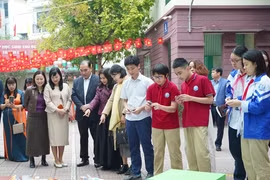
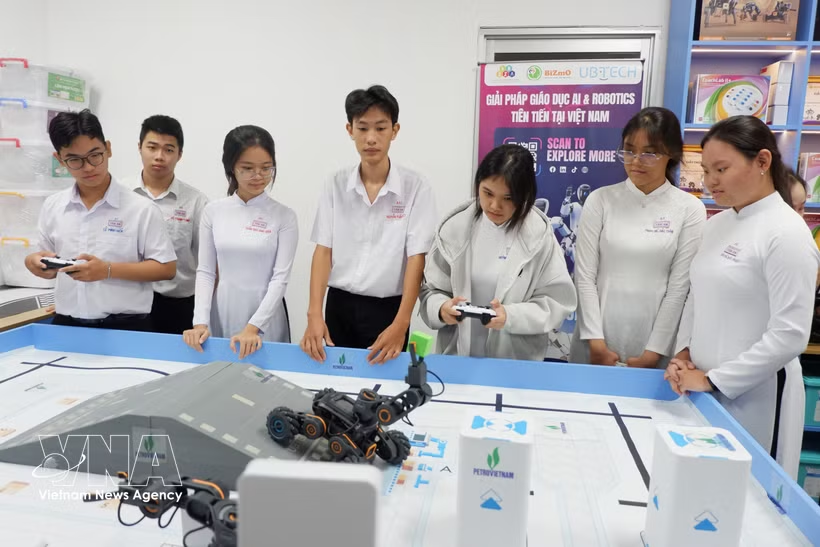
Students of the Tan An High School in Tay Ninh province practice at the school's STEM education laboratory. (Photo: VNA)

Hanoi (VNA) – Vietnam is placing a strong emphasis on developing a high-quality workforce in science, technology, engineering and mathematics (STEM) as it seeks to strengthen its competitiveness in emerging fields such as artificial intelligence (AI), semiconductor and quantum technologies.

Shifting from training human resources to national capabilities

Assoc. Prof. and Dr Phan Thanh Binh, former Chairman of the National Assembly’s Committee for Culture, Education, Youth, Adolescents and Children, said the Fourth Industrial Revolution is being driven by strategic technologies including AI, semiconductors, advanced biotechnology, new materials and energy technologies, quantum technology and next-generation digital technologies.

He noted that these strategic technologies represent an advanced evolution of the four key technological sectors that Vietnam identified more than two decades ago, namely information technology (IT), biotechnology, materials technology, and mechanical engineering and automation.

Today, IT has grown into AI, big data, cloud computing and quantum technology while mechanical engineering – automation has evolved into robotics, smart manufacturing and Industry 4.0 applications. Materials technology has expanded into advanced materials, nanomaterials and materials for new energy applications; and biotechnology has evolved into gene technology, cell technology, synthetic biology and precision biomedicine.

Vietnam has demonstrated a relatively strong capacity to absorb and apply new technologies and is gradually establishing itself as an innovation-driven economy. However, he assessed, significant challenges remain, particularly in mastering core technologies, commercialising research outcomes, strengthening the innovation ecosystem and developing a highly skilled workforce.

To meet the requirements of the new development phase, Vietnam needs to shift its mindset from simply training human resources to building national capabilities, the former official opined.

He stressed the importance of promoting STEM education from an early age to cultivate scientific thinking, creativity and problem-solving skills. At the same time, Vietnam should restructure technical, technological and basic science education, with greater emphasis on mathematics, physics, chemistry and computer science – the essentials for AI, semiconductor and quantum technologies.

Beyond education, Binh emphasised the need to develop talent at multiple levels, from technicians and engineers to researchers, technology strategists and managers. He also called for stronger collaboration among government agencies, universities and businesses, alongside more effective mechanisms to attract overseas Vietnamese professionals and international experts.

Vietnam’s challenge is not merely to train more engineers or scientists, but to cultivate a generation capable of mastering, improving and eventually creating core technologies. Such capabilities will be crucial to enhancing the country’s competitiveness and securing its position in the global technology landscape in the years ahead, he emphasised.

Aligning training with industry needs

Universities across Vietnam have already begun adapting their training models to these priorities.

Assoc. Prof. and Dr Tran Le Quan, President of the University of Science under the Vietnam National University, Ho Chi Minh City, said the institution has invested heavily in modern laboratories, research centres and advanced equipment serving semiconductor technology, advanced materials, AI, data science, biotechnology and quantum technology.

The university has also expanded partnerships with businesses to establish industry-linked laboratories, enabling students to gain hands-on experience with advanced production technologies and real-world industrial challenges, he noted.

Meanwhile, the Ho Chi Minh City University of Technology is strengthening project-based learning, interdisciplinary education and industry internships. Students are encouraged to participate in research projects from an early stage, and also equipped with innovation, entrepreneurship and digital skills as well as foreign-language proficiency.

Training programmes are being updated to meet international standards and better integrate academic knowledge with practical industry needs. The institution continues to invest in laboratories and research platforms, particularly in semiconductors, advanced materials, energy and digital technologies, according to head of its training affairs division Assoc. Prof. and Dr Bui Hoai Thang./.
VNA

See more

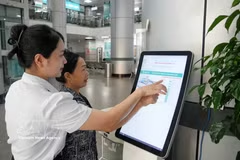
The smart medical kiosk system at Hop Luc General Hospital in Thanh Hoa province makes it easier for patients to access medical examination and treatment services. (Photo: VNA)

Vietnam’s digital overhaul starts to deliver: French newswire

Inforadar noted that Vietnam has progressively streamlined its regulatory framework to clear institutional bottlenecks while putting in place mechanisms designed to spur innovation and technology adoption. The process has also pivoted from a resource-heavy approach to one focused on practical results, with stricter monitoring of projects’ progress.

Visitors experience an e-book app (Photo: VNA)

Verified subscriber data builds stronger digital shield

As Vietnam accelerates its national digital transformation, every correctly verified mobile subscription builds a more comprehensive and reliable telecom database, laying the groundwork for secure, sustainable digital services and public confidence in the country’s digital ecosystem.

A banana plantation cultivated to standardised production practices by Hung Son High-Tech Agriculture JSC in An Phu ward, Gia Lai province. (Photo: VNA)

Crop breeding innovation key to boosting agricultural productivity

According to the Plant Production and Protection Department under the Ministry of Agriculture and Environment, improved crop varieties have increased yields by 8–15%, depending on the crop, while enhancing farmers' incomes and supporting the restructuring of the agricultural sector.

Quantum technology is emerging as a strategic frontier in global science, technology and security competition. - Illustrative image (Photo: VNA)

Quantum tech seen as strategic pillar for Vietnam’s technological self-reliance

In Vietnam, the Politburo’s Resolution No. 57-NQ/TW identifies science, technology, innovation and digital transformation as breakthrough drivers of national development. In this context, the Prime Minister’s Decision No. 21/2026/QD-TTg has added cybersecurity and quantum technologies to the country’s list of 10 strategic technology groups.

A 3D mapping light show projected onto Turtle Tower, combined with a water screen system. (Photo: VNA)

Smart tourism takes hold nationwide

Under the country’s 2026–2030 digital economy and digital society development programme, the sector has been identified as one of the priority ones for accelerating digital transformation to improve governance efficiency, service quality, and visitor experiences.

Delegates at the launch ceremony of the Vietnam National Multi-Project Wafer Coordination Centre (VNMPW/CC) on June 26. (Photo: VNA)

First national semiconductor chip prototyping support centre makes debut

Vietnam's semiconductor ecosystem now comprises around 60 chip design companies, some 7,000 chip design engineers and 166 universities offering semiconductor-related training programmes. Initial registrations from 12 organisations indicate demand for the prototyping of approximately 30,000 chips.

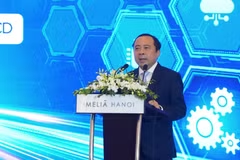
Minister of Science and Technology Vu Hai Quan speaks at the forum (Photo: nhandan.vn)

Vietnam redefines growth through strategic technologies: Forum

Vietnam should stop simply using technology and start truly mastering artificial intelligence (AI), semiconductors, clean energy and advanced materials; swap a resource-driven economy for one fired by innovation, knowledge and talent; and ditch cheap labour as its main calling card in favour of real technological competitiveness that lifts the country into higher-value global supply chains.

A product showcased at the AI Day 2026 (Photo: VNA)

Identifying right competitive advantages key to breaking through in AI era: Expert

Vietnam should develop a “borderless national intellectual network”, enabling Vietnamese professionals living abroad to contribute as visiting professors, strategic advisers, research leaders or co-directors of key laboratories. Such a model would help tap into global expertise without requiring specialists to return home permanently., according to Assoc. Prof., Dr Nguyen Thanh Phuong of the Department of Information Engineering, Computer Science and Mathematics (DISIM) at the University of L’Aquila in Italy.

Robots handle cargo loading and unloading, helping reduce labour intensity and boost productivity (Photo: VNA)

Flexible policies key to unlocking Vietnam’s strategic technology ambitions: expert

According to Assoc. Prof. Dr. Tran Le Hung from Gustave Eiffel University (France), many countries have invested heavily in cutting-edge technologies but have failed to achieve expected results. The main constraints, he said, are often not capital or human resources, but regulatory bottlenecks, policy policies and implementation mechanisms.

Deputy Prime Minister Ho Quoc Dung chairs the meeting in Hanoi on June 23. (Photo: VNA)

Investment should prioritise strategic technologies: Deputy PM

Under the draft project, research infrastructure development will align with Vietnam’s science, technology and innovation strategy, focusing on strategic technologies. The system will follow a unified three-tier model, prioritising the upgrading, integration and shared use of existing facilities, while ensuring operational efficiency, accountability, data security, intellectual property protection and national interests.