Hanoi (VNA) – The inclusion of cybersecurity and quantum technologies among Vietnam's 10 strategic technology groups is seen as a key step toward building research capacity, training high-quality human resources and gradually mastering quantum technologies, towards strengthening national technological self-reliance and competitiveness in the new era, according to experts.
Quantum technology is emerging as a strategic frontier in global science, technology and security competition, as countries ramp up investment and gradually commercialise applications such as quantum communications and quantum sensing, while continuing to develop large-scale quantum computing systems.
In Vietnam, the Politburo’s Resolution No. 57-NQ/TW identifies science, technology, innovation and digital transformation as breakthrough drivers of national development. In this context, the Prime Minister’s Decision No. 21/2026/QD-TTg has added cybersecurity and quantum technologies to the country’s list of 10 strategic technology groups.
Early action needed
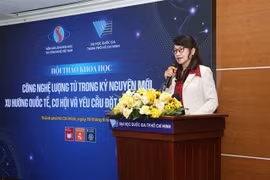
Dr. Nguyen Quoc Hung, Director of the Quantum Technology Institute under Vietnam National University, Hanoi (VNU Hanoi), cited a report by the global management consulting McKinsey & Company, noting that investment in quantum technology start-ups surged in 2025 compared to the previous year, with most funding still focused on quantum computing.
Alongside rising investment, countries with a developed technological sector are tightening export controls on quantum-related equipment and components, including cryogenic cooling systems, high-frequency electronics and specialised devices, making access increasingly difficult for latecomers.
Hung said this is a crucial time for Vietnam to act if it wants to become part of the global quantum technology development chain. While Vietnam may have missed earlier waves of foundational technologies, it still has an opportunity to catch up by rapidly building research capacity, developing a skilled workforce and gradually mastering core technologies.
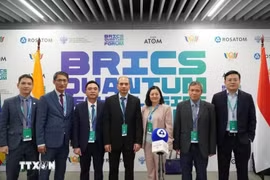
According the expert, Vietnam has begun taking concrete steps to integrate quantum technology into its national development pathway and enhance its regional standing in the field, including plans to host the Southeast Asia Quantum Hackathon in July and the ASEAN Quantum Summit in October.
The establishment of the Institute of Quantum Technology at VNU Hanoi, is also seen as a move to implement the Party’s and State’s orientations on science, technology and innovation, particularly Resolution 57-NQ/TW and Resolution 71-NQ/TW. The institute will focus on research infrastructure, core technology development, human resources training and international cooperation to build an emerging quantum ecosystem.
However, Hung noted that Vietnam’s quantum sector remains at an early stage, with fragmented research groups, limited specialised training, weak business participation and insufficient infrastructure. Key bottlenecks include the absence of a national programme and inter-sector coordination mechanism, a shortage of experts, underdeveloped laboratories, and funding mechanisms that are not well suited to long-term, high-risk research.
Vietnam should pursue a focused approach rather than spread its resources across the entire quantum technology value chain. In the near term, the country should prioritise areas that address practical needs and build on its existing strengths, including quantum communications, post-quantum cryptography, quantum sensing and talent development, while establishing a national programme and a phased development roadmap, he said.
Vital element in strategic competition
Assoc. Prof. Dr. Tran Quang Dieu, Director of the Centre for Technology and Digital Transformation at the Ho Chi Minh National Academy of Politics, said Vietnam’s long-term development vision sets science, technology and innovation as key drivers for breakthrough growth.
He outlined Vietnam’s long-term economic development vision and noted that achieving those ambitions will require breakthrough reforms in national governance, including a shift toward a more enabling, post-audit management approach, the elimination of the “ask–give” mechanism, the development of a two-tier local government system focused on service delivery and co-creation, and a transition from process-based management to results-oriented governance.
Early preparation in institutions, governance capacity, human resources and infrastructure will be essential for Vietnam to seise opportunities and strengthen competitiveness, he stressed.
Vietnam cannot stay outside
Dr. Tran Hong Thai, President of the Vietnam Academy of Science and Technology, stressed that quantum technology is highly complex, requiring advanced expertise, infrastructure and human resources.
He noted that many global research directions remain experimental and not yet commercially scalable. However, Vietnam cannot wait until technologies are fully mature before engaging.
If preparation is delayed until technology standards, supply chains, and markets are already established, opportunities for Vietnam will be significantly narrowed, he noted.
Vietnam should focus not on whether to participate, but on how and at what level to engage in quantum technology to build real capacity for the country, avoiding fragmented or trend-driven approaches, he noted.
Quantum technology is becoming a new arena of strategic competition. With existing policy foundations, Vietnam now has the conditions to join this technological race – but success will require long-term, focused investment and coordinated efforts among the State, research institutes, universities and enterprises, experts stressed./.