Hanoi (VNA) – After 18 months of implementing Politburo Resolution No. 57-NQ/TW on breakthroughs in science and technology development, innovation and national digital transformation, Vietnam has made significant strides in laying the foundations for a national artificial intelligence (AI) ecosystem, with AI emerging as one of the fastest-moving fields in terms of policy development and implementation.
Once viewed primarily as an application technology, AI is increasingly being positioned as strategic infrastructure linked to data, computing capacity, innovation and national digital sovereignty.
Strategic policy
One of the most notable developments since the adoption of Resolution 57 is that AI has, for the first time, been placed at the centre of Vietnam’s national development strategy. The resolution sets the goal of positioning Vietnam among the top three countries in Southeast Asia in AI research and development by 2030, while gradually mastering strategic technologies such as AI, the Internet of Things, big data, cloud computing, semiconductors and quantum technology.
This reflects a new development vision in which AI is regarded as a key driver of economic growth, productivity enhancement and innovation in national governance. The policy orientation has since been translated into a series of concrete measures. AI, together with big data, cloud computing, digital twins, edge computing, the Internet of Things and blockchain, has been included in the Government’s list of strategic technologies. Vietnamese large language models, virtual assistants and specialised AI applications have also been identified among strategic technology products expected to generate significant economic impact.
At the same time, Vietnam has moved forward with legislation and policy frameworks related to digital transformation and AI, while developing a national AI strategy and considering the establishment of a National AI Development Fund.
For the first time, the country has formed a relatively comprehensive legal and policy framework dedicated to AI, reflecting a shift in governance thinking with AI regarded as an integral component of national development.
From application to mastery
The implementation of Resolution 57 has also brought about changes in the country’s approach to AI development. While domestic enterprises previously relied largely on foreign AI models, investment has increasingly shifted towards core technologies and technological self-reliance.
According to a report reviewing the first 18 months of implementation, AI application has begun to support management, administration and public service delivery through virtual assistants, chatbots, text analysis, forecasting tools, image recognition systems and traffic monitoring solutions. Ai is now applied in sectors including finance, healthcare, education, energy and urban management.
Several major technology firms have increased investment in AI development. FPT has partnered with NVIDIA to invest around 200 million USD in an AI factory project, providing computing infrastructure and developing more than 20 generative AI products. Meanwhile, Viettel, VNPT, VinAI and Zalo are developing Vietnamese-language large language models.
At the local level, AI application is becoming increasingly widespread. Hanoi has signed a cooperation agreement with technology corporation CMC for the 2026–2030 period to promote digital administration, the digital economy, the digital society and digital citizenship. The cooperation also includes plans to develop integrated technology complexes featuring data centres, cloud infrastructure, AI capabilities, research and development facilities, innovation spaces and digital workforce training centres. AI, semiconductor and digital technology education and research hubs are also planned in Thuong Cat and Hoa Lac.
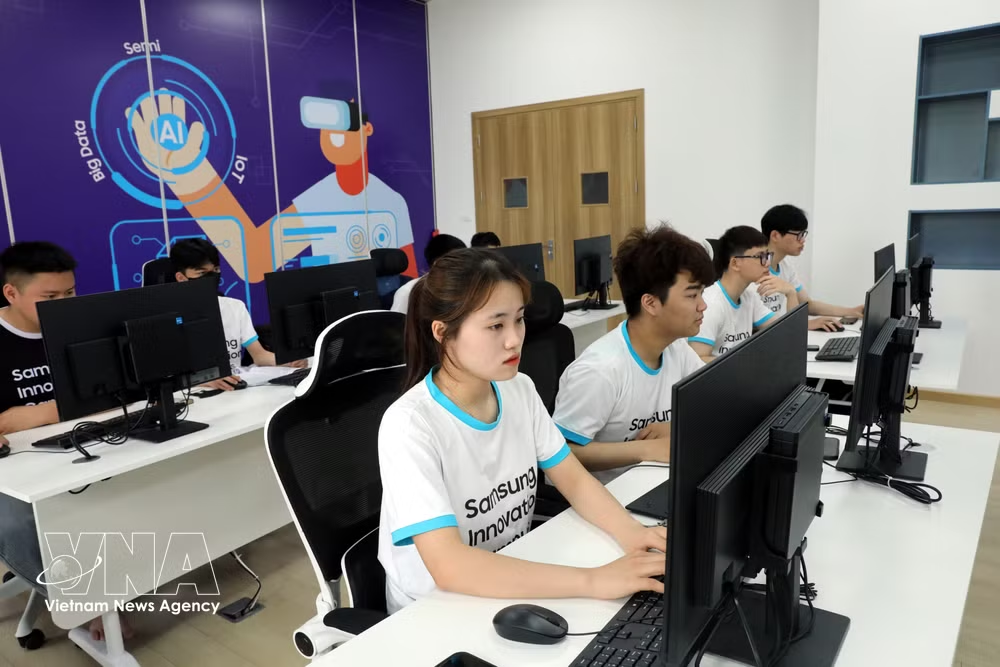
In Ninh Binh province, AI-powered reception robots, digital assistants and administrative support solutions have been introduced at public service centres to guide citizens through administrative procedures, reduce waiting times and support officials in handling workloads. These efforts, together with the expansion of digital public services, are helping to build key national AI capabilities, including computing infrastructure, Vietnamese-language AI models and a skilled research workforce.
Forming a national AI ecosystem
Eighteen months after the launch of Resolution 57, a national AI ecosystem is gradually taking shape, bringing together institutions, data resources, computing infrastructure, technology enterprises, human resources and application markets.
The Ministry of Science and Technology recently issued a set of criteria for evaluating AI platforms used in public administration nationwide. The framework requires compliance with legal regulations, personal data protection, AI security standards and professional accountability. It also clearly stipulates that AI serves as a tool to support analysis, consultation and decision-making, while legal responsibility remains with authorised officials.
Notably, technological self-reliance has been established as a key requirement for AI systems serving the public sector. Platforms that do not use Vietnamese-language large language models controlled by Vietnamese enterprises or lack training and inference infrastructure located in Vietnam will not be eligible for pilot deployment.
It can be said that Resolution 57 has helped lay the foundations for Vietnam’s AI ecosystem. The challenge ahead will be how to transform these foundations into genuine competitive advantages, creating AI products, platforms and enterprises capable of supporting national development and competing in international markets. Success in AI development is expected to contribute to shaping a new growth model for Vietnam based on knowledge, data and innovation./.