Experts call for strengthening innovation ecosystem through closer collaboration

According to the State Agency for Technology and Innovation under the Ministry of Science and Technology, Vietnam is now home to nearly 4,000 start-ups and enterprises operating in the fields of science, technology and innovation, supported by a workforce of more than 30,000 highly skilled professionals.

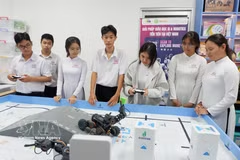
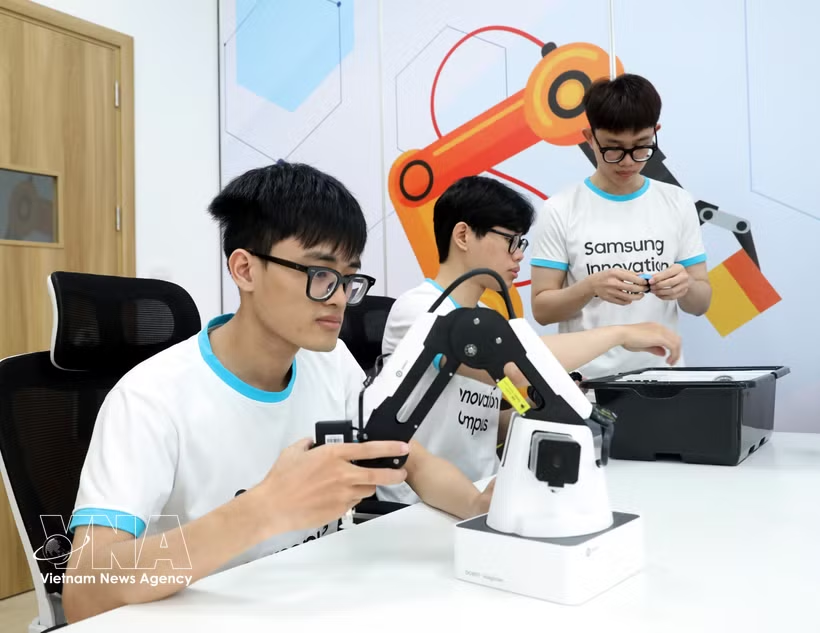
Students take part in a high-tech practical session under the Samsung innovation campus programme at the Vietnam–Korea College of Technology in Bac Giang. (Photo: VNA)

Hanoi (VNA) – Experts have called for a stronger innovation ecosystem and closer collaboration between the State, research institutions and businesses to unlock the potential of Vietnam's science and technology sector, where most enterprises remain small in scale, face resource constraints and continue to encounter significant challenges in research and innovation.

According to the State Agency for Technology and Innovation under the Ministry of Science and Technology, Vietnam is now home to nearly 4,000 start-ups and enterprises operating in the fields of science, technology and innovation, supported by a workforce of more than 30,000 highly skilled professionals.

In 2025, sci-tech enterprises generated an estimated 196 trillion VND (7.45 billion USD) in revenue, with private firms accounting for 98.5% of the total number of those in the sector.

The Ministry of Science and Technology said it has continued to strengthen the legal and policy framework, notably through the submission of Decree No. 268/2025/ND-CP to the Government for issuance, which provides detailed guidance on the Law on Science, Technology and Innovation and establishes legal criteria for recognising innovative start-ups.

The ministry also submited to the Government for approval of Decree No. 264/2025/ND-CP on venture capital funds to improve access to investment capital, and Decree No. 271/2025/ND-CP, which creates a legal framework enabling research institutes and universities in Hanoi to establish spin-off companies.

Decentralisation has also been advanced through Decree No. 133/2025/ND-CP, which transfers full authority for recognising high-tech enterprises to provincial/municipal People's Committees. The national innovation strategy has been translated into action through the 2025 innovation action programme and strategic orientations through 2030, alongside the expansion of innovation centres in key localities. The country’s science and technology market has also made significant progress with the launch of the national science and technology exchange, which is connected to data from 19 local technology exchanges.

However, experts noted that while the number of sci-tech enterprises is relatively large, only a limited number has achieved significant scale.

According to Hoang Duc Thao, Chairman of the Vietnam Association of Science and Technology Enterprises, said its member companies have developed hundreds of innovations that have delivered tangible benefits to businesses and society, with some technology firms generating annual revenues of tens of trillions of Vietnamese dong. These achievements demonstrate the sector's considerable economic potential. Nevertheless, opportunities for breakthrough growth remain constrained by limitations in technology, capital, human resources, business networks and intense competition among firms pursuing similar objectives.

While most research outcomes remain at the laboratory or proof-of-concept stage, technology companies generally require solutions that have already been validated and can be rapidly commercialised. The shortage of professional technology transfer intermediaries has limited cooperation between researchers and businesses, increasing costs, extending development timelines and raising risks for start-ups seeking to adopt new technologies.
vnanet-automech.jpg
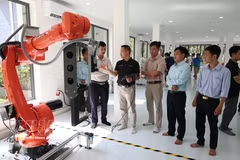
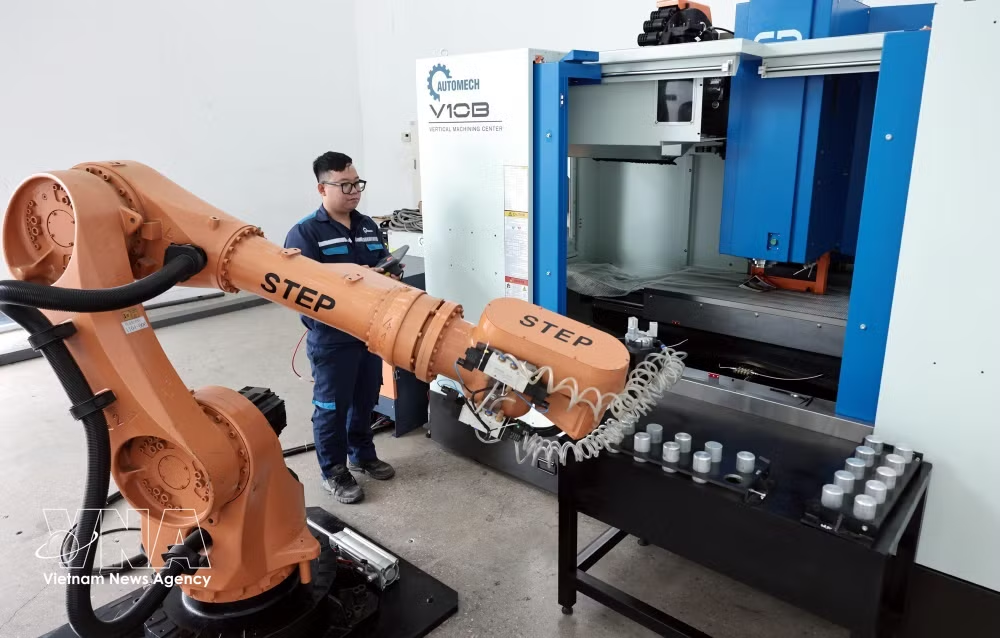
A robotic system for the mechanical engineering and manufacturing industry developed by Automech Mechanical Equipment and Solutions JSC. (Photo: VNA)

Many experts have, therefore, called for the development of professional technology transfer organisations to strengthen links between research institutes, universities and businesses. They also recommended establishing mechanisms to support companies in accessing new technologies, creating digital technology marketplaces and setting up risk-sharing funds for technology transfer to reduce research costs, share commercialisation risks and accelerate product development.

Dr Dang Duc Anh, Acting Director of the Institute for Policy and Strategy Studies under the Party Central Committee's Commission for Policies and Strategies, noted that addressing the challenges facing sci-tech enterprises will require closer cooperation between government agencies, research institutes, universities and businesses to promote technology transfer and the commercialisation of research outcomes.

He added that companies also need stronger policy support to invest in research and development, improve access to concessional finance, adopt new technologies and attract highly skilled talents./.


VNA

See more

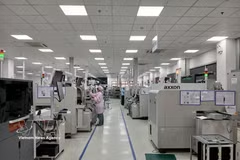
A SMT (Surface Mount Technology) production line for electronic devices at Trung Nam EMS Factory, Da Nang High-Tech Park. (Photo: VNA)

New decree offers major incentives for high-tech R&D

The decree, which took effect on July 1, gives priority to investment in high-tech R&D, including research into innovative and core technologies; efforts to decode, master and improve high technologies; and the application, testing and refinement of advanced technologies.

The smart medical kiosk system at Hop Luc General Hospital in Thanh Hoa province makes it easier for patients to access medical examination and treatment services. (Photo: VNA)

Vietnam’s digital overhaul starts to deliver: French newswire

Inforadar noted that Vietnam has progressively streamlined its regulatory framework to clear institutional bottlenecks while putting in place mechanisms designed to spur innovation and technology adoption. The process has also pivoted from a resource-heavy approach to one focused on practical results, with stricter monitoring of projects’ progress.

Visitors experience an e-book app (Photo: VNA)

Verified subscriber data builds stronger digital shield

As Vietnam accelerates its national digital transformation, every correctly verified mobile subscription builds a more comprehensive and reliable telecom database, laying the groundwork for secure, sustainable digital services and public confidence in the country’s digital ecosystem.

Quantum technology is emerging as a strategic frontier in global science, technology and security competition. - Illustrative image (Photo: VNA)

Quantum tech seen as strategic pillar for Vietnam’s technological self-reliance

In Vietnam, the Politburo’s Resolution No. 57-NQ/TW identifies science, technology, innovation and digital transformation as breakthrough drivers of national development. In this context, the Prime Minister’s Decision No. 21/2026/QD-TTg has added cybersecurity and quantum technologies to the country’s list of 10 strategic technology groups.

A 3D mapping light show projected onto Turtle Tower, combined with a water screen system. (Photo: VNA)

Smart tourism takes hold nationwide

Under the country’s 2026–2030 digital economy and digital society development programme, the sector has been identified as one of the priority ones for accelerating digital transformation to improve governance efficiency, service quality, and visitor experiences.

Delegates at the launch ceremony of the Vietnam National Multi-Project Wafer Coordination Centre (VNMPW/CC) on June 26. (Photo: VNA)

First national semiconductor chip prototyping support centre makes debut

Vietnam's semiconductor ecosystem now comprises around 60 chip design companies, some 7,000 chip design engineers and 166 universities offering semiconductor-related training programmes. Initial registrations from 12 organisations indicate demand for the prototyping of approximately 30,000 chips.

Minister of Science and Technology Vu Hai Quan speaks at the forum (Photo: nhandan.vn)

Vietnam redefines growth through strategic technologies: Forum

Vietnam should stop simply using technology and start truly mastering artificial intelligence (AI), semiconductors, clean energy and advanced materials; swap a resource-driven economy for one fired by innovation, knowledge and talent; and ditch cheap labour as its main calling card in favour of real technological competitiveness that lifts the country into higher-value global supply chains.

A product showcased at the AI Day 2026 (Photo: VNA)

Identifying right competitive advantages key to breaking through in AI era: Expert

Vietnam should develop a “borderless national intellectual network”, enabling Vietnamese professionals living abroad to contribute as visiting professors, strategic advisers, research leaders or co-directors of key laboratories. Such a model would help tap into global expertise without requiring specialists to return home permanently., according to Assoc. Prof., Dr Nguyen Thanh Phuong of the Department of Information Engineering, Computer Science and Mathematics (DISIM) at the University of L’Aquila in Italy.

Robots handle cargo loading and unloading, helping reduce labour intensity and boost productivity (Photo: VNA)

Flexible policies key to unlocking Vietnam’s strategic technology ambitions: expert

According to Assoc. Prof. Dr. Tran Le Hung from Gustave Eiffel University (France), many countries have invested heavily in cutting-edge technologies but have failed to achieve expected results. The main constraints, he said, are often not capital or human resources, but regulatory bottlenecks, policy policies and implementation mechanisms.