New decree offers major incentives for high-tech R&D

The decree, which took effect on July 1, gives priority to investment in high-tech R&D, including research into innovative and core technologies; efforts to decode, master and improve high technologies; and the application, testing and refinement of advanced technologies.

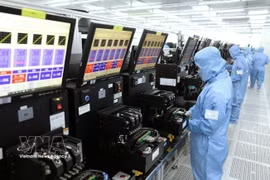
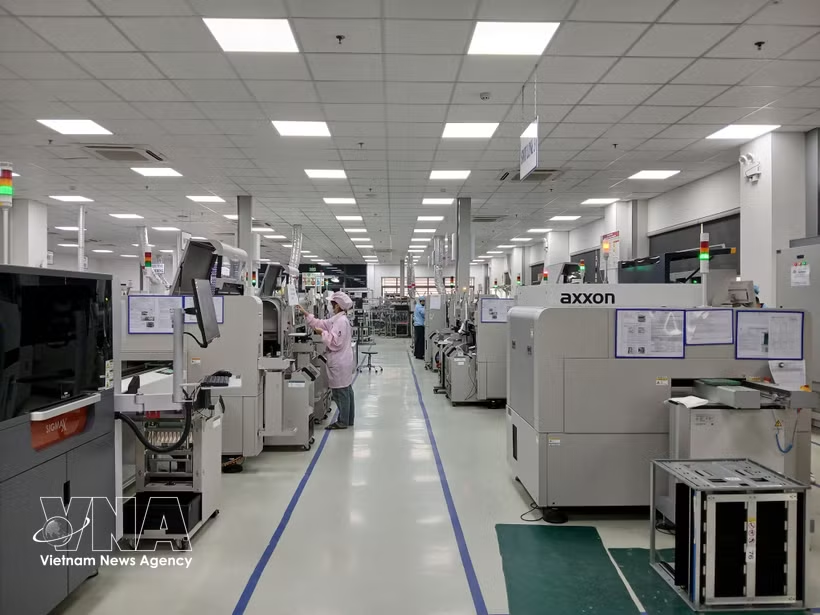
A SMT (Surface Mount Technology) production line for electronic devices at Trung Nam EMS Factory, Da Nang High-Tech Park. (Photo: VNA)

Hanoi (VNA) – Organisations and individuals undertaking high-tech tasks will receive a wide range of incentives under Decree No. 260/2026/ND-CP, recently issued by the Government, which details and guides the implementation of several articles of the Law on High Technology, including policies to promote high-tech research and development (R&D).

The decree, which took effect on July 1, gives priority to investment in high-tech R&D, including research into innovative and core technologies; efforts to decode, master and improve high technologies; and the application, testing and refinement of advanced technologies.

Organisations and individuals undertaking high-tech tasks will receive priority consideration for orders and financial support through science, technology and innovation programmes and projects. Funding sources include the National Foundation for Science and Technology Development (NAFOSTED), the National Technology Innovation Fund, and science, technology and innovation funds managed by ministries, sectors and localities.

For State-commissioned or State-funded high-tech projects, support may cover up to 100% of total costs.

New technologies, products and business models will also be prioritised for controlled pilot implementation and given preferential access to State-invested national research centres, testing facilities and key laboratories.

Regarding taxation, the decree grants import tax exemptions for machinery, equipment, spare parts, specialised materials, scientific documents and publications used directly for high-tech R&D. Corporate expenditure on high-tech research and development will be treated in accordance with the laws on corporate income tax and on science, technology and innovation.

Individuals directly engaged in high-tech R&D will be exempt from personal income tax on wages and remuneration earned from high-tech assignments, as well as income derived from copyrights when research results are commercialised.

The State will also provide support covering up to 100% of training and capacity-building costs for personnel participating in high-tech R&D through high-tech projects or capability-enhancement programmes funded by NAFOSTED or ministerial and local funds, in accordance with relevant regulations.

To promote the commercialisation of research outcomes, organisations and individuals may receive support covering up to 100% of consultancy costs for preparing applications for domestic and international intellectual property protection. Products, goods and services developed through high-tech projects will be entitled to incentives under the Law on Bidding and Decree No. 214/2025/ND-CP.

Enterprises investing in technological infrastructure for urgent high-tech projects serving socio-economic development, national defence and security will be eligible for State support. Infrastructure investment costs may be deducted when determining taxable corporate income.

Notably, enterprises engaged in scientific research, technology development and innovation in the high-tech sector will be eligible for interest-rate support on loans through the National Technology Innovation Fund or ministerial and local funds. The support will cover 70% of the contractual lending rate, capped at 8% per year, for a maximum period of five years./.


VNA

See more

The smart medical kiosk system at Hop Luc General Hospital in Thanh Hoa province makes it easier for patients to access medical examination and treatment services. (Photo: VNA)

Vietnam’s digital overhaul starts to deliver: French newswire

Inforadar noted that Vietnam has progressively streamlined its regulatory framework to clear institutional bottlenecks while putting in place mechanisms designed to spur innovation and technology adoption. The process has also pivoted from a resource-heavy approach to one focused on practical results, with stricter monitoring of projects’ progress.

Visitors experience an e-book app (Photo: VNA)

Verified subscriber data builds stronger digital shield

As Vietnam accelerates its national digital transformation, every correctly verified mobile subscription builds a more comprehensive and reliable telecom database, laying the groundwork for secure, sustainable digital services and public confidence in the country’s digital ecosystem.

A banana plantation cultivated to standardised production practices by Hung Son High-Tech Agriculture JSC in An Phu ward, Gia Lai province. (Photo: VNA)

Crop breeding innovation key to boosting agricultural productivity

According to the Plant Production and Protection Department under the Ministry of Agriculture and Environment, improved crop varieties have increased yields by 8–15%, depending on the crop, while enhancing farmers' incomes and supporting the restructuring of the agricultural sector.

Quantum technology is emerging as a strategic frontier in global science, technology and security competition. - Illustrative image (Photo: VNA)

Quantum tech seen as strategic pillar for Vietnam’s technological self-reliance

In Vietnam, the Politburo’s Resolution No. 57-NQ/TW identifies science, technology, innovation and digital transformation as breakthrough drivers of national development. In this context, the Prime Minister’s Decision No. 21/2026/QD-TTg has added cybersecurity and quantum technologies to the country’s list of 10 strategic technology groups.

A 3D mapping light show projected onto Turtle Tower, combined with a water screen system. (Photo: VNA)

Smart tourism takes hold nationwide

Under the country’s 2026–2030 digital economy and digital society development programme, the sector has been identified as one of the priority ones for accelerating digital transformation to improve governance efficiency, service quality, and visitor experiences.

Delegates at the launch ceremony of the Vietnam National Multi-Project Wafer Coordination Centre (VNMPW/CC) on June 26. (Photo: VNA)

First national semiconductor chip prototyping support centre makes debut

Vietnam's semiconductor ecosystem now comprises around 60 chip design companies, some 7,000 chip design engineers and 166 universities offering semiconductor-related training programmes. Initial registrations from 12 organisations indicate demand for the prototyping of approximately 30,000 chips.

Minister of Science and Technology Vu Hai Quan speaks at the forum (Photo: nhandan.vn)

Vietnam redefines growth through strategic technologies: Forum

Vietnam should stop simply using technology and start truly mastering artificial intelligence (AI), semiconductors, clean energy and advanced materials; swap a resource-driven economy for one fired by innovation, knowledge and talent; and ditch cheap labour as its main calling card in favour of real technological competitiveness that lifts the country into higher-value global supply chains.

A product showcased at the AI Day 2026 (Photo: VNA)

Identifying right competitive advantages key to breaking through in AI era: Expert

Vietnam should develop a “borderless national intellectual network”, enabling Vietnamese professionals living abroad to contribute as visiting professors, strategic advisers, research leaders or co-directors of key laboratories. Such a model would help tap into global expertise without requiring specialists to return home permanently., according to Assoc. Prof., Dr Nguyen Thanh Phuong of the Department of Information Engineering, Computer Science and Mathematics (DISIM) at the University of L’Aquila in Italy.

Robots handle cargo loading and unloading, helping reduce labour intensity and boost productivity (Photo: VNA)

Flexible policies key to unlocking Vietnam’s strategic technology ambitions: expert

According to Assoc. Prof. Dr. Tran Le Hung from Gustave Eiffel University (France), many countries have invested heavily in cutting-edge technologies but have failed to achieve expected results. The main constraints, he said, are often not capital or human resources, but regulatory bottlenecks, policy policies and implementation mechanisms.