Vietnam tops Southeast Asia in AI learning on Gemini: Google

Academic queries account for 17% of all prompts submitted by Vietnamese users, well above the regional average of 11%, cementing Vietnam’s position as the region’s top adopter of AI for education.

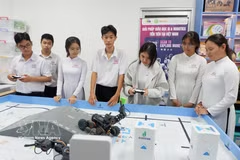
Illustrative image (Photo: VNA)

Hanoi (VNA) - Vietnam leads Southeast Asia in the use of Google's Gemini AI for learning, according to regional statistics released by Google on July 14.

Academic queries account for 17% of all prompts submitted by Vietnamese users, well above the regional average of 11%, cementing Vietnam’s position as the region’s top adopter of AI for education.

More than 160,000 students rely on Gemini Canvas, an AI-powered study tool, each month to prepare for exams, while educators generate roughly 55,000 teaching-related prompts a day, the report showed.

Dang Thanh Nga, Google Student Ambassador, said Gemini features such as Canvas have become a go-to study companion, helping her untangle complicated math formulas and catch mistakes in her code when she gets stuck.

“It’s a great way to solve problems and get my thoughts in order, but the critical thinking and the final work still have to come from me,” Nga said, adding that the tool just makes learning “faster, more efficient and better organised".

Vietnam also ranks first in Southeast Asia for sticking to their mother tongue. A full 89% of Gemini prompts from Vietnam are written in Vietnamese, compared with 87% in Thailand and 84% in Indonesia.

Google painted a picture of how far that goes: a Shan Tuyet tea farmer in Lao Cai province uses Gemini to translate documents, write professional emails and invoices in English, and sell directly to customers in Europe and the US.

That kind of reliance, Google said, turns Gemini into “an important bridge to global markets”, noting that Vietnamese users lean on the platform’s translation and localisation tools more heavily than anyone else in Southeast Asia.

Vietnam also sits near the top in the region for AI-assisted coding and math. Programming prompts make up 4% of all requests, and math accounts for 5%. But the biggest chunk of interactions is plain old conversation at 29%, with content creation coming in at 17%.

Desktops handle 32% of Gemini prompts from Vietnam, second only to Singapore, while 66% come from mobile devices. That relatively heavy desktop use, Google noted, signals strong demand for more complex, concentration-heavy tasks.

The report is Google’s first regional snapshot of Gemini usage across six Southeast Asian markets, including Vietnam, Indonesia, Malaysia, the Philippines, Singapore and Thailand.

vnan.jpg
Google’s Vice President for Southeast Asia and South Asia Frontier Sapna Chadha (Photo: Google)

Gemini is already Google’s fastest-growing app in the region, with active users more than doubling in the past year. It has also become the most searched AI assistant in Vietnam, Indonesia and Thailand.

Sapna Chadha, Google’s Vice President for Southeast Asia and South Asia Frontier, the region stands out as people here have woven AI naturally into their daily lives.

Google, for its part, is sticking to a big goal of making Gemini “the most helpful AI assistant” for all 600 million people across Southeast Asia.

To get there, the company plans to roll out AI agents, including one called Gemini Spark that turns Gemini from a question-answering helper into a true AI partner that can proactively complete tasks.

Gemini Spark is a personalised agent that works around the clock, managing tasks while connecting to Google Workspace apps like Gmail, Docs and Slides. It’s now available in English for Google AI Ultra subscribers, with support for all Southeast Asian languages beginning to roll out this week./.

VNA

See more

A medical worker gives guidance to a mother on how to care for a newborn in Ta Ca commune, Nghe An province. (Photo: VNA)

Top leader unveils people-centred vision for new development model

Vietnam's growth model, long fueled by low-cost labour, resource extraction, contract manufacturing, expanded investment, and capital accumulation, has run out of road. The country now needs a sweeping reform agenda to shift from extensive growth to a model driven by productivity, knowledge, science and technology, innovation, and digital transformation.

Youth union members in Bu Gia Map commune help local residents complete administrative procedures. (Photo: VNA)

Digital governance transforms life in border commune of Dong Nai city

A year after adopting the two-tier local administration model, Bu Gia Map, a remote border commune in the southern city of Dong Nai with a significant ethnic minority community, has experienced notable improvements in public administration, making digital public services more accessible to residents and boosting governance efficiency.

Individuals and organisations should strengthen data protection measures in the digital economy. ( Photo: nhandan.vn)

Experts recommend risk-based data governance to strengthen legal protection

In the first quarter of 2026, more than 6.9 million accounts were exposed, double the figure recorded in the same period last years. Stolen personal data has frequently been exploited in sophisticated online scams, particularly impersonation schemes targeting victims through fake relatives or acquaintances.

The exhibition combines digital technology, simulation models and hands-on activities to help the public gain knowledge of information security in an engaging and easy-to-understand manner. (Photo: VNA)

Interactive "Cyber Security Wall" exhibition spreads digital safety awareness in Hanoi

Through a series of display areas, visitors can explore notable scientific and technological achievements of the People's Public Security Force in safeguarding national security in cyberspace. The exhibition also provides information on common forms of online fraud and cyber scams, along with practical guidance on how to identify and prevent them.

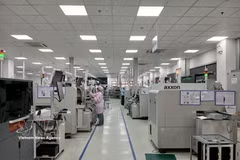
A SMT (Surface Mount Technology) production line for electronic devices at Trung Nam EMS Factory, Da Nang High-Tech Park. (Photo: VNA)

New decree offers major incentives for high-tech R&D

The decree, which took effect on July 1, gives priority to investment in high-tech R&D, including research into innovative and core technologies; efforts to decode, master and improve high technologies; and the application, testing and refinement of advanced technologies.

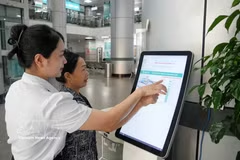
The smart medical kiosk system at Hop Luc General Hospital in Thanh Hoa province makes it easier for patients to access medical examination and treatment services. (Photo: VNA)

Vietnam’s digital overhaul starts to deliver: French newswire

Inforadar noted that Vietnam has progressively streamlined its regulatory framework to clear institutional bottlenecks while putting in place mechanisms designed to spur innovation and technology adoption. The process has also pivoted from a resource-heavy approach to one focused on practical results, with stricter monitoring of projects’ progress.

Visitors experience an e-book app (Photo: VNA)

Verified subscriber data builds stronger digital shield

As Vietnam accelerates its national digital transformation, every correctly verified mobile subscription builds a more comprehensive and reliable telecom database, laying the groundwork for secure, sustainable digital services and public confidence in the country’s digital ecosystem.

A banana plantation cultivated to standardised production practices by Hung Son High-Tech Agriculture JSC in An Phu ward, Gia Lai province. (Photo: VNA)

Crop breeding innovation key to boosting agricultural productivity

According to the Plant Production and Protection Department under the Ministry of Agriculture and Environment, improved crop varieties have increased yields by 8–15%, depending on the crop, while enhancing farmers' incomes and supporting the restructuring of the agricultural sector.

Quantum technology is emerging as a strategic frontier in global science, technology and security competition. - Illustrative image (Photo: VNA)

Quantum tech seen as strategic pillar for Vietnam’s technological self-reliance

In Vietnam, the Politburo’s Resolution No. 57-NQ/TW identifies science, technology, innovation and digital transformation as breakthrough drivers of national development. In this context, the Prime Minister’s Decision No. 21/2026/QD-TTg has added cybersecurity and quantum technologies to the country’s list of 10 strategic technology groups.