Vietnam designates October 15 as National Digital Citizen Day

Under the newly issued resolution, citizens have the right to control the use of their personal data, access digital services and receive legal protection in the digital environment.

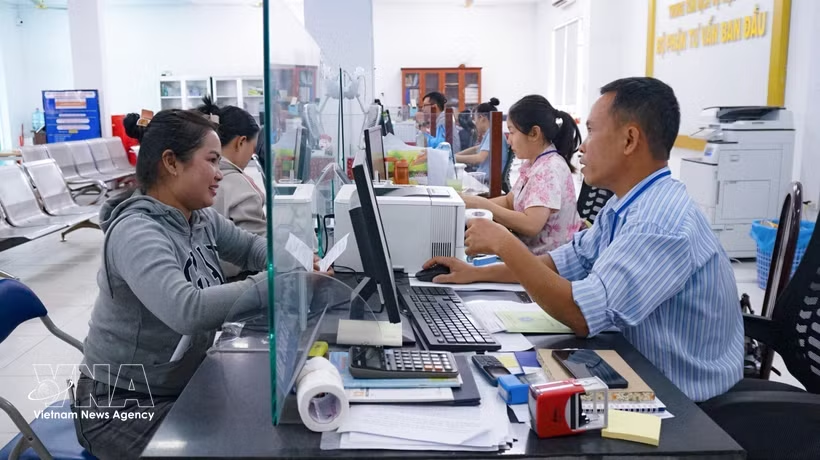
Civil servants at the Public Administrative Services Centre in Tan Ninh ward, Tay Ninh province, guide residents in carrying out administrative procedures online. (Photo: VNA)

Hanoi (VNA) – The Government has issued Resolution No. 66.22/2026/NQ-CP on digital citizen development, officially designating October 15 each year as Vietnam Digital Citizen Day.

The resolution, taking effect from August 15, 2026 to February 28, 2027, establishes principles for developing digital citizens, stipulates beneficiaries of relevant policies, defines their rights and responsibilities, introduces State incentive policies, expands the national digital identity application (VNeID), and outlines the responsibilities of State agencies, organisations and providers of digital products and services.

Under the resolution, citizens have the right to control the use of their personal data, access digital services and receive legal protection in the digital environment. They will also enjoy fee exemptions and reductions for eligible online public services. In return, citizens are required to update and integrate accurate personal information into their electronic identity accounts, as well as national and specialised databases.

To encourage digital adoption, the Government will offer incentives to citizens who integrate five basic categories of personal information and documents into the VNeID application and complete eligible administrative procedures online. Benefits include exemptions from fees for vehicle registration and identity card renewal, a 10% reduction in land and housing registration fees, a 50% cut in automobile registration fees, and a full exemption for motorcycle registration fees, subject to specified conditions.

The resolution also regulates that VNeID is to be developed further to support electronic identification and authentication, online public services, free digital signatures, digital payments and secure communication between citizens, State agencies and businesses.

The Police Department for Administrative Management of Social Order under the Ministry of Public Security will continue to manage and develop the national electronic identification and authentication system. Electronic identity accounts and authentication services used in online public services and administrative procedures will have full legal validity./.


source

See more

The Da Nang People’s Committee presents awards to the Top 10 projects in the Student Category of the Da Nang Innovation and Startup Competition at SURF 2026. (Photo: VNA)

Da Nang runs biggest annual startup event

Themed “A New Era of Growth – Pioneering Innovation”, the festival focused on expanding international connectivity, promoting cross-border investment cooperation and highlighting strategic technology sectors such as artificial intelligence (AI), semiconductors, digital technology, blockchain, green technology and digital transformation.

Personnel responsible for safeguarding national digital sovereignty in cyberspace maintain a serious and focused working spirit at all times (Photo: VNA)

Protecting national security amid digital transformation, cyberspace

Cybersecurity, information security and data security risks must be identified and addressed early and from afar, with appropriate defensive measures ready to neutralise threats and protect national interests in cyberspace, said Lieutenant General Le Xuan Minh, Director of the Ministry of Public Security’s Department of Cybersecurity and Hi-tech Crime Prevention (A05).

The leadership of the Institute of Robotics and Artificial Intelligence is introduced. (Photo:VNA)

Mekong Delta launches first robotics, AI research institute

Dr. Nguyen Van Quang, Rector of Nam Can Tho University, said the university is developing a value chain covering training, research, technology development, testing, technology transfer and commercialisation. The model is designed to link research more closely with practical needs, ensuring that technologies generate products and products create value for society.

Participants pose for a photo at the launch of the Daegu innovation space in Da Nang city. (Photo: VNA)

Daegu innovation space opens in Da Nang

The Daegu technology and innovation space in Da Nang will introduce Daegu’s outstanding technologies, innovative products and solutions while serving as a bridge connecting businesses, research institutes, universities and startup communities from the two cities.

The virtual assistant interface on the reception robot in Lai Hoa commune. (Photo: VNA)

Can Tho builds smart, modern administration through AI application

Amid efforts to accelerate national digital transformation, localities in Can Tho city are integrating modern technologies into State administration. Beyond conventional software and online platforms, artificial intelligence (AI) is being incorporated into public administrative service processes, leading to tangible improvements in service of people and businesses.

Delegates at the opening ceremony of Conviction 2026 (Photo: VNA)

Ho Chi Minh City urged to lead in developing, testing new technology models: Deputy PM

Conviction 2026, a national-level forum on Digital Assets and Artificial Intelligence, which opened in Ho Chi Minh City on August 14, brings together representatives from State management agencies, technology companies, financial institutions, investment funds, experts, research institutes, universities and domestic and international partners, creating opportunities to connect policies, technology, resources and markets, according to Deputy Prime Minister Ho Quoc Dung.

Students at the Ho Chi Minh City University of Technology – Vietnam National University, Ho Chi Minh City, practice applying advanced technologies (Photo: VNA)

Vietnam taps global expertise to develop world-class AI workforce

The network aims to attract global Vietnamese AI talents, strengthen links among research institutions, businesses and experts to form strong research teams and promote commercialisation, while mobilising experts to advise on policies and key national AI programmes and projects.

Vietnam moves to build quantum workforce

Vietnam moves to build quantum workforce

As the country's science, technology and innovation hub, Ho Chi Minh City is now scrambling to build capacity for the quantum age, with workforce development at the centre of its push to seize future opportunities.

At the Vietnam – Japan Innovation Forum 2026 (Photo: tapchikinhtetaichinh.vn)

Vietnam – Japan Innovation Forum 2026 drives new models

NIC Deputy Director Hoang Trung Hieu shared that Vietnam is working to gradually make science, technology, and innovation its main growth drivers. Along the way, Japan stands out as one of its key partners, bringing strong capabilities in sci-tech, industry, and workforce, along with an extensive network of companies, research institutes, and universities.

Vice President of the National Assembly Nguyen Doan Anh (R) and Deputy Speaker of the Australian House of Representatives Sharon Claydon (Photo: VNA)

Vietnam, Australia strengthen parliamentary cooperation

the Australian Parliament looks forward to close coordination with the Vietnamese NA at the Inter-Parliamentary Union (IPU) and other multilateral forums, said Deputy Speaker of the Australian House of Representatives Sharon Claydon.

Deputy Prime Minister Ho Quoc Dung (R) receives Gianluca Pettiti, President and Chief Operating Officer of US-based Thermo Fisher Scientific, in Hanoi on August 12 (Photo: VNA)

Vietnam seeks stronger cooperation with US partner in semiconductors, biomedical technology

Vietnam welcomes leading global technology groups such as Thermo Fisher Scientific to engage more deeply in the country’s science and technology ecosystem through investment, research and development, technology transfer and human resources training, as well as cooperation with domestic research institutes, universities and businesses, Deputy Prime Minister Ho Quoc Dung said.

AI-powered robots help ease the workload of civil servants in providing initial consultations, while enabling citizens to become familiar with AI applications in accessing public services. (Photo: VNA)

National programme on AI human resources development approved

The programme aims to develop an AI workforce of sufficient scale, structure and quality to meet the requirements of strategic technology sectors, enhance national technological self-reliance, promote innovation and digital transformation, and foster the digital economy and digital society.