DNA technology helps identify Vietnam's unknown fallen soldiers

With the NGS-SNP technology, kinship analysis can now extend beyond immediate family members to relatives as distant as the fourth or fifth generation, significantly increasing the chances of identification.

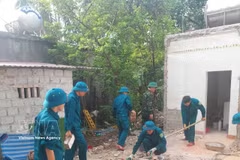
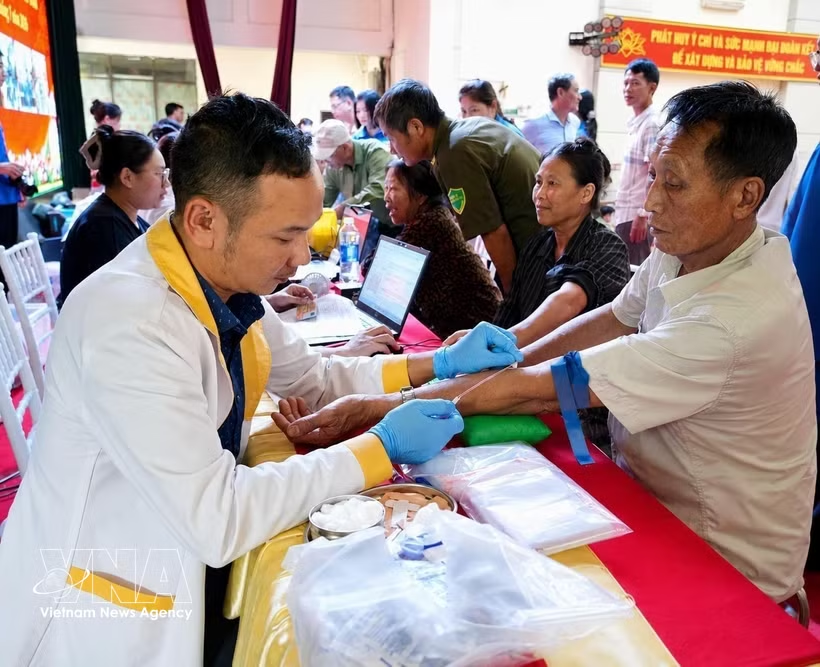
Medical workers collect DNA samples from relatives of fallen soldiers in Yen Lac commune, Phu Tho province. (Photo: VNA)

Hanoi (VNA) – As DNA speaks through next-generation sequencing technology, Vietnamese scientists are uncovering the identities of unknown fallen soldiers, rekindling hope for families that have spent decades searching for their loved ones.

At the DNA Analysis Centre under the Institute of Biology of the Vietnam Academy of Science and Technology (VAST), every unidentified set of remains begins a painstaking journey. Carefully cleaned, processed and analysed under strict laboratory conditions, bone samples are examined in the hope of returning a fallen soldier to his family.

The painstaking work extends beyond meticulous sample processing and the development of a DNA database.

Inside a transparent plastic box no larger than a hand are a few bone fragments discoloured by time. Instead of a name, the label bears only a coded identification number. From these scant remains, specialists at the centre begin a process that can take days or even months, hoping to restore the identity of an unknown fallen soldier and return him to his family.
vnanet-ad2.jpg
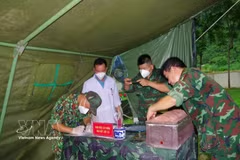
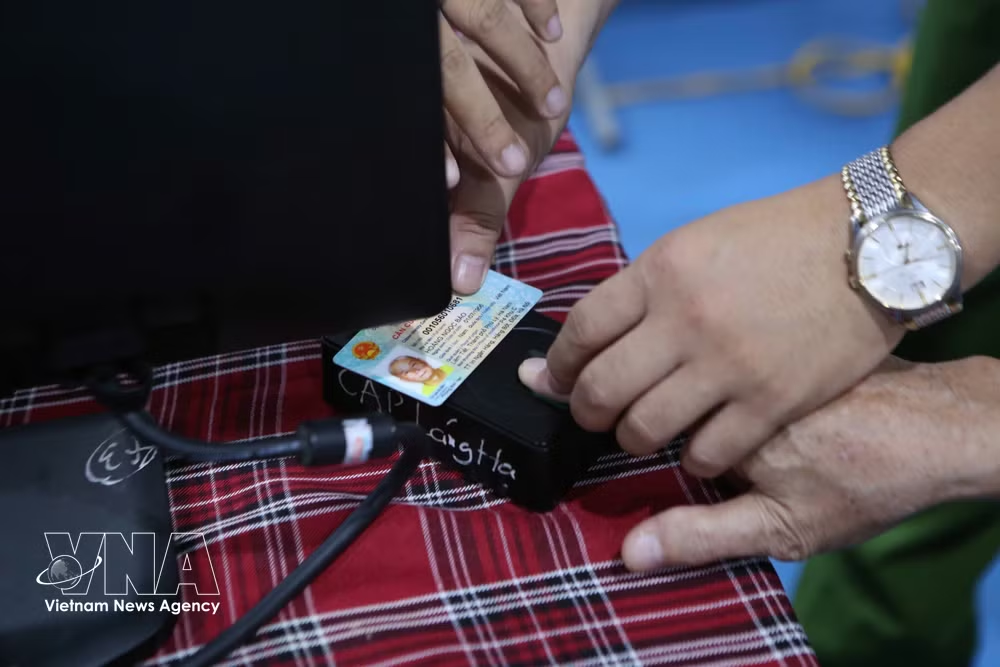
Biometric DNA data from relatives of fallen soldiers are being integrated into the national database in Giang Vo ward, Hanoi. (Photo: VNA)

Tran Manh Ha, who has worked at the centre since 2006 when the unit was still a small research group, said after remains are received from recovery sites, they are cleaned and have quality assessed. Suitable bone fragments are then cut and ground into fine powder under sterile conditions in a specialised fume hood to minimise the risk of contamination.

DNA extraction is the most critical stage of the process. Some remains, however, have deteriorated so severely after decades underground that they no longer contain enough DNA for analysis, he noted.

"Whenever that happens, we all feel disappointed," Ha said, noting that every unsuccessful test means another family must continue waiting for answers. He stressed that proper collection and preservation of remains at excavation sites are crucial to improving identification success rates.

Despite the challenges, Ha said the humanitarian value of the work has kept him and his colleagues committed for nearly two decades.

Dr. Tran Trung Thanh, Director of the DNA Analysis Centre, said every successful identification represents not only a scientific achievement but also a tribute to those who sacrificed for the nation.

He explained that DNA in decades-old remains is often severely degraded by soil conditions, temperature, humidity and microorganisms, while many samples contain only tiny DNA fragments or substances that interfere with analysis. Because each sample is preserved differently, scientists must carefully select the most appropriate extraction and sequencing methods to ensure exact and reliable results.

The quality of a sample also depends heavily on how it is collected at the recovery site. If the appropriate bone is not selected or the sample is improperly preserved or transported, the DNA may continue to degrade, reducing the likelihood of successful analysis, Thanh added.

Another challenge lies in collecting DNA from relatives as many direct family members of fallen soldiers have passed away over time, leaving only more distant relatives for comparison, making kinship analysis considerably more complex.

To improve success rates, the centre has adopted the next-generation sequencing using single nucleotide polymorphism (NGS-SNP) technology for difficult samples, while continuously refining DNA extraction techniques, expanding the collection of relatives' samples and updating its DNA database.

Dr. Phi Quyet Tien, Director of the Institute of Biology, said that a pilot project at the Tra Linh Martyrs' Cemetery in the northern mountainous province of Cao Bang in 2025 demonstrated the technology's potential. Fifty-four out of 58 exhumed remains, or 93%, yielded usable SNP data despite severe degradation – a result that would have been virtually impossible to achieve using the mitochondrial DNA analysis method previously employed.

By comparing the data with DNA samples from relatives of 14 fallen soldiers, scientists successfully identified two of them in the first pilot phase, he noted.

Similar DNA sampling has since been carried out at the Giong Rieng Martyrs' Cemetery in the Mekong Delta province of An Giang, where 964 graves remain unidentified.

Tien said that building a comprehensive national DNA database is just as important as advancing technology. Between 2019 and 2021, more than 4,000 analysed remains had to be stored because there were insufficient DNA samples from relatives for comparison.

The expert noted that collecting DNA samples from the relatives of fallen soldiers nationwide and building a concentrated genetic database are as strategically important as mastering DNA identification technology.

With the NGS-SNP technology, kinship analysis can now extend beyond immediate family members to relatives as distant as the fourth or fifth generation, significantly increasing the chances of identification.

The VAST’s Institute of Biotechnology stands ready to work with the Ministry of Public Security, the Ministry of National Defence and local authorities to standardise SNP data for inclusion in the national DNA database, ensuring interoperability and enabling long-term storage, retrieval and comparison, Tien said.

According to Tien, one of the most important lessons from the 500-day campaign to recover and identify the remains of fallen soldiers is that no single institution, regardless of how advanced its technology may be, can accomplish this mission alone.
Coordination among the Ministry of National Defence, the Ministry of Public Security, the Ministry of Home Affairs, the Ministry of Health, the VAST, and local authorities has established an integrated workflow covering every stage—from site surveys, the recovery of remains and field sample collection to secure sample transport under a strict chain of custody, laboratory analysis at the DNA Analysis Centre, and comparison with relatives' DNA profiles and martyrs' records.

This coordinated mechanism has significantly shortened the time from collecting samples to obtaining results while ensuring transparency and full traceability throughout the entire process—an essential requirement in a field where any error could directly affect the dignity of the fallen and the trust of their families, he said.

As Vietnam prepares to mark the 79th anniversary of War Invalids and Martyrs' Day (July 27, 1947–2026), DNA analyst Ha and his colleagues at the DNA Analysis Centre continue to work quietly in the laboratory, examining the remains of unidentified fallen soldiers. Their mission of remembrance carries on, while each day in the laboratory brings renewed hope to families still waiting to learn the identities of their loved ones who gave their lives for the nation./.
VNA

See more

The former headquarters of the Bac Lieu provincial Fatherland Front Committee and mass organisations is proposed for transfer to the provincial Land Development Centre for auction or investment attraction. (Photo: VNA)

Efficient use of surplus public assets gains urgency

According to the Ministry of Finance (MoF), more than 11,000 public land and property facilities nationwide have been recovered or transferred to local authorities but have yet to be put back into use. The portfolio includes office buildings, public service facilities and many land plots in prime urban and residential locations.

5G base stations installed by Viettel line streets around Hoan Kiem Lake in Hanoi to support network coverage during the National Day last year. (Photo: VNA)

100-day drive launched to remove digital bottlenecks

The plan seeks to accelerate the shift to data-driven governance by reducing paperwork, streamlining administrative procedures and expanding the use of shared digital platforms and integrated data across government agencies while strengthening cybersecurity.

As of June 10, 2026, the Thanh Hoa provincial Military Command deploys 674 officers and soldiers to assist families eligible for the programme to replace temporary and dilapidated homes for the biological children of revolutionaries exposed to toxic chemicals, contributing a total of 4,592 workdays. (Photo: VNA)

Ten localities to launch housing projects for Agent Orange victims’ children

The Deputy PM assigned the Chairpersons of the People’s Committees of the 10 provinces and cities that have yet to begin construction to urgently complete all necessary preparations and hold simultaneous ground-breaking ceremonies on July 15, for projects to build and repair homes for eligible beneficiaries.

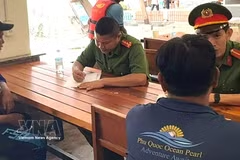
The scene of the deadly canoe accident off Phu Quoc Island on July 11 afternoon. (Photo: chinhphu.vn)

Prime Minister orders urgent response to deadly canoe accident off Phu Quoc Island

According to the document, at around 13:00 on July 11, an especially serious waterway traffic accident occurred about 200 metres off Hon May Rut Ngoai Island. Passenger canoe AG-26751, carrying 32 Indian tourists and three crew members, capsized while travelling from Hon May Rut Ngoai Island to An Thoi Port, claiming 15 lives as of 15:00 the same day.

Rescuers search for victims after a tourist canoe carrying more than 30 people capsizes off Phu Quoc island on July 11 afternoon (Photo: baoangiang.com.vn)

Search and rescue underway after tourist speedboat capsizes off Phu Quoc

According to the local authorities, the canoe operated by Ocean Pearl Island Company was transporting 32 Indian tourists and three crew members, including one captain, one mechanic, and one staff member, capsized while en route from May Rut Ngoai Island to An Thoi Port amid strong wave and wind condition. As a result, by 15:00 on July 11, the accident had claimed 15 lives.

Vietnam’s five-member national team wins four gold medals and one silver medal at the 56th International Physics Olympiad 2026 (IPhO 2026). (Photo: VNA)

Vietnam records best-ever result at International Physics Olympiad 2026

The achievements placed Vietnam among the top seven-performing teams at this year’s Olympiad. It is also the first time that two Vietnamese contestants earned a perfect score of 30/30 in the theoretical examination, surpassing previous performances despite matching the team’s 2017 tally in terms of medal numbers.

Young people in Hanoi are provided with information and knowledge on reproductive healthcare and population growth management. (Photo: VNA)

Vietnam promotes youth-centred policies for sustainable development

Deputy Minister of Health Do Xuan Tuyen said Vietnam currently has nearly 70 million people aged 15-64, giving the country the advantage of a golden population structure. This presents a valuable opportunity to improve the quality of its workforce, drive economic growth and support national development.

Assoc. Prof. Dr Nguyen Huu Quynh, Vice Rector of CMC University. (Photo: VNA)

Dual training: Renovating mindset to develop high-quality workforce

The spirit of the Politburo’s Resolution No. 57-NQ/TW on breakthroughs in science, technology, innovation and national digital transformation, together with Resolution No. 71-NQ/TW on breakthroughs in education and training, is encouraging educational institutions to shift from training based on existing institutional capacity to training that responds to labour market needs and aligns with the country’s development strategy and global technological trends.

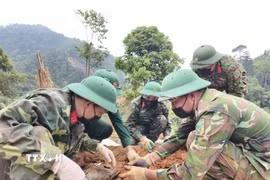
Authorities digitise data collected during the sampling and forensic identification process for fallen soldiers' remains. (Photo: VNA)

Cao Bang accelerates DNA sampling of unidentified war martyrs

The work, which began on July 9, is being carried out by military and medical personnel following strict technical procedures. The process includes exhumation, biological sample collection, sealing and preservation of samples, documentation, and digitalisation of all relevant information. Each sample is carefully verified and catalogued, while excavation sites are accurately marked.

Senior Lieutenant General Le Quang Minh (fifth from left), Deputy Director of the General Department of Politics of the Vietnam People's Army, and Senior Lieutenant General Pham Truong Son, Deputy Chief of the General Staff of the Vietnam People's Army, present awards to outstanding collectives and individuals. (Photo: VNA)

Military women support nearly 1,000 orphaned children through "Adoptive Mother" programme

Launched in 2021, the programme has been implemented by military women’s associations in close coordination with Party committees, organisations and individuals. Integrated into emulation movements across the armed forces, the initiative has promoted compassion, social responsibility and the nation's tradition of mutual support through practical assistance for orphaned children facing difficult circumstances.

Officials attend at the meeting in Hanoi on July 10 to review how agencies are teaming up to get the International Press Centre for the APEC Economic Leaders’ Week 2027 built. (Photo: VNA)

Deputy FM orders modern int’l press centre for APEC 2027

Communications and cultural activities will take on a hugely important role during APEC Year 2027, giving Vietnam a platform to project its image, people and culture to international friends, said Deputy Minister of Foreign Affairs Le Thi Thu Hang.

Officers and personnel of the People's Public Security Force visit an exhibition showcasing the achievements of the People's Security Force. (Photo: VNA)

Public security anniversary events begin in Hanoi

Through music, storytelling and stage performances, the programme paid tribute to generations of officers and personnel who have contributed to safeguarding national security and maintaining peace and stability. It also offered the public a closer look at the force’s specialised responsibilities and the quiet sacrifices made in service of the nation.