Topics

500-day campaign

Archived records prove golden key to 500-day campaign

Archived records prove golden key to 500-day campaign

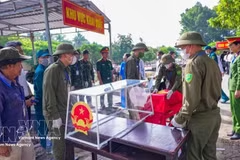
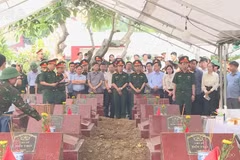
The nationwide 500-day campaign to search for, recover and identify the remains of fallen soldiers is being stepped up. Most recently, a mass grave containing soldiers killed during the 1968 Tet Offensive was uncovered at Le Thi Rieng Park in Ho Chi Minh City. Archived records played a crucial role as the golden key that led search teams to the site.

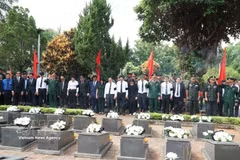
Party General Secretary and State President To Lam offers incense at the memorial stele dedicated to heroic martyrs. (Photo: VNA)

Identifying fallen soldiers a sacred responsibility towards Fatherland: Top leader

Party General Secretary and State President To Lam stressed that every set of remains recovered represents far more than a technical achievement. It marks the return of a son or daughter to the Fatherland and to his/her family, the restoration of a missing chapter of history, and a reaffirmation of the country's enduring tradition of remembering those who served the nation.

Top leader pays tribute to heroic martyrs at Le Thi Rieng Park

Top leader pays tribute to heroic martyrs at Le Thi Rieng Park

Party General Secretary and State President To Lam on July 17 laid flowers and offered incense in tribute to late Party General Secretary Tran Phu and the nation's heroic martyrs at Le Thi Rieng Park in Ho Chi Minh City. During the visit, he also inspected the ongoing search for and recovery of martyrs' remains under the 500-Day-and-Night Campaign.

Top leader calls for better care for invalids, revolutionary contributors

Top leader calls for better care for invalids, revolutionary contributors

Party General Secretary and State President To Lam on July 15 affirmed that caring for revolutionary contributors is both a political responsibility and a moral obligation, calling for more comprehensive and timely policies to ensure that those who sacrificed for the nation receive the care and respect they deserve.

Biological samples are collected from the remains of unidentified fallen soldiers at the Pho An Martyrs' Cemetery in Tra Cau ward, Quang Ngai province. (Photo: VNA)

Tireless efforts made to restore the names of fallen soldiers

Quang Ngai currently has 127 martyrs' cemeteries containing 37,689 graves, including 26 collective ones. Of these, 16,758 have complete information, 5,134 contain partial information, while 15,771 remain unidentified. Around 6,000 martyrs from the province have yet to have their remains located.

Members of Team K51 under the Dak Lak provincial Military Command travel through remote forests and mountains in Vietnam and Cambodia in search of the remains of Vietnamese volunteer soldiers and military experts who died during wartime. (Photo published by VNA)

Dak Lak team presses on with search for fallen soldiers

During the 2025–2026 dry season, Team K51 recovered and repatriated the remains of 27 Vietnamese volunteer soldiers and experts who died in Cambodia. The achievement came after nearly seven months of searching through forests, crossing streams and following even the smallest leads.

Documents containing the Prime Minister's commendation decisions awarding the “To quoc ghi cong” (The Fatherland acknowledges the merit) certificate to the families of martyrs, including Decision No. 04TtgA awarding the certificate to the family of martyr Huynh Van Quen (Photo: VNA)

Unlocking value of archives in search for fallen soldiers’ identities

Once digitisation is completed and a unified database is established, searches will become much faster and more accurate, providing an important foundation for the search for, recovery and identification of martyrs’ remains and for better implementing policies for people with meritorious service.

Dak Lak soldiers carry on silent mission to bring fallen heroes home

Dak Lak soldiers carry on silent mission to bring fallen heroes home

Members of Team K51 under the Dak Lak Provincial Military Command are continuing their search for the remains of fallen Vietnamese soldiers across the Central Highlands, overcoming difficult terrain to help reunite missing war heroes with their families decades after the war ended.

Wartime relics, including ammunition and a toothbrush, discovered at Da Sap Cave in Lam Tay hamlet, Ha Nha commune, Da Nang city. (Photo: VNA)

Bringing the fallen home: Da Sap Cave mission begins

Situated between protection and production forests in Ha Nha commune, the cave remains largely untouched since the war. Huge boulders blasted down by bombing still block part of the entrance, making excavation difficult and hazardous.

Director of the General Department of Politics under the Vietnam People’s Army General Nguyen Trong Nghia inspects the ongoing search and recovery operation for martyrs’ remains at Le Thi Rieng Park in Ho Chi Minh City. (Photo: VNA)

Senior military officer inspects martyrs’ remains search at Le Thi Rieng Park

Nghia described the ongoing 500-day campaign as a sacred mission that embodies the Vietnamese tradition of remembering those who served and sacrificed for the nation. The current generation, he said, must spare no effort in carrying out the Party’s policy and fulfilling the aspirations of the people, particularly the families of the fallen.

Authorities digitise data collected during the sampling and forensic identification process for fallen soldiers' remains. (Photo: VNA)

Cao Bang accelerates DNA sampling of unidentified war martyrs

The work, which began on July 9, is being carried out by military and medical personnel following strict technical procedures. The process includes exhumation, biological sample collection, sealing and preservation of samples, documentation, and digitalisation of all relevant information. Each sample is carefully verified and catalogued, while excavation sites are accurately marked.