Hanoi (VNA) - As science, technology and digital transformation advance rapidly, a dual training model with meaningful participation of businesses is emerging as a key approach to reforming vocational education, aligning training with labour market needs and developing a high-quality workforce capable of mastering modern technologies.
The spirit of the Politburo’s Resolution No. 57-NQ/TW on breakthroughs in science, technology, innovation and national digital transformation, together with Resolution No. 71-NQ/TW on breakthroughs in education and training, is encouraging educational institutions to shift from training based on existing institutional capacity to training that responds to labour market needs and aligns with the country’s development strategy and global technological trends.
From autonomy to a new training mindset
Prof. Academician Nguyen Quoc Sy, Director of the Russia–Vietnam Innovation Centre and Chairman of the VinIT Institute of Technology, said the two resolutions complement each other closely in developing human resources. While Resolution 57 sets the goal of building a high-quality workforce for science, technology and digital transformation, Resolution 71 provides educational institutions with greater autonomy to implement solutions to achieve that goal.
As a result, vocational institutions must do more than open new majors or adjust enrolment targets. More importantly, they need to transform their governance mindset and training methods, moving from an approach based on what schools can currently offer to one driven by labour market demands, national development priorities and global technology trends.
Alongside governance reform, the enrolment should place greater emphasis on the quality of recruited students and their ability to adapt to a digital environment. Training should no longer focus solely on transferring knowledge through traditional methods, but on developing practical skills, creative thinking, digital competencies, lifelong learning and the ability to work in international settings.
Sy noted that vocational education should focus on cultivating adaptability so that learners can meet changing labour market requirements throughout different stages of development.
He also stressed that the dual training model must be implemented more substantively, with businesses involved from the outset in setting learning outcomes, designing curricula, organising practical training and assessing results. Students should gain exposure to real workplaces from their early years of study rather than only during final internships. Training programmes should be updated regularly to reflect business technologies, professional foreign-language skills, and the ability to work in multicultural environments.
To encourage deeper participation of businesses, Sy proposed mechanisms that balance the interests of the State, schools and enterprises. Possible measures include incentives for companies that invest in training equipment, participate in vocational training, accept apprentices, and contribute to skill-development funds and co-investment programmes in strategic technology sectors.
He added that as educational institutions receive greater autonomy, they must also strengthen accountability and use graduate outcomes as a key measure of quality. Training effectiveness should be assessed through graduate employment rates, employers’ satisfaction, adaptability to new technologies, and the ability to work in international environments. A high-quality workforce includes not only highly educated professionals but also skilled technicians and workers capable of mastering advanced technologies for the digital economy.
Training linked to business realities
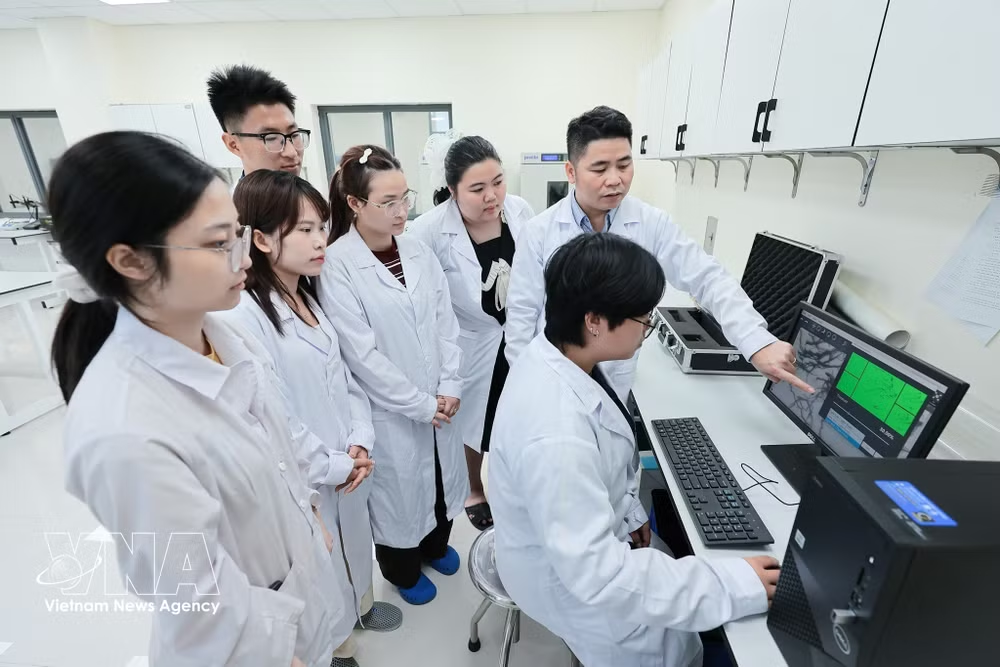
Assoc. Prof. Dr Nguyen Huu Quynh, Vice Rector of CMC University, said the dual training model has evolved significantly. In the past, businesses were involved mainly during students’ internships after coursework had been completed. Today, many companies participate throughout the entire process, from curriculum development and training organisation to assessment, making education more closely aligned with real business needs.
As part of this transformation, universities are promoting more active learning through technology and new teaching methods while focusing on technology fields that match workforce demands. The core principle is continuous involvement of businesses in curriculum design, learning materials, teaching, workplace-based learning, assessment and recruitment after graduation.
From the business perspective, Nguyen Van Luu, General Director of Dong Tam High-Tech Agriculture JSC, said companies participate in training because it serves their own development needs. Allowing students to experience the workplace during their studies benefits both sides: businesses can prepare a workforce that matches production requirements and reduce retraining costs, while students gain early access to production processes, technologies and professional working environments, helping them adapt more quickly after graduation.
In addition to occupational skills, Luu said learners should be equipped with the ability to operate smart equipment, manage production data, use electronic traceability systems, and understand circular production models and sustainable development. Integrating these competencies into training programmes will help the workforce meet businesses' demands more effectively in the digital transformation era./.