Children’s rights underserved in corporate sustainability reports: UNICEF

Few companies in Vietnam and across Asia have identified, reported on or measured their impacts on children despite growing risks from climate change, digital harms and poor nutrition.

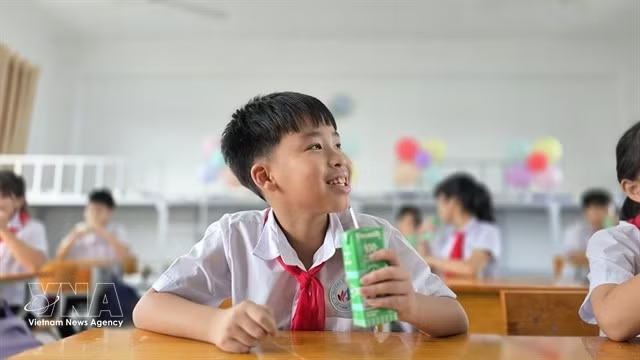
Formal corporate commitments to children’s rights remain low in Vietnam, a new UNICEF study finds. In the photo: Pupils drink milk at Le Thanh Tong interlevel school in Quang Ninh province. (Photo: VNA)

Hanoi (VNS/VNA) - A new UNICEF study has found that few companies in Vietnam and across Asia have identified, reported on or measured their impacts on children despite growing risks from climate change, digital harms and poor nutrition.

The study, ‘Making Children Count: Sustainability Reporting across Emerging Asia’, analysed corporate sustainability (ESG) reports of 1,399 listed companies across nine Asian markets – India, Indonesia, Thailand, Malaysia, Vietnam, Pakistan, Bangladesh, Nepal and Sri Lanka.

It found that children remain largely invisible in these reports, despite making up around one in three people across much of the region.

In Vietnam, the study reviewed reports of 109 listed companies across the Ho Chi Minh and Hanoi stock exchanges.

Companies achieved an average score of 57 out of 260, below the regional average of 77.7, indicating that children’s rights remain at an early stage of being integrated into their sustainability efforts.

While 83% of companies reported supporting child-related initiatives at community level, formal corporate commitments to children’s rights have yet to emerge.

Only 37% of companies explicitly committed to addressing child labour risks, while commitments to promoting living wages in supply chains were not reported.

These findings come at a time when Vietnam has mandatory sustainability disclosure requirements and aligns its reporting framework more closely with international sustainability standards.

Silvia Danailov, UNICEF Representative in Vietnam, said: "This study shows that many companies in Vietnam are already investing in children through community programmes.

"The next step is to embed children's rights into the way businesses operate to better manage risks, build investor confidence and contribute to a healthier, more skilled and more resilient workforce.

“UNICEF Vietnam continues working with government, investors and the private sector to make children's rights an integral part of responsible business and sustainability reporting."

Across the reviewed markets, nearly three out of four companies reported human rights commitments and 88% report child-related community activities as corporate philanthropy.

However, only one in 20 companies identified children as stakeholders, and only one in 100 assess their business impacts on children.

The disconnect is particularly stark in sectors tied to some of the region's greatest challenges for children.

Only a small fraction of companies disclosed how they were addressing risks and material impacts on children in climate change, online harms, malnutrition, child labour and the working conditions of parents.

Only 2% mentioned children in climate strategies, fewer than 10% of tech companies reported measures to protect children online, and only 3% of companies committed to implementing protective marketing practices for children.

On child labour, where 72% of companies had commitments, only 2% explained how they remediate cases when these are found, while just 3% supported suppliers to improve practices.

The picture is slightly better on family-friendly workplaces, where reporting is more common, but meaningful commitments on living wages remain rare.

UNICEF called for companies to move from promises to proof by identifying, managing and reporting on impacts on children and aligning philanthropy with children's needs and business impacts.

Governments and policymakers should make child-inclusive business the norm by integrating children's rights into laws, policies and reporting frameworks, it said./.

VNA

See more

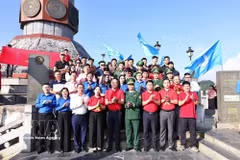
Delegates at the Lung Cu Flag Tower, a symbol of Vietnam's northernmost point. (Photo: VNA)

"I Love My Fatherland" journey reaches Lung Cu Flag Tower

This year's journey comprises of seven stages linked to historical, cultural and revolutionary sites across the country. It began in Nghe An on May 16 to celebrate President Ho Chi Minh’s birth anniversary, before continuing through Hue city, Tuyen Quang–Lung Cu Flag Tower, Dien Bien, Khanh Hoa, Ca Mau and Ho Chi Minh City, and concluding in Hanoi in October.

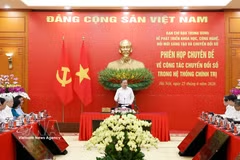
Party General Secretary and State President To Lam, Head of the Central Steering Committee for Science and Technology Development, Innovation and Digital Transformation, chairs the thematic session on digital transformation in the political system on June 25, 2026. (Photo: VNA)

100-day drive launched to remove digital bottlenecks

The plan seeks to accelerate the shift to data-driven governance by reducing paperwork, streamlining administrative procedures and expanding the use of shared digital platforms and integrated data across government agencies while strengthening cybersecurity.

Wartime relics, including ammunition and a toothbrush, discovered at Da Sap Cave in Lam Tay hamlet, Ha Nha commune, Da Nang city. (Photo: VNA)

Bringing the fallen home: Da Sap Cave mission begins

Situated between protection and production forests in Ha Nha commune, the cave remains largely untouched since the war. Huge boulders blasted down by bombing still block part of the entrance, making excavation difficult and hazardous.

Participants in the ceremony celebrating the CVS's 10th founding anniversary in Ottawa on July 12 (Photo: VNA)

Canada-Vietnam Society marks decade of promoting people-to-people exchanges

Nguyen Dai Trang, a member of the CVS’s executive board, said the organisation's greatest achievement over the past 10 years lies not only in the number of programmes it has organised but also in its success in bringing together Vietnamese associations across Canada, and fostering a shared voice within the community.

The former headquarters of the Bac Lieu provincial Fatherland Front Committee and mass organisations is proposed for transfer to the provincial Land Development Centre for auction or investment attraction. (Photo: VNA)

Efficient use of surplus public assets gains urgency

According to the Ministry of Finance (MoF), more than 11,000 public land and property facilities nationwide have been recovered or transferred to local authorities but have yet to be put back into use. The portfolio includes office buildings, public service facilities and many land plots in prime urban and residential locations.

As of June 10, 2026, the Thanh Hoa provincial Military Command deploys 674 officers and soldiers to assist families eligible for the programme to replace temporary and dilapidated homes for the biological children of revolutionaries exposed to toxic chemicals, contributing a total of 4,592 workdays. (Photo: VNA)

Ten localities to launch housing projects for Agent Orange victims’ children

The Deputy PM assigned the Chairpersons of the People’s Committees of the 10 provinces and cities that have yet to begin construction to urgently complete all necessary preparations and hold simultaneous ground-breaking ceremonies on July 15, for projects to build and repair homes for eligible beneficiaries.

The scene of the deadly canoe accident off Phu Quoc Island on July 11 afternoon. (Photo: chinhphu.vn)

Prime Minister orders urgent response to deadly canoe accident off Phu Quoc Island

According to the document, at around 13:00 on July 11, an especially serious waterway traffic accident occurred about 200 metres off Hon May Rut Ngoai Island. Passenger canoe AG-26751, carrying 32 Indian tourists and three crew members, capsized while travelling from Hon May Rut Ngoai Island to An Thoi Port, claiming 15 lives as of 15:00 the same day.

Rescuers search for victims after a tourist canoe carrying more than 30 people capsizes off Phu Quoc island on July 11 afternoon (Photo: baoangiang.com.vn)

Search and rescue underway after tourist speedboat capsizes off Phu Quoc

According to the local authorities, the canoe operated by Ocean Pearl Island Company was transporting 32 Indian tourists and three crew members, including one captain, one mechanic, and one staff member, capsized while en route from May Rut Ngoai Island to An Thoi Port amid strong wave and wind condition. As a result, by 15:00 on July 11, the accident had claimed 15 lives.

Vietnam’s five-member national team wins four gold medals and one silver medal at the 56th International Physics Olympiad 2026 (IPhO 2026). (Photo: VNA)

Vietnam records best-ever result at International Physics Olympiad 2026

The achievements placed Vietnam among the top seven-performing teams at this year’s Olympiad. It is also the first time that two Vietnamese contestants earned a perfect score of 30/30 in the theoretical examination, surpassing previous performances despite matching the team’s 2017 tally in terms of medal numbers.

Young people in Hanoi are provided with information and knowledge on reproductive healthcare and population growth management. (Photo: VNA)

Vietnam promotes youth-centred policies for sustainable development

Deputy Minister of Health Do Xuan Tuyen said Vietnam currently has nearly 70 million people aged 15-64, giving the country the advantage of a golden population structure. This presents a valuable opportunity to improve the quality of its workforce, drive economic growth and support national development.

Assoc. Prof. Dr Nguyen Huu Quynh, Vice Rector of CMC University. (Photo: VNA)

Dual training: Renovating mindset to develop high-quality workforce

The spirit of the Politburo’s Resolution No. 57-NQ/TW on breakthroughs in science, technology, innovation and national digital transformation, together with Resolution No. 71-NQ/TW on breakthroughs in education and training, is encouraging educational institutions to shift from training based on existing institutional capacity to training that responds to labour market needs and aligns with the country’s development strategy and global technological trends.