
Hanoi (VNA) – The 2026 economic census shows that Vietnam's economy has continued to expand, with the number of economic establishments increasing compared with the previous census.
The business sector has further consolidated its role as the main driver of growth, while the household business sector is undergoing restructuring with significant changes in operating models and employment.
The preliminary findings were unveiled at a conference reviewing the census held by the National Statistics Office (NSO) under the Ministry of Finance on July 13.
"This is the largest economic census ever conducted in Vietnam; it also expands the scope of data collection to cover many new categories of respondents, providing a more comprehensive picture of the country's socio-economic landscape," said NSO Director Nguyen Thi Huong.
According to the results, there were nearly 6.3 million active economic establishments engaged in production and business activities nationwide. These included nearly 876,200 enterprises and cooperatives, almost 5.3 million non-agricultural household production and business facilities, 52,200 religious establishments, nearly 8,000 cooperative groups, and 82,500 administrative agencies, public service units, associations, and non-governmental organisations.
The 2025 business landscape indicates that the enterprise sector continued to demonstrate resilience amid fluctuations in both domestic and international business environments. Growth in the enterprise number, employment, and capital reflects an ongoing expansion of production and business activities while also highlighting the effectiveness of policies aimed at improving the investment climate, supporting businesses, and developing the private sector.
As of December 31, 2025, information had been collected from 1,220,678 enterprises nationwide. Of these, 859,048 were actively operating and generating business results, representing an increase of 2.4% compared with 2024 and 25.5% compared with 2020.
The domestic non-state business sector continued to play the leading role, with 827,500 enterprises, up 2.1% year-on-year and 25.4% higher than in 2020. This reflects the resilience and adaptability of private businesses as well as the effectiveness of policies supporting enterprise development.
Notably, the foreign direct investment (FDI) sector recorded the strongest growth, with 29,800 enterprises, up 11.1% from 2024 and 33.9% from 2020. The figures reaffirm Vietnam's attractiveness as an investment destination amid the global restructuring of supply chains and sustained positive FDI flows, the NSO said.
Meanwhile, the number of state-owned enterprises reached 1,770, a slight increase of 0.3% from 2024 but a decline of 9.8% compared with 2020, in line with the ongoing policy of restructuring and improving the efficiency of the sector.
By industry, the services sector remained dominant with 612,500 enterprises, accounting for 71.3% of all businesses nationwide. The number rose 5.8% year-on-year and 31.3% compared with 2020.
The industry and construction sector had 240,600 enterprises, down 5.2% from 2024 but still 13.8% higher than in 2020, indicating that the sector has maintained a relatively large business base over the long term.
In agro-forestry-fisheries, there were 5,989 enterprises, up 0.7% from 2024 but down 7.2% compared with 2020.
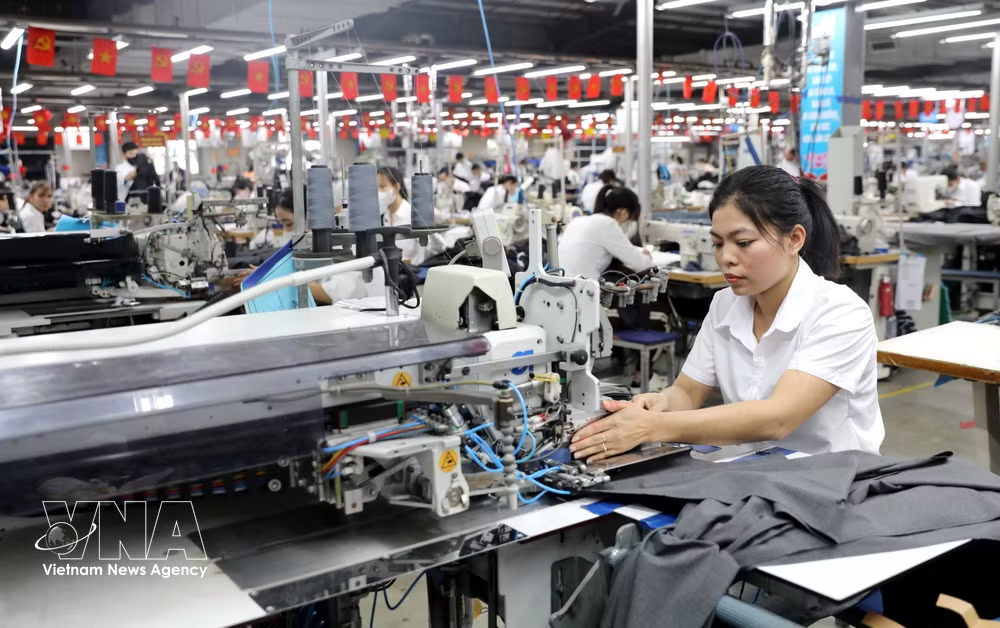
NSO Deputy Director Nguyen Thanh Duong said the expansion of the enterprise sector has also led to continued growth in employment. By the end of 2025, businesses had employed nearly 17.6 million workers, an increase of 7.5% compared with 2024 and 19.7% compared with 2020.
The faster growth in employment than in the number of enterprises suggests that many businesses were expanding their operations and increasing their capacity to create jobs. The private and FDI sectors continued to be the two largest contributors to employment generation.
Alongside the enterprise sector, household production and business establishments remained an important component of the economy, with nearly 5.3 million units, up 1.1% from 2020. However, employment in this sector declined to nearly 8.6 million workers, down 1.1% from 2020. This marks the first time among economic censuses that employment in the household business sector has fallen.
According to the NSO, this trend shows the shift of labour towards enterprises and industries with higher productivity. It also underscores the need to modernise production models and improve productivity and competitiveness within the household business sector./.