Top private firms plan 200 billion USD in 40 mega projects

According to a recent report by BIDV Securities (BSC), these projects span residential and urban developments, airports, expressways, high-speed rail, industrial facilities and other strategic infrastructure.

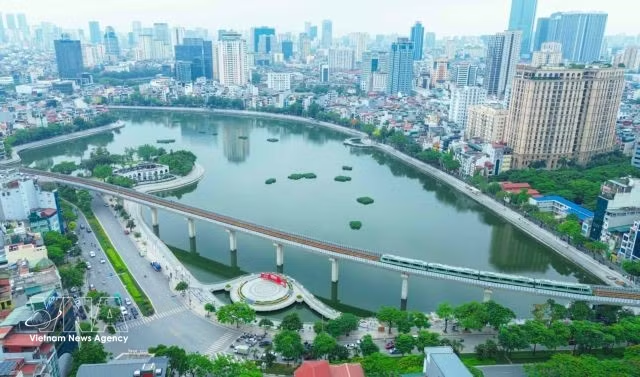
A corner of Hanoi. Real estate is the sector which attracts the largest share of planned private investment. (Photo: VNA)

Hanoi (VNS/VNA) - Six of Vietnam's largest private conglomerates are splashing nearly 4.9 quadrillion VND (200 billion USD) across 40 major projects, underscoring the growing role of the private sector in driving the country's infrastructure, industrial and urban development.

According to a recent report by BIDV Securities (BSC), these projects span residential and urban developments, airports, expressways, high-speed rail, industrial facilities and other strategic infrastructure.

Property developer Vingroup accounts for the largest planned investment, with 12 projects worth totally 2.3 quadrillion VND.

Sunshine Group ranks second with five projects worth about 818 trillion VND.

Other major investors include Sun Group, with ten projects worth 457 trillion VND, THACO with five projects worth 342 trillion VND, Masterise Group with three projects worth 232 trillion VND, and Hoa Phat Group with four projects worth 12.5 trillion VND.

There is also a joint project between THACO and Hoa Phat with an estimated investment of around 714 trillion VND.

BSC noted that the report excludes approximately 1.5 quadrillion VND earmarked for five metro lines in Hanoi, as those projects are financed with State capital.

It also excludes several Masterise and MIK Group property developments as information is unavailable, as well as projects still at the proposal stage.

Real estate is the sector which attracts the largest share of planned private investment. Vingroup alone is expected to invest nearly 1.9 quadrillion VND in property projects, while Sunshine Group plans 818 trillion VND.

A consortium involving THACO, Dai Quang Minh and Hoa Phat is expected to invest nearly 737 trillion VND while Sun Group plans around 392.5 trillion VND in real estate.

The companies are also expanding into transport infrastructure and industry.

Vingroup plans to invest about 224.5 trillion VND in high-speed rail projects, more than 105 trillion VND in energy and 80 trillion VND in steel production.

Masterise and Sun Group are pursuing airport projects valued at approximately 196 trillion VND and 8.5 trillion VND, respectively.

Sun Group also plans to invest more than 25 trillion VND in expressways, while Masterise is developing bridge projects worth around 35 trillion VND.

BSC said the investment plans are expected to boost credit demand and could make banks among the main beneficiaries in 2027, as large private corporations seek financing for capital-intensive projects.

However, the concentration of lending to a small number of conglomerates and mega-projects could increase credit concentration risks for the banking sector, BSC warned./.

VNA

See more

New Zealand apples on sale at a supermarket in Vietnam (Photo: VNA)

Vietnamese consumers develop taste for Australian, New Zealand fruit

According to statistics from the Department of Customs, in the first six months of 2026, Vietnam imported 102.8 million USD worth of fruit, vegetables and flowers from Australia, up 55.7% from the same period last year. Australia's share of total imports rose from 5.5% to 6.51%, highlighting the growing position of the market as a supplier. Imports from New Zealand reached 78.04 million USD, up 20.4% year-on-year.

Semiconductor products, chips and components displayed at a ceremony to launch a national centre for semiconductor chip pilot production support in Hanoi on June 26. (Photo: VNA)

US semiconductor push offers Vietnam opportunities, policy challenges

The Vietnam-US semiconductor partnership is therefore not simply a “golden opportunity” arising from geopolitical shifts, but also a long-term test of Vietnam’s institutional reform and implementation capacity. If domestic capacity cannot keep pace, adjusting targets toward quality and execution, rather than simply expanding the number of projects, will be essential.

Workers process fruit for export at the Chanh Thu factory in Cho Lach commune, Vinh Long province. (Photo: VNA)

Vietnam works to maintain edge in key agricultural market

According to Le Hang, Deputy Secretary-General of the Vietnam Association of Seafood Exporters and Producers (VASEP), China and Hong Kong (China) remained bright spots for Vietnam’s aquatic exports in July, with revenue exceeding 267 million USD, up 24.7% year-on-year.

An estimated 6,300 workers are needed by the semiconductor industry in Bac Giang province during the 2025-2030 period. (Photo: VNA)

India's semiconductor strategy complementary to Vietnam's chip sector: expert

Sudhanshu Mittal, Director of Engineering Solutions at the National Association of Software and Service Companies (Nasscom) of India, noted that during the state visit to India by General Secretary of the Communist Party of Vietnam Central Committee and President To Lam in May, the two countries signed a number of cooperation agreements, with semiconductors identified as a priority area alongside artificial intelligence (AI), cybersecurity, and advanced technologies.

At the working session between Vietnamese Minister of Finance Ngo Van Tuan (right) and RMIT University’s Vice-Chancellor and President Professor Alec Cameron in Sydney on August 10 (Photo: tapchikinhtetaichinh.vn)

Vietnam, Australia seek to expand investment in rice value chain

During General Secretary of the Communist Party of Vietnam Central Committee and President To Lam’s state visit to Australia from August 9-12, Vietnamese Minister of Finance Ngo Van Tuan, authorised by the General Secretary and President, held working sessions with SunRice Group CEO Paul Serra and RMIT University’s Vice-Chancellor and President Professor Alec Cameron in Sydney on August 10.

Students practice microcontroller programming at the Vietnam-Korea College of Technology in Bac Ninh province (Photo: VNA)

Vietnam – one of most attractive destinations for leading US semiconductor companies: expert

Vietnam has built a solid semiconductor and electronics industry before joining ITSI, attracting major US semiconductor companies. Intel Products Vietnam is one of Intel's largest assembly and testing facilities worldwide, while chip design companies such as Synopsys, Cadence, Marvell and Qualcomm have established engineering and research centres in the Southeast Asian country.

Lawmakers on August 9 discuss a draft law amending and supplementing a number of articles of the Law on the State Bank of Vietnam, the Law on Anti-Money Laundering and the Law on Credit Institutions. (Photo: VNA)

Lawmakers discuss measures to ensure banking system safety, support digital economy

The draft law sets out provisions to control conflicts of interest when commercial banks act as agents managing collateral for corporate bonds. In this regard, Deputy Le Van The of Ninh Binh province said he supported the move, noting that it could provide a more professional approach to collateral management and help strengthen investor confidence if properly regulated.

A company in Da Nang operates a customer relationship management system supported by AI chatbots. (Photo: VNA)

AI drives rise of sleepless enterprises in Vietnam

The concept of a sleepless enterprise does not necessarily mean making employees stay on the job all the time. Instead, it's about building intelligent systems that can respond to customers, process transactions, monitor operations, analyse data and flag risks continuously.

Head of the Vietnam Trade Office in Australia Tran Thi Thanh My (Photo: VNA)

Vietnam, Australia eye 20 bln USD trade target

The head of the Vietnam Trade Office in Australia hoped that the visit by Party General Secretary and State President To Lam will mark a new milestone, opening the door for firms on both sides to forge stronger links and launch concrete cooperation agendas, helping hit that 20 billion USD trade goal sooner rather than later.