Ho Chi Minh City promotes UAV applications to develop low-altitude economy

With its enlarged development space, Ho Chi Minh City now combines strengths in urban development, industry and services with high-tech agriculture, the marine economy, logistics and diverse ecological areas. These conditions provide an ideal testing ground for UAV applications in urban management, land administration, environmental monitoring, disaster prevention and response, agriculture, logistics and public services.

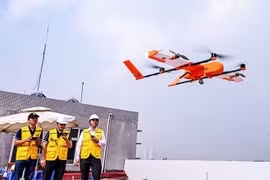
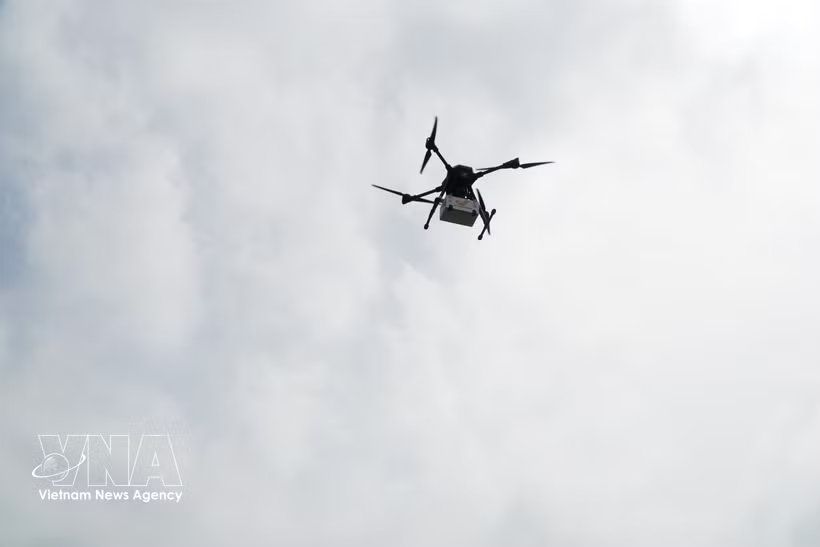
Ho Chi Minh City inaugurates a UAV postal route linking Can Gio commune and Vung Tau ward on February 12, 2026. (Photo: VNA)

Ho Chi Minh City (VNA) - Building on advances in science and technology, innovation and the expanded development space created by the recent merger, Ho Chi Minh City is accelerating the testing and deployment of unmanned aerial vehicles (UAVs) across multiple sectors, laying the groundwork for a low-altitude economy while improving governance, operational infrastructure and a collaborative ecosystem linking the State, universities and businesses.

Expanding UAV trials and applications

With its enlarged development space, Ho Chi Minh City now combines strengths in urban development, industry and services with high-tech agriculture, the marine economy, logistics and diverse ecological areas. These conditions provide an ideal testing ground for UAV applications in urban management, land administration, environmental monitoring, disaster prevention and response, agriculture, logistics and public services.

Under the city's Low-Altitude Economy Development Plan to 2030, the sector has been identified as a strategic new growth driver. The plan aims to turn Ho Chi Minh City into Vietnam's first hub for research, manufacturing and services related to the low-altitude economy.

During the 2026-2027 period, the city will focus on refining regulations, establishing a regulatory sandbox, planning low-altitude airspace and launching pilot projects. Between 2028 and 2030, it plans to expand commercialisation, invest in infrastructure and develop services in healthcare, rescue operations, surveillance, transport, agriculture and logistics. Beyond 2030, the city aims to diversify low-altitude economic services and gradually master core and foundational technologies to build a comprehensive ecosystem.

On January 5, the city launched a UAV delivery pilot programme involving Saolatek, Real-Time Robotics Vietnam and Di Dong Viet to gather real-world data for improving management policies and operating procedures. According to Saolatek founder Tran Anh Tuan, the sandbox mechanism gives companies greater room to refine products, master technologies and expand markets, although further support in resources and ecosystem development remains necessary.

On February 12, the city inaugurated a UAV postal route linking Can Gio commune and Vung Tau ward. The route, operated by CT UAV in cooperation with the Vietnam Post Corporation, is the country's first cross-sea unmanned postal service. It cuts delivery times from about one day to roughly two hours. If the pilot proves successful, the model could be expanded to areas with difficult transport conditions and used for emergency medical deliveries, search and rescue, disaster response and smart urban management.

A survey conducted by the municipal Department of Science and Technology across 60 communes and wards found that 56 have demand for UAV applications in public security, land and construction management, disaster prevention and control, rescue operations and environmental monitoring, indicating that UAVs have become a practical rather than futuristic requirement.
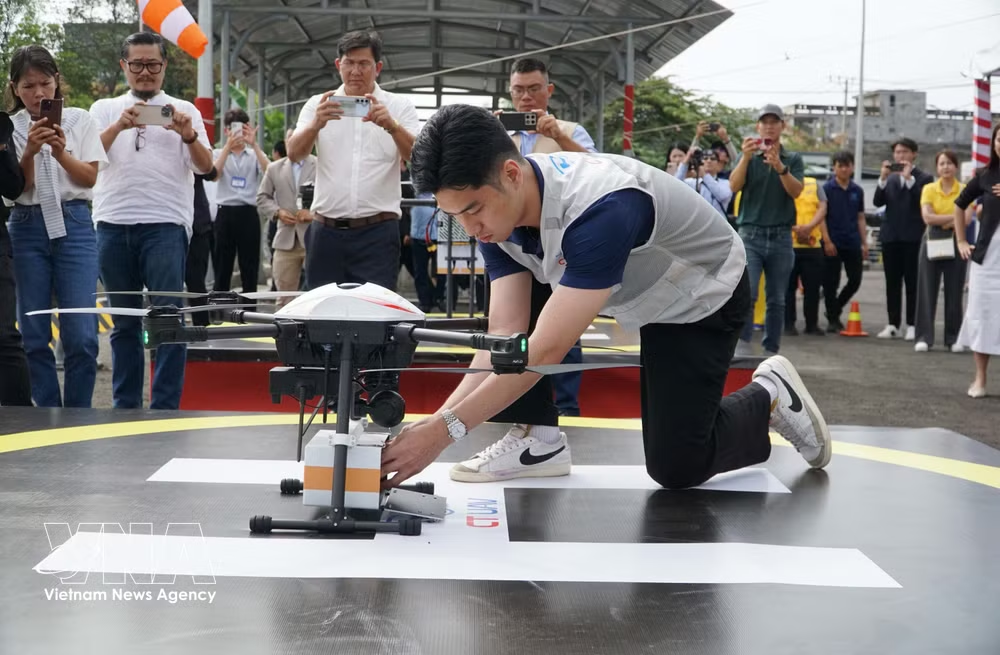
vnanet-potal-tp-ho-chi-minh-khai-truong-tuyen-buu-chinh-khong-nguoi-lai-xuyen-bien-dau-tien-8588818.jpg
A staff prepares parcels for delivery by UAV. (Photo: VNA)

Strengthening the State-university-business partnership

UAVs are among the 11 national strategic technology groups in which Vietnam seeks to master core technologies. Experts say that improving competitiveness will require the development of a full UAV ecosystem built on close cooperation among the State, universities and enterprises.

Assoc. Prof. Dr. Ngo Khanh Hieu of the Ho Chi Minh City University of Technology under the Vietnam National University-Ho Chi Minh City said the State should continue improving the legal framework, universities should lead research and workforce training, and businesses should bring technologies into practical use. While Vietnam is benefiting from gradually improving regulations and pilot mechanisms, challenges remain in human resources, infrastructure and business conditions governing civilian UAV operations. He added that companies should focus on practical solutions and application efficiency while expanding sandbox programmes on a larger scale.

From the business perspective, Luong Viet Quoc, Chief Executive Officer of Realtime Robotics, said Vietnamese UAVs can compete internationally if they possess superior technology. To build a strong UAV industry, he said, Vietnam must address financing, human resources and institutions at the same time, deepen cooperation among the State, universities and businesses, expand procurement mechanisms for proven products, provide preferential credit and support for R&D and testing facilities, and introduce policies that encourage the development of strategic technology talent./.

VNA

See more

Workers produce outdoor wooden furniture for export to Europe at the factory of Hong Ngoc Co., Ltd. in Phu Tai Industrial Park, Quy Nhon Bac ward, Gia Lai province. (Photo: VNA)

Vietnam's wood exporters race to stay on growth path

Despite headwinds from Middle East tensions that have pushed up freight and logistics costs, exports of wood and wood products were estimated at 1.53 billion USD in June, lifting first-half export turnover to 8.54 billion USD, up 4.4% from a year earlier, according to the Ministry of Agriculture and Environment (MAE).

Workers make clothes for export to the Japanese market at Hung Viet Garment Company in Hung Yen province. (Photo: VNA)

Vietnam seeks stronger export growth in H2

Despite the encouraging performance, Vietnam's exports remain heavily dependent on a limited number of major markets and product groups, while the domestic value added of many export products remains relatively low because of their reliance on imported raw materials and components.

Hiep Phuoc Industrial Park in Hiep Phuoc commune, Ho Chi Minh City. (Photo: VNA)

Ho Chi Minh City: Industrial, export processing zones attract over 2.6 bln USD in H1

Speaking at the at the city's regular socio-economic press briefing on July 9, Deputy Head of the Ho Chi Minh City Export Processing and Industrial Zones Authority (HEPZA) Tran Viet Ha said that foreign direct investment (FDI) accounted for nearly 1.6 billion USD of the total, including 65 newly licensed projects worth more than 867 million USD and 83 existing projects that added over 707 million USD in registered capital.

Ofer Fohrer, Head of the Export and Investment Promotion Division under the Foreign Trade Administration of Israel's Ministry of Economy and Industry, shares prospects for bilateral cooperation in trade, investment, and high-tech agriculture. (Photo: VNA)

Vietnam, Israel strengthen connectivity in high-tech agriculture

Israeli businesses and experts introduced a wide range of technologies and solutions for sustainable agricultural development, including smart irrigation systems, greenhouse technologies, crop varieties, microbial technologies, post-harvest solutions, aquaculture technologies, and digital transformation in agriculture.

Petrolimex Hung Yen staff serves a customer at an E10 RON95-V biofuel pump, newly put into operation to completely replace mineral gasoline. (Photo: VNA)

Fuel prices continue to fall on latest adjustment

The maximum retail price of E5RON92 was set at 19,191 VND (0.73 USD) per litre, down 539 VND from the previous ceiling and 812 VND lower than E10RON95-III. The latter was capped at 20,003 VND per litre, a decrease of 412 VND.

Workers on a production line manufacturing camera modules and electronic components for export at a factory of MCNEX VINA Co., Ltd.. of the Republic of Korea in Phuc Son Industrial Park, Ninh Binh province. (Photo: VNA)

UOB revises up Vietnam's 2026 GDP growth forecast to 8.5%

Singapore-based United Overseas Bank (UOB) has sharply raised its forecast for Vietnam's 2026 GDP growth to 8.5%, more than reversing the previous downgrade to 7%, citing stronger-than-expected first-half economic performance driven by manufacturing, investment and foreign direct investment (FDI).

The Vietnam Financial Forum 2026 (VFF 2026) takes place in Da Nang on July 9, 2026. (Photo: VNA)

Da Nang eyes role as gateway for global capital

Da Nang is pursuing a next-generation IFC focused on innovation, fintech and sustainable finance, concentrating on high-value segments rather than a traditional fully integrated financial-centre model.

Consumer spending has contributed to Vietnam's economic growth. (Photo: VNA)

ADB keeps Vietnam as Southeast Asia’s fastest-growing economy

Vietnam is projected to remain the fastest-growing economy in Southeast Asia, with the Asian Development Bank (ADB) maintaining its growth forecasts of 7.2% for 2026 and 7.0% for 2027 in its Asian Development Outlook (ADO) July 2026 released on July 8.