Ho Chi Minh City (VNA) - Singapore-based United Overseas Bank (UOB) has sharply raised its forecast for Vietnam's 2026 GDP growth to 8.5%, more than reversing the previous downgrade to 7%, citing stronger-than-expected first-half economic performance driven by manufacturing, investment and foreign direct investment (FDI).
According to the bank, Vietnam’s GDP growth strengthened to 8.39% year-on-year in the second quarter of 2026, from 7.94% in the first quarter, lifting the first half’s figure to 8.18%.
In its latest economic update, UOB said the result was well abobe its earlier expectations despite the overhang of geopolitical risks in the Middle East and elevated energy prices. It noted that the outcome reflected broad-based momentum across industry, construction, services, and agriculture, helping Vietnam retain its position as ASEAN's fastest-growing economy.
Despite revising up its forecast for Vietnam's full-year GDP growth, the organisation said the Government's 10% growth target will be difficult to attain given continued uncertainties in the global economy.
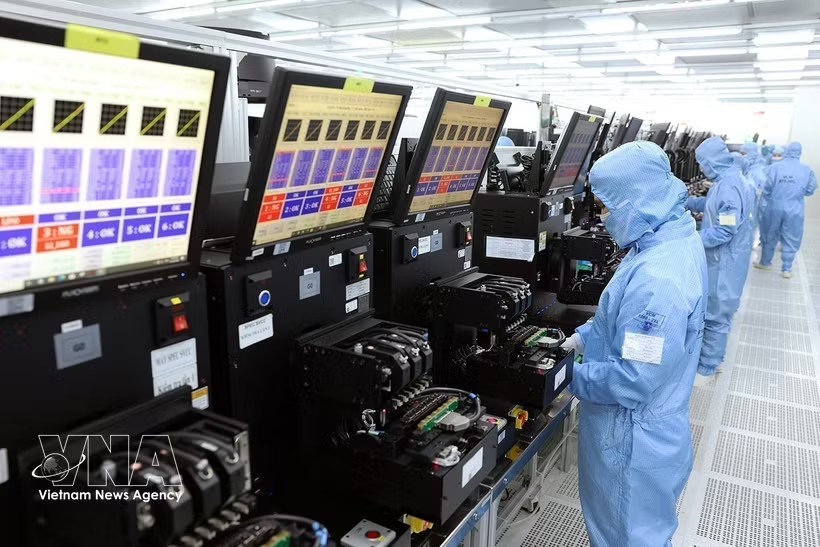
According to UOB, manufacturing remained the economy's main growth engine. The industrial and construction sector expanded 10.51% year-on-year in the second quarter, faster than 9.01% recorded in the previous quarter. Industrial production also maintained double-digit growth, with the Index of Industrial Production (IIP) rising 12.7% year-on-year in June and 10.8% in the first half.
Notably, manufacturing grew 11.4%, supported in H1 by rising global demand for artificial intelligence (AI)-related products as major technology companies continued expanding investment.
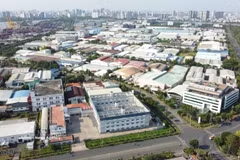
FDI remained another bright spot despite geopolitical headwinds. Disbursed FDI reached about 13 billion USD in the first six months, up 11.2% compared to the same period last year, while newly registered FDI climbed 61% to 34.7 billion USD.
UOB said the figures underscored Vietnam's continued attractiveness as the ongoing diversification of global supply chains continues to benefit the country. The robust volume of newly registered FDI also provides a solid foundation for stronger disbursements in the remaining months of the year, potentially making 2026 one of the country's strongest years for attracting foreign inflows.
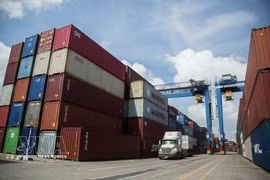
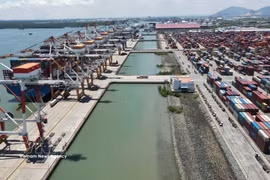
Despite the positive trends, the bank said the strong economic performance comes with a weakened external balance. Although exports rose 22.8% in the last quarter, imports jumped 38.14%, resulting in a second consecutive quarterly trade deficit of around 11.8 billion USD. The first-half trade deficit reached approximately 15 billion USD, reversing a surplus of 7.9 billion USD recorded in the same period last year.
Nonetheless, UOB experts said that with the US and Iran now engaging in negotiations and the Strait of Hormuz reopening, energy prices are expected to ease gradually. As such, the trade balance is expected to return to a surplus position towards the end of 2026.
Meanwhile, inflation has shown signs of moderating. The CPI eased to 4.69% in June from above 5% in the previous two months. The average inflation for the first half stood at 4.38% and core inflation at 4.12%.
The bank said some of the Government’s earlier efforts to bring prices under control, including freezing taxes on gasoline and promoting wider adoption of electric vehicles and use of biofuels, helped ease inflationary pressures.
However, global oil prices remain a key factor to monitor as geopolitical tensions continue to pose uncertainties, it added./.