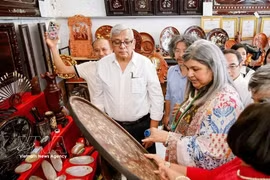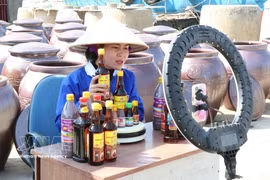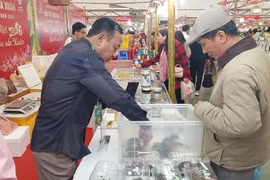
Hanoi (VNA) – Vietnam is focusing on promoting the collective economy and the One Commune One Product (OCOP) programme during 2026–2030, with digital transformation, stronger value chains and improved policies expected to help local products participate more deeply in the digital economy and global value chains.
The new phase marks an important step in implementing the National Target Programmes on new-style rural development, sustainable poverty reduction, and socio-economic development in ethnic minority and mountainous areas for 2026–2035.
According to Deputy Chief of the National Coordination Office for the new-style rural development programme under the Ministry of Agriculture and Environment Phuong Dinh Anh, the programme will shift its focus from infrastructure construction to developing the rural economy, improving living standards and preserving traditional culture. It will also promote digital transformation, green transition, the circular economy and climate resilience.
By 2030, Vietnam aims to have around 65% of communes meeting new-style rural development standards. Rural incomes are expected to increase by 2.5-3 times from 2020, while the poverty rate will continue to fall by 1–1.5% each year. Cooperatives are expected to play a central role in achieving these goals by developing OCOP products through value chains.
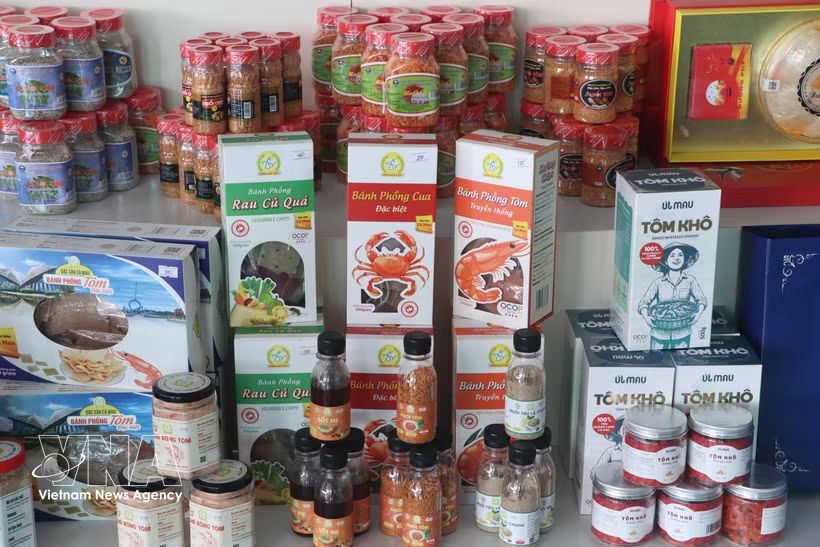
Vietnam currently has about 17,400 OCOP products rated three stars or above. The figure is set to increase to around 25,000 by 2030, with greater emphasis on improving quality, adding value and enhancing competitiveness rather than simply expanding the number of products.
Digital transformation will be one of the programme's key priorities. Cooperatives will adopt digital technologies to improve governance, financial transparency, land and membership management, and access to credit. In production, digital databases, planting area codes and product traceability systems will help monitor quality from farms to consumers.
Beyond linking small producers, cooperatives are also expected to standardise production processes to meet domestic and international market requirements, creating a stronger foundation for sustainable OCOP development.
To support collective economy development, the Government plans to address four major bottlenecks, including capital access, human resources, markets, and science-technology.
New financial policies are expected to allow assets created with borrowed capital, such as factories, machinery and land-use rights, to be used as collateral. The Cooperative Development Support Fund will also be strengthened as a specialised financial institution.
Cooperatives and OCOP producers will receive greater support to connect with modern retail chains and e-commerce platforms, while technology transfer from research institutes, universities and technology firms will be accelerated.
Assistance will also be provided for trademark registration, product preservation and modern packaging.
The Ministry of Agriculture and Environment also plans to develop specialised raw material areas, expand planting area codes, build a national digital database for OCOP products and strengthen product traceability.
Officials believed that closer links between the new-style rural development programme and the collective economy will create stronger value chains, helping OCOP products increase their competitiveness while contributing to a modern, efficient and internationally integrated agricultural sector./.
See more
UOB revises up Vietnam's 2026 GDP growth forecast to 8.5%
Singapore-based United Overseas Bank (UOB) has sharply raised its forecast for Vietnam's 2026 GDP growth to 8.5%, more than reversing the previous downgrade to 7%, citing stronger-than-expected first-half economic performance driven by manufacturing, investment and foreign direct investment (FDI).
PM requests full disbursement of national target programme funds in 2026
PM Le Minh Hung said the fulfilment of the capital disbursement target should become a key criterion in evaluating the performance of ministries, sectors and local authorities.
Da Nang eyes role as gateway for global capital
Da Nang is pursuing a next-generation IFC focused on innovation, fintech and sustainable finance, concentrating on high-value segments rather than a traditional fully integrated financial-centre model.
Beyond FDI, Vietnam leverages foreign resources to build up domestic capacity
Instead of concentrating mainly on attracting foreign capital, Resolution No. 10-NQ/TW emphasises building a foreign-invested sector that is closely integrated with the domestic sector to create new growth drivers for the country.
ADB keeps Vietnam as Southeast Asia’s fastest-growing economy
Vietnam is projected to remain the fastest-growing economy in Southeast Asia, with the Asian Development Bank (ADB) maintaining its growth forecasts of 7.2% for 2026 and 7.0% for 2027 in its Asian Development Outlook (ADO) July 2026 released on July 8.
Ministry pushes social and rental housing, saying apartment prices have stabilised
Vietnam currently has 130,571 rental housing units under construction. A review of national rental housing demand will be completed before the construction ministry assigns specific targets to provincial governments.
Vietnam spends over 121.5 million USD on diamond imports in first half
India remained the largest supplier, with the value reaching 63.2 million USD, representing around 52% of Vietnam's total diamond imports.
Vietnamese firms seek deeper access to UK supply chains
Speaking at the opening ceremony at Staybridge Suites London-Vauxhall in Lambeth, Vietnamese Ambassador to the UK Do Minh Hung said bilateral ties have developed strongly in recent years, culminating in the establishment of a Comprehensive Strategic Partnership during Party General Secretary To Lam’s official visit to the UK in October last year.
Quang Ngai seeks stronger French partnership for green growth
The meetings with AFD and EDF were seen as an important step in deepening ties between Quang Ngai and French partners as the province enters a new phase of development. Through broader international cooperation, Quang Ngai aims to attract more capital, technology, management expertise and training resources to advance green industry, clean energy and sustainable infrastructure, strengthen competitiveness and move toward becoming a major industrial, energy and logistics hub in central Vietnam and the country.
Agriculture sustains growth momentum in H1, strengthening foundation for green development
Deputy Minister of Agriculture and Environment Dang Ngoc Diep said the sector achieved encouraging results thanks to close monitoring of market developments, proactive production management and timely measures to remove institutional and policy bottlenecks.
Ho Chi Minh City eyes vibrant night-time economy through cultural industries
According to the National Statistics Office, cultural industries contributed about 3.54% of Ho Chi Minh City's gross regional domestic product (GRDP) in 2020. The figure rose to around 5.7% in 2025 and is expected to continue growing.
Reference exchange increases slightly on July 9
The State Bank of Vietnam set the daily reference exchange rate at 25,211 VND/USD on July 9, up 5 VND from the previous day.
Hanoi's second airport officially added to national airport plan
By 2030, Vietnam aims for its airport network to handle about 249 million passengers and 4.4 million tonnes of cargo annually, while ensuring more than 95% of the population lives within 100km of an airport.
Resolution charts coordinated strategy to attract new-generation FDI
Experts say Resolution No. 10-NQ/TW could become a strategic lever for Vietnam’s sustainable development, but pose major challenges related to infrastructure capacity and environmental standards.
Vietnamese, Chinese firms deepen cooperation across multiple sectors
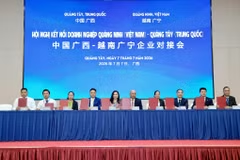
At the conference, 11 pairs of businesses from Guangxi and Quang Ninh signed cooperation agreements in areas including smart border gate development, logistics infrastructure, trade in agricultural, forestry and fishery products, cross-border cultural tourism, and testing and inspection services, to enhance connectivity between Guangxi's industrial and supply chains and those of Vietnam.
Identifying advantages to realise FDI attraction targets: experts
The positive FDI performance in the first half of 2026 provides a favourable foundation for Vietnam to realise Resolution No. 10-NQ/TW’s goals. However, to maintain advantages and improve the quality of capital inflows, Vietnam needs not only to improve the investment environment but also develop infrastructure, strengthen domestic enterprises, expand capital markets and promote substantive links between the FDI and domestic sectors.
Red River Delta drives H1 growth, with five localities in top nine
Beyond fast GRDP growth, many Red River Delta localities were also among the largest contributors to overall national economic expansion during the period.
Creating momentum for double-digit growth target
When businesses spend less time on procedures, gain more transparent access to land and capital, and operate in a stable, predictable business environment, reform policies can be truly translated into projects, products, jobs and productivity gains.
Quang Ninh steps up investment, tourism cooperation with Russia’s Sverdlovsk oblast
Addressing the conference, which took place as Vietnam participated in INNOPROM with a national pavilion for the first time, Vietnamese Consul General Nguyen Mai Huong praised Quang Ninh’s growing cooperation with Sverdlovsk, long recognised as one of Russia’s major industrial centres.
Vietnam's specialty coffee sets sights on Chinese market
As part of the roadshow, in July, a pilot event is set to be held in Shanghai to introduce Vietnamese specialty coffee to the professional coffee community, gauge market interest and lay the groundwork for future trade promotion activities.