OCOP standards seen as key to raising quality of Vietnam’s community tourism

Tourism products will be assessed under three groups of criteria worth a maximum of 100 points. Product quality and community strength account for 40 points, marketing capability 25 points, and product quality standards 35 points.

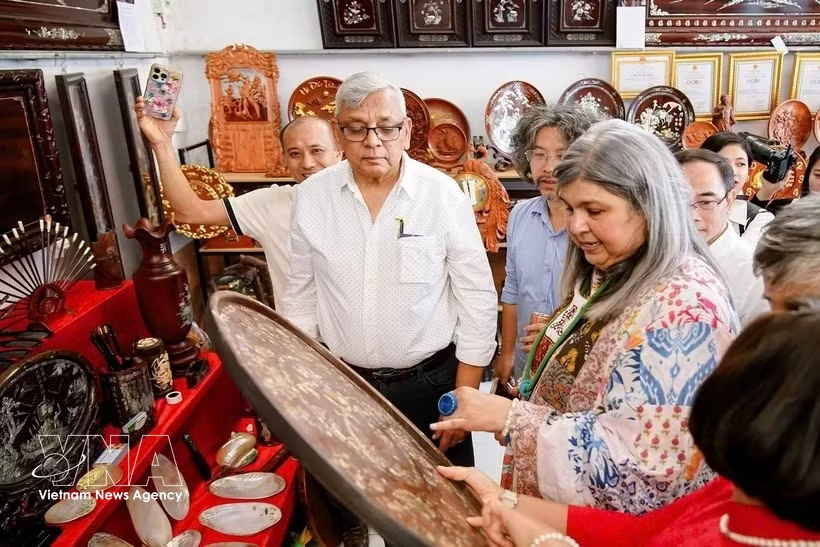
Tourists learn about the products of the Chuyen My mother-of-pearl inlay village. (Photo: VNA)

Hanoi (VNA) – A new set of criteria for evaluating and rating products under the One Commune One Product (OCOP) programme has been issued with community-based tourism, ecotourism services and tourist attractions remaining among the six product categories eligible for certification.

The new regulations, issued under Decision No. 26/2026/QD-TTg by the Prime Minister, are expected to help standardise service quality and encourage community tourism destinations to develop in a more professional, sustainable and culturally distinctive way.

According to the Ministry of Agriculture and Environment, Vietnam currently has more than 600 agricultural and rural tourism models. However, only just over 200 community tourism services and tourist destinations have been recognised as three-star OCOP products or higher.

The figures suggest there remains considerable room to improve tourism products and expand the network of certified destinations. They also highlight a common challenge. Many community tourism models have developed spontaneously, without branding or consistent service standards, making it difficult to attract visitors despite their rich natural and cultural resources.

The new OCOP framework is therefore expected to help local authorities review and improve the entire tourism value chain.

Under the decision, OCOP products must be unique local specialties that reflect the identity of their communities. They must meet production standards linked to traditional cultural values while ensuring food safety, environmental protection, social responsibility and sustainable development.

Tourism products will be assessed under three groups of criteria worth a maximum of 100 points. Product quality and community strength account for 40 points, marketing capability 25 points, and product quality standards 35 points.

Products scoring 90-100 points will receive a five-star OCOP rating, while those scoring 70-89 points will be awarded four stars and 50-69 points three stars.

The criteria mean that tourism destinations can no longer rely solely on attractive landscapes. They must also demonstrate effective management, marketing capability, high service quality and meaningful community participation.

The "Tay Ethnic Culture Tourism, Thai Hai Village" is recognised as a national 5-star OCOP product in 2025. (Photo: vneconomy.vn)

The "Tay Ethnic Culture Tourism, Thai Hai Village" is recognised as a national 5-star OCOP product in 2025. (Photo: vneconomy.vn)

Director of the Asia Tourism Development Institute Pham Hai Quynh said the OCOP criteria is a comprehensive quality management framework.

He said the standards encourage tourism operators to upgrade infrastructure, improve staff training and strengthen management practices, helping to reduce fragmented development. At the same time, an OCOP rating enhances a destination's reputation, builds trust among domestic and international visitors, and shifts its focus from simply selling tourism services to offering authentic cultural experiences.

Certified destinations are also more likely to receive support through national tourism promotion programmes as well as policies on investment and infrastructure, creating sustainable value while encouraging local communities to preserve their cultural heritage and improve their incomes.

Importantly, the new decision also allows OCOP certificates to be withdrawn if products fail to maintain the required standards. This means tourism operators must continuously monitor and improve their services rather than treating certification as a one-time achievement.

Experts say certification alone is not enough to attract visitors.

Vu Van Tuyen, a community tourism expert and Director of Travelogy Vietnam, said today's travellers are looking for complete travel experiences rather than isolated attractions. Destinations therefore need stronger regional cooperation and closer partnerships with travel companies to create attractive itineraries built around their unique local identity.

Successful OCOP tourism models such as Ban Lac, Tra Que vegetable village, Thai Hai cultural village and Sin Suoi Ho have shown that combining tourism with agriculture and local culture can create greater economic value while supporting rural development.

Quynh said these destinations have succeeded by turning everyday local life into memorable visitor experiences. In many places, tourists can join farming activities, learn traditional crafts and purchase authentic local products, creating stronger emotional connections with the destination.

He added that community support, effective cooperative management, stable pricing, environmental protection and high service standards are essential to preventing excessive commercialisation.

Looking ahead, Quynh said community tourism sites should combine tourism with other OCOP products to offer richer experiences, allowing visitors not only to see local culture but also to taste regional specialties, learn traditional skills and bring home locally made products.

He also stressed the importance of maintaining green standards, reducing waste and protecting the environment.

In the digital era, he added, community tourism destinations should also embrace technology by developing digital maps, automated tour guides and engaging social media content to tell their cultural stories. At the same time, local residents should become professional tourism ambassadors while preserving the warmth and authenticity that make Vietnam's community tourism unique./.​

VNA

See more

The Law on E-commerce, which takes effect on July 1, marks a major milestone in strengthening the legal framework for the digital economy (Illustrative image. Source: VNA)

E-commerce Law takes effect on July 1, paving way for more transparent digital marketplace

The law also encourages green e-commerce, more efficient logistics and environmentally friendly packaging, while creating greater opportunities for small and medium-sized enterprises, household businesses and start-ups. E-commerce platforms are now required to verify sellers' identities, disclose information on sellers, products and transaction conditions, proactively detect violations and establish effective complaint-handling mechanisms. Consumer protection has also been reinforced through clearer rules on complaints, refunds, compensation and personal data protection.

Delegates sample green durian curry at the event. (Photo: VNA)

Dak Lak puts durian in spotlight with culinary innovation

The event brought together internationally renowned culinary experts and chefs from Vietnam, Thailand and Malaysia – three of the world's leading durian-producing and exporting countries. They presented seven innovative dishes blending Dak Lak durian with the culinary traditions of the three nations, ranging from appetisers and main courses to desserts.

Illustrative Image (Photo: VNA)

Lao Cai border trade surges, durian exports hit record high

Export value through border gates in the northern province of Lao Cai reached 636 million USD during the six-month period, up 62% from a year earlier and accounting for more than half of the province's total border trade. Agricultural products remained the dominant export category, making up over 90% of outbound shipments.

Deputy Prime Minister Ho Quoc Dung and other participants experience Vietnam's agricultural product traceability system on a durian. (Photo: danviet.vn)

National traceability system to strengthen reputation of Vietnamese farm produce: Deputy PM

Deputy Prime Minister Ho Quoc Dung praised the Ministry of Agriculture and Environment for developing and putting the system into operation, saying it would improve transparency across the agricultural supply chain, enable the tracing of product origins and help safeguard the quality and reputation of Vietnamese agricultural products in international markets.

Fireworks over the Han River in Da Nang. The central city is scheduled to host the Vietnam Financial Forum 2026 on July 9–10. (Photo: VNA)

Vietnam Financial Forum 2026 to be held in Da Nang this July

The high-level forum will serve as a platform for in-depth discussions on key issues shaping Vietnam's financial sector, including capital market modernisation, digital finance, financial infrastructure, sustainable investment and venture capital.

Vu Dai Thang, Chairman of the Hanoi People’s Committee, speaks at the national conference on studying, disseminating and implementing the Politburo’s Resolution No. 10-NQ/TW on developing the foreign-invested economic sector, held in Hanoi on June 30, 2026. (Photo: VNA)

Local authorities, FDI businesses propose measures to advance foreign-invested economic sector

Chairman of the Ho Chi Minh City People’s Committee Nguyen Van Duoc proposed priorities linked to the Vietnam International Financial Centre (VIFC) to draw new-generation, high-quality capital flows. These include shifting from a project-attraction approach towards building an investment ecosystem and positioning the IFC as a strategic instrument for implementing Vietnam’s new-generation FDI strategy.

At a working session between Vietnamese Ambassador to Israel Nguyen Ky Son and Israeli Minister of Economy and Industry Nir Barkat. (Photo: VNA)

Vietnam, Israel vow to speed up free trade deal

During January-May, Vietnam-Israel trade neared 1.6 billion USD. Vietnam's exports to Israel jumped 30.6% year-on-year to 462 million USD. If the current growth momentum holds, full-year trade is on track to reach around 3.9 billion USD, with Vietnam's exports set to surpass 1 billion USD for the first time.

A memorandum of understanding is signed between the Hanoi People's Committee and AMD Vietnam Corporation, SunEdu Joint Stock Company, a member of SunElectronics Group, on cooperation in training and developing high-quality human resources. (Photo courtesy of the organising committee)

Hanoi unveils 276 investment projects under 100-year development vision

According to the municipal People's Committee, Hanoi's investment attraction strategy is shifting from prioritising capital volume to focusing on investment quality. In the coming period, the city will seek strategic investors capable of driving growth through high-value projects in semiconductors, integrated circuit design, artificial intelligence (AI), big data, biotechnology, new materials, research and development (R&D), innovation centres, modern logistics, green finance, financial technology (fintech), education and training, and specialised healthcare.

Shopping via Co.op Online is becoming increasingly popular among consumers. (Photo: sggp.org.vn)

E-commerce helps expand market access for Vietnamese products

E-commerce is becoming an essential pillar of the digital economy as Vietnamese businesses are shifting from online sales to building digital commerce ecosystems, connecting production, logistics, and distribution to expand their markets and participate more deeply in the global value chain.

A tilapia fingerling nursery operated by Cuu Long Fisheries JSC in Vinh Kim commune, Vinh Long province. (Photo: VNA)

Vietnam's tilapia exports maintain strong growth

Vietnam's tilapia export revenue in the first five months of 2026 hit 62 million USD, more than doubling that in the same period last year, reflecting a strong recovery in international demand

Authorities in Ho Chi Minh City conduct regular inspections to ensure fishing vessels that fail to meet operational requirements are prevented from sailing to the sea. (Photo: VNA)

Ho Chi Minh City rolls out digital fishing logs in renewed push against IUU fishing

Under the rollout plan, the 234 vessels of 24 metres or more must complete installation before July 1, followed by the 1,963 vehicles between 15 and under 24 metres by September 1, and the 626 others between 12 and under 15 metres by January 1 next year. All the vessels will be required to use the system throughout their fishing trips.

Border guards at the Lao Cai International Border Gate uncover and seize multiple cases involving the illegal transport of foreign currency through the Lao Cai International Road Border Gate. (Photo: VNA)

Vietnam adopts action plan to combat money laundering, terrorist financing

Ministries are required to develop, issue and effectively implement sector-specific policies and action plans by September 2026 to mitigate money laundering risks in line with the national action plan on addressing risks related to money laundering, terrorist financing and proliferation financing for the 2023–2028 period.

Pham Tan Hoa, Vice Chairman of the Tay Ninh People's Committee, speaks at the meeting. (Photo:VNA)

RoK partner supports Tay Ninh in UAV ecosystem development

The RoK is one of Tay Ninh's important foreign investors. Among more than 40 countries and territories investing in the province, it ranks second in the number of projects and fourth in total registered capital, with 298 projects worth more than 2.36 billion USD.

Delegates perform the ceremonial launch of Vietnam’s domestic carbon exchange in Hanoi on June 29, 2026. (Photo: VNA)

Vietnam’s domestic carbon exchange launched

The carbon exchange creates a mechanism that enables businesses to optimise emission-reduction costs through trading emission quotas and carbon credits, encourages technological innovation, and supports sustainable development while maintaining the principle of not sacrificing the environment for economic growth.