Free bus fares expected to encourage shift away from private vehicles

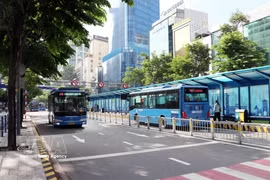
From July 1, Ho Chi Minh City will waive fares on 134 bus routes, including 109 subsidised and 25 non-subsidised services, with the policy remaining in effect through the end of 2026.

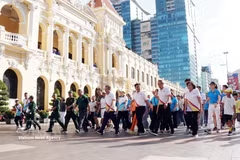
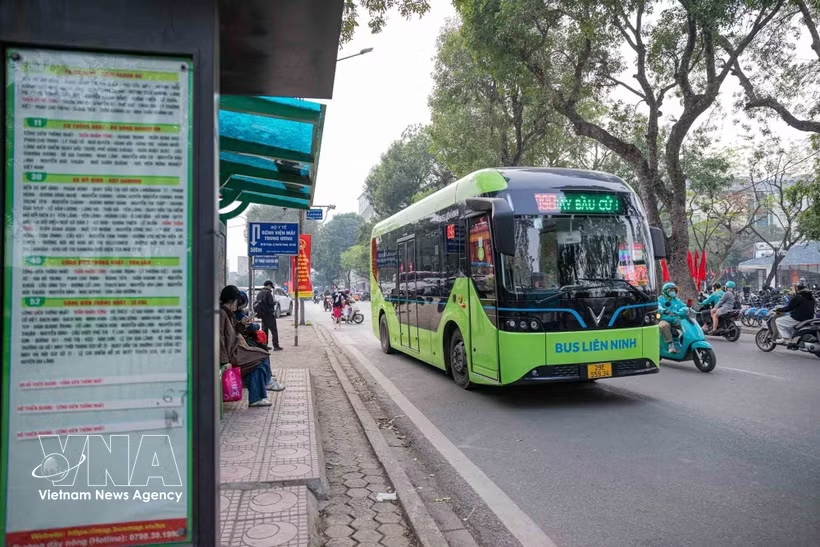
Illustrative photo (Photo: VNA)

Hanoi (VNA) – Hanoi and Ho Chi Minh City are rolling out free bus fare policies in a move aimed at encouraging greater use of public transport, reducing dependence on private vehicles and supporting the transition to greener urban mobility.

From July 1, Ho Chi Minh City will waive fares on 134 bus routes, including 109 subsidised and 25 non-subsidised services, with the policy remaining in effect through the end of 2026.

The programme will be implemented in two phases. Between July and September, passengers can travel free of charge without registering or using electronic tickets, while transport operators will be reimbursed based on trip revenue.

From October, passengers will continue to ride free but will need to verify their journeys using digital payment methods such as bank cards, e-wallets, VNeID accounts, MultiGo app or other electronic platforms. Ticketing data will be used to calculate payments for operators based on actual passenger numbers.

The city said separate guidelines will be introduced to ensure convenient access for elderly passengers, people with disabilities, students and other priority groups.

For many commuters, the policy offers more than financial savings.

Nguyen Thi Huyen, who regularly travels by bus to work, said fares are relatively affordable, but monthly transport costs can still add up.

"Free bus travel will help reduce living expenses. More importantly, it may encourage people who usually travel by motorbike to try public transport," she said.

Lan Anh, an office worker, believed buses could become a practical daily transport option if services become more convenient.

"Passengers need more than free fares. Better bus shelters, smoother connections with the metro, water buses and public bicycles, as well as friendlier services, are equally important," she said.

According to Tran Quang Lam, Director of the municipal Department of Construction, the fare exemption is part of a broader strategy to modernise the city's public transport network. Alongside expanding green transport, authorities are upgrading bus stops and waiting areas while improving service quality.

Ho Chi Minh City's public transport system currently comprises Metro Line No. 1 and 180 bus routes. Of the city's 2,432 buses, 1,649 already operate on electricity or other environmentally friendly fuels. The city aims to convert all locally operated buses to green energy by early 2027.

Meanwhile, Hanoi has also adopted a free bus fare policy as part of a broader package encouraging cleaner transport and public transit use.

Under a resolution approved by the municipal People's Council, passengers travelling from within Ring Road 1 will be exempt from bus fares, except on tourist bus services, from July 1, 2026 to June 30, 2027. The policy applies regardless of whether journeys remain within the central area or continue to suburban districts.

Hanoi authorities said the measure is designed to support residents most affected by the roadmap for low-emission zones and restrictions on fossil fuel-powered vehicles. By making public transport more attractive during the transition period, the city hopes to encourage people to gradually change their travel habits before tighter vehicle controls take effect.

Besides its environmental benefits, people said free bus travel could also boost tourism in the capital, as many tourist attractions are located in the city centre./.
VNA

See more

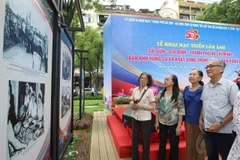
A view of a photo exhibition opened in Ho Chi Minh City on June 29, 2026, to commemorate the 50th anniversary of the city of Saigon–Gia Dinh officially renamed after President Ho Chi Minh. (Photo: VNA)

Photo exhibition showcases Ho Chi Minh City’s 50 years of growth

More than a display of photographs and archival materials, the event serves as an epic narrative, vividly retracing the city’s more than 300-year journey of exploration, development and defence, alongside five decades of achievements under the name Ho Chi Minh City.

Residents are watching a short animated clip created using AI by the police in Bo Trach commune, Quang Tri province, to raise public awareness and provide warnings about crimes. (Photo: VNA)

Vietnam steps up crackdown on tech-enabled trafficking, online scam rings

The plan aims to mobilise the involvement of the entire political system, ministries, local authorities and the public to combat human trafficking, while implementing key tasks set out in the Prime Minister's Human Trafficking Prevention and Control Programme for 2026–2030, with a vision to 2035, while ensuring the effective enforcement of the 2024 Law on Human Trafficking Prevention and Control (amended in 2025).

Representatives of overseas Vietnamese families in France present the Ho Chi Minh Relic Site at the Presidential Palace with valuable archival documents and photographs of President Ho Chi Minh preserved in France. (Photo: VNA)

Series of events in France honours President Ho Chi Minh

The programme included the opening of a thematic exhibition, the launch of the bilingual Vietnamese–French photo book on Nguyen Ai Quoc – Ho Chi Minh and France, a ceremony to receive archival photographs donated by overseas Vietnamese families who welcomed the late Vietnamese leader during his 1946 visit to the European country, and an artistic performance dedicated to his life and legacy.

Logistics and technical personnel transport relief supplies, food and essential provisions for shipment to Venezuela (Photo: VNA)

Vietnam deploys military disaster relief team to earthquake-hit Venezuela

During the mission, the Vietnamese force will use search dogs to locate victims trapped under collapsed structures, conduct urban search-and-rescue operations, provide emergency medical assistance to survivors, and carry out other humanitarian tasks to help Venezuelan authorities and local communities recover from the disaster.

Party General Secretary and State President To Lam (Photo: VNA)

Top leader’s letter honours Vietnamese family values

Party General Secretary and State President To Lam wrote that every Vietnamese family will maintain these cherished traditional values through concrete daily actions: respecting grandparents and parents; loving and caring for children; spouses being faithful, equal, and sharing; and generations listening to, respecting, and supporting each other. Preserving the family means preserving family traditions, culture, and the enduring strength of the nation.

Bui Thi Minh Hoai, Politburo member, Secretary of the Party Central Committee and President of the Vietnam Fatherland Front (VFF) Central Committee (Photo: VNA)

Party official offers congratulations on Hoahaoism’s 87th anniversary

President of the VFF Central Committee Bui Thi Minh Hoai praised the Central Executive Board of the Hoa Hao Buddhist Sangha, its dignitaries, and followers for actively implementing the Party’s guidelines and the State’s policies and laws while effectively responding to patriotic emulation movements and campaigns launched by the VFF.