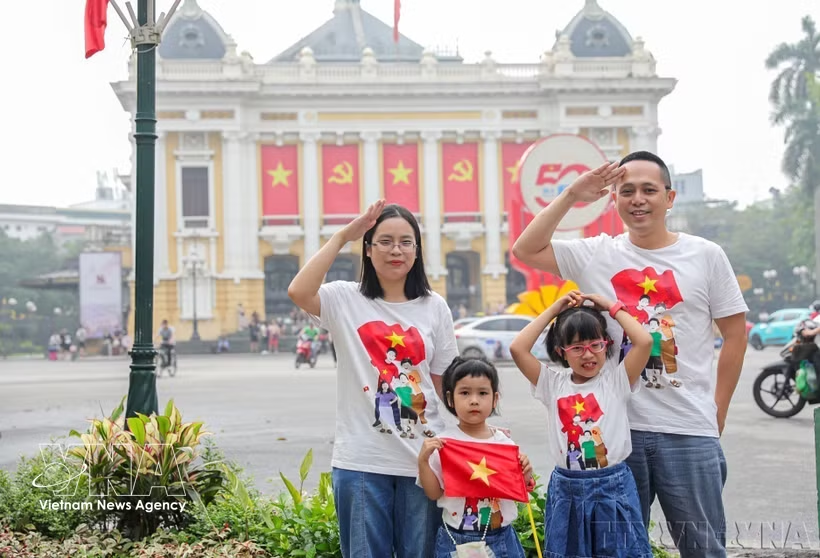
Hanoi (VNA) - As Vietnam accelerates industrialisation, modernisation, digital transformation and international integration, families are undergoing profound changes, creating new opportunities while posing challenges to preserving traditional values, according to researchers.
Throughout Vietnam's history, the family has remained a cornerstone of society. Beyond nurturing future generations and preserving cultural traditions, it is the first environment where personality, values and aspirations are formed. The strength of families is closely linked to social sustainability, human resources quality and the country's long-term development.
Family transformation in digital age
According to Prof. Dr. Nguyen Huu Minh, Chairman of the Vietnam Sociological Association, Vietnamese families have changed significantly in both structure and function.
Household size has steadily declined, from an average of 5.2 members in 1979 to 3.6 in 2024, while extended families have increasingly given way to nuclear families.
Although this reflects urbanisation and industrialisation, it has weakened intergenerational support and family cohesion.
Another concern is the persistent imbalance in the sex ratio at birth, which remains around 111 boys for every 100 girls. If the trend continues, an estimated 3.5 million Vietnamese men could face difficulties finding spouses within the next decade.
Family care functions have also changed. As nuclear families become more common, fewer family members are available to care for older people and children. Labour migration, both domestic and overseas, has left many parents working far from home. Meanwhile, public elderly care services remain limited and private facilities are too costly for most households.
Children whose parents work away often rely on grandparents or caregivers, who may be unable to provide sufficient educational and emotional support. This can affect children's personality development and mental well-being.
Prof. Minh recalled cases of children experiencing deep emotional distress because of prolonged separation from their parents. One boy said he regularly spoke to his mother via Zalo but wished most simply to fall asleep beside her, highlighting that technology cannot replace parental presence.
Rising divorce rates present another challenge. Over the past three decades, Vietnam's divorce rate has increased roughly sevenfold. While divorce may offer adults a fresh start, children often bear the greatest emotional burden through custody disputes and prolonged parental conflict.
Digital technology is also reshaping family relationships. It is increasingly common for family members to focus on smartphones, tablets or televisions even during meals, reducing face-to-face interaction and weakening emotional bonds. Parents also face greater difficulties guiding and monitoring their children's online lives, widening the generation gap.
Khuat Van Quy, Deputy Director General of the Department of Grassroots Culture, Family and Libraries under the Ministry of Culture, Sports and Tourism, noted that shrinking family size and the rise of single-parent, incomplete and single-person households reflect broader social change.

Without appropriate guidance, however, these trends could weaken the family's educational role and interrupt the transmission of traditional values, said Quy.
Building Vietnamese families for a new era
Deputy Minister of Culture, Sports and Tourism Trinh Thi Thuy said today's family transformations are an inevitable result of development, affecting education, caregiving, protection, intergenerational ties and cultural preservation. Population ageing, declining birth rates, work-family pressures, rising divorce, wider generation gaps and the growing influence of digital technology all present new challenges.
Experts agree that regardless of social change, the family remains the foundation for shaping responsible citizens. Values such as patriotism, respect for the law, compassion, morality and cultural identity all begin at home.
The Politburo's Resolution No. 80-NQ/TW on developing Vietnamese culture identifies four core family values: prosperity, happiness, progress and civility.
Prof. Minh said these principles are well suited to modern society but should be translated into measurable indicators. Clear definitions of prosperity, happiness, progress and civility should be incorporated into local socio-economic development targets, alongside indicators on gender equality and family well-being, areas that currently receive insufficient attention.
As Vietnam pursues its goal of building a prosperous and happy society, understanding changing family trends, assessing their impacts and implementing appropriate policies will be essential to ensuring that Vietnamese families remain the foundation of sustainable national development./.