E-commerce helps expand market access for Vietnamese products

E-commerce is becoming an essential pillar of the digital economy as Vietnamese businesses are shifting from online sales to building digital commerce ecosystems, connecting production, logistics, and distribution to expand their markets and participate more deeply in the global value chain.

Shopping via Co.op Online is becoming increasingly popular among consumers. (Photo: sggp.org.vn)

Ho Chi Minh City (VNA) – E-commerce is becoming an essential pillar of the digital economy as Vietnamese businesses are shifting from online sales to building digital commerce ecosystems, connecting production, logistics, and distribution to expand their markets and participate more deeply in the global value chain.

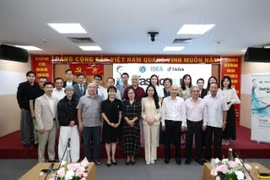
Speaking at a recent seminar on e-commerce development in the fashion industry, jointly organised by Ho Chi Minh City's Department of Industry and Trade, and the Ministry of Industry and Trade (MoIT), officials said digital transformation is no longer limited to online sales but has become a prerequisite for maintaining competitiveness.

​Do Thi Minh Tram, Deputy Director of the MoIT's Department of Innovation, Green Transition and Industrial Promotion, said growing requirements for supply chain transparency, traceability and sustainable production in export markets have made digital transformation and e-commerce increasingly important. Beyond expanding customer reach, digital platforms have also helped businesses standardise operations, improve data management and enhance competitiveness.

​According to Nguyen Cao Duc, Deputy Director of the Institute for European and American Studies, the restructuring of global supply chains under the "China+1" strategy is creating new opportunities for Vietnam to attract investment and integrate more deeply into international production networks.

Vuong Thi Oanh, a representative of the MoIT's Agency of Foreign Trade, noted that international buyers now require not only competitive prices but also product quality, on-time delivery, traceability, carbon emission management and digital connectivity. Enterprises that lag behind in digital transformation risk losing their place in global supply chains, she said.

Many Vietnamese companies have responded by investing in integrated digital commerce ecosystems. Retailer Saigon Co.op, for example, has been expanding its Co.op Online platform and centralised data management system to connect sourcing, warehousing, distribution and customer services across nearly 800 outlets nationwide.

Saigon Co.op Deputy General Director Nguyen Ngoc Thang said the model helps optimise inventories, shorten delivery time and improve demand forecasting while providing consumers with a seamless omnichannel shopping experience. He added that the company aims to build a modern commercial infrastructure that better connects manufacturers, logistics providers and consumers, enabling Vietnamese products to reach the market more efficiently.

Manufacturers are also expanding their presence on e-commerce platforms through official online stores, livestream sales and digital marketing to strengthen brand recognition, access customer data and reduce reliance on intermediaries.

Industry experts said cross-border e-commerce is opening up new opportunities for Vietnamese products, but long-term success will depend on meeting international standards for product quality, traceability, data management and supply chain integration.

Mirash Basheer, Director of Garment Exports Vietnam Company under Lulu Group, said demand for Vietnamese food, agricultural products, seafood, consumer goods and garments remains strong in the Middle East. He noted that suppliers must comply with international standards on food safety, traceability, packaging and delivery reliability to join Lulu's retail and e-commerce network across the Gulf region and other international markets.

Similarly, Veronica Alcaraz Silva, Chief Representative in Vietnam of Mexican retail group Coppel, said Latin America offers growing opportunities for Vietnamese exports. However, she stressed that businesses must go beyond price competitiveness by ensuring consistent product quality, reliable supply, transparent traceability and stronger digital capabilities to become long-term suppliers for global retailers./.

VNA

See more

A tilapia fingerling nursery operated by Cuu Long Fisheries JSC in Vinh Kim commune, Vinh Long province. (Photo: VNA)

Vietnam's tilapia exports maintain strong growth

Vietnam's tilapia export revenue in the first five months of 2026 hit 62 million USD, more than doubling that in the same period last year, reflecting a strong recovery in international demand

Authorities in Ho Chi Minh City conduct regular inspections to ensure fishing vessels that fail to meet operational requirements are prevented from sailing to the sea. (Photo: VNA)

Ho Chi Minh City rolls out digital fishing logs in renewed push against IUU fishing

Under the rollout plan, the 234 vessels of 24 metres or more must complete installation before July 1, followed by the 1,963 vehicles between 15 and under 24 metres by September 1, and the 626 others between 12 and under 15 metres by January 1 next year. All the vessels will be required to use the system throughout their fishing trips.

Border guards at the Lao Cai International Border Gate uncover and seize multiple cases involving the illegal transport of foreign currency through the Lao Cai International Road Border Gate. (Photo: VNA)

Vietnam adopts action plan to combat money laundering, terrorist financing

Ministries are required to develop, issue and effectively implement sector-specific policies and action plans by September 2026 to mitigate money laundering risks in line with the national action plan on addressing risks related to money laundering, terrorist financing and proliferation financing for the 2023–2028 period.

Pham Tan Hoa, Vice Chairman of the Tay Ninh People's Committee, speaks at the meeting. (Photo:VNA)

RoK partner supports Tay Ninh in UAV ecosystem development

The RoK is one of Tay Ninh's important foreign investors. Among more than 40 countries and territories investing in the province, it ranks second in the number of projects and fourth in total registered capital, with 298 projects worth more than 2.36 billion USD.

Delegates perform the ceremonial launch of Vietnam’s domestic carbon exchange in Hanoi on June 29, 2026. (Photo: VNA)

Vietnam’s domestic carbon exchange launched

The carbon exchange creates a mechanism that enables businesses to optimise emission-reduction costs through trading emission quotas and carbon credits, encourages technological innovation, and supports sustainable development while maintaining the principle of not sacrificing the environment for economic growth.

Real estate projects are being implemented across the country. (Photo: VNA)

National property identification system to be launched on July 1: MoC

Vietnam is scheduled to launch a national housing and real estate market information system on July 1, assigning each property a unique identification code to improve market transparency, enhance state management and curb speculation, according to the Ministry of Construction.

Delegates pose for a commemorative photograph following the cooperation announcement ceremony and the presentation of letters of intent for cooperation at the Ho Chi Minh City investment cooperation forum. (Photo: VNA)

Ho Chi Minh City steps up investment attraction in next-generation industries

The Vietnamese southern economic hub’s programme attracted nearly 1,000 participants, with nine cooperation initiatives announced between municipal agencies and businesses and Chinese enterprises across sectors including artificial intelligence (AI), autonomous vehicles and smart mobility, high-tech healthcare, smart agriculture and aquaculture, smart urban centres, green materials, robotics and automation, innovation, digital transformation and innovation-driven finance.