E-commerce boom puts pressure on Malaysia’s transport infrastructure

The surge in online shopping in Malaysia has significantly increased freight movement nationwide, particularly during weekends and holiday periods when logistics operators must meet rising demand for fast deliveries in the digital economy.

Hanoi (VNA) – The rapid growth of e-commerce in Malaysia is placing unprecedented pressure on the country’s transport infrastructure, turning major highways into “moving warehouses” operating around the clock, according to transport experts.

The surge in online shopping has significantly increased freight movement nationwide, particularly during weekends and holiday periods when logistics operators must meet rising demand for fast deliveries in the digital economy.

Wan Agyl Wan Hassan, founder and senior adviser of mobility consultancy MY Mobility Vision, said the expansion of e-commerce and platform-driven delivery services has dramatically boosted traffic volumes on key transport corridors.

With daily traffic on peak holiday periods reaching up to 2.2 million vehicles, major routes such as the North–South Expressway are simultaneously serving commuters, buses, industrial freight, port logistics and time-sensitive parcel deliveries, he noted. According to Wan Agyl, the digital economy is expanding faster than the country’s transport and logistics infrastructure can adapt. As a result, traffic congestion has worsened and travel times have become increasingly unpredictable.

“A trip that normally takes two hours can suddenly become four,” he said, warning that such uncertainty results in higher fuel consumption, delayed deliveries, inventory disruptions, overtime costs and reduced workforce productivity.

Beyond economic losses, heavy congestion also exposes road users to greater stress, fatigue and accident risks in increasingly complex mixed-traffic conditions involving both passenger vehicles and commercial trucks.

Experts have called for a stronger shift towards alternative transport modes to reduce reliance on roads. While new highways such as the West Coast Expressway are expected to help redistribute traffic and improve freight efficiency, rail transport is viewed as a strategic long-term solution.

Wan Agyl stressed that a single freight train could potentially replace dozens of long-haul trucks, helping create a more balanced transport ecosystem linking highways, railways, ports, warehouses and logistics hubs.

However, transport consultant YS Chan believes private cars will remain the preferred mode of transport for many Malaysians in the near future./.
VNA

See more

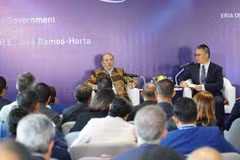
President of Timor-Leste José Ramos-Horta (L) at the leadership lecture in Jakarta on June 2 hosted by the ERIA School of Government under the Economic Research Institute for ASEAN and East Asia (ERIA). (Photo: ERIA)

Timor-Leste President shares vision for peacebuilding, ASEAN integration

Drawing on his experience as a diplomat and Nobel Peace Prize laureate, Ramos-Horta cited the reconciliation process between Timor-Leste and Indonesia as a model for peacebuilding. He paid tribute to former Indonesian leaders for their contributions to normalising bilateral ties, stressing that friendship and cooperation ultimately prevailed over past divisions and laid the foundation for Southeast Asia's stability today.

Southeast Asia tourism sustains rebound

Southeast Asia tourism sustains rebound

Indonesia welcomed 4.68 million foreigners in the first four months, an 8.24% hike from a year earlier and the highest tally for the period since the COVID-19 outbreak, its Central Bureau of Statistics said on June 3.

 Indonesia replaces free school meal programme chief after food poisoning scandals

Indonesia replaces free school meal programme chief after food poisoning scandals

The free meal initiative forms part of Indonesia’s broader effort to tackle chronic malnutrition, with more than 20% of children in the country still affected by stunting caused by inadequate nutrition. Jakarta’s long-term goal is to provide meals to around 82.9 million children, pregnant women and breastfeeding mothers, equivalent to more than 30% of the national population.

SAANSOOK application supports holistic health management and promotes workplace wellness to help reduce non-communicable diseases among working-age people. (Photo: SAANSOOK)

Thailand launches AI-powered tool to combat non-communicable diseases

Developed under the “DOPA” strategy – Data, Outcomes, Partners and AI-driven, the SAANSOOK application tracks four key health behaviours: eating, sleeping, exercising and relaxation. It encourages users to adopt healthier lifestyles through challenges and rewards aimed at sustaining long-term behavioural change.

Indonesia moves to diversify tourism investment flows

Indonesia moves to diversify tourism investment flows

Tourism Minister Widiyanti Putri Wardhana stressed that Indonesia is not just Bali, it has numerous top destinations with vast tourist and investment potential, which are waiting for responsible and sustainable development efforts.

Biodiesel – Malaysia’s energy security buffer: Expert

Biodiesel – Malaysia’s energy security buffer: Expert

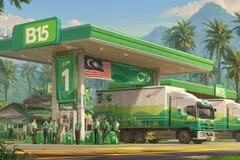
Malaysia has officially increased the biodiesel blending mandate in Peninsular Malaysia from B10 to B15. Under the new policy, diesel sold on the domestic market contains 15% biofuel and 85% petroleum-based diesel, economist and international relations expert, senior adviser at Global Asia Consulting Samirul Ariff Othman told the Vietnam News Agency's correspondent in Kuala Lumpur.

Indonesia tightens control over e-cigarettes

Indonesia tightens control over e-cigarettes

The head of Indonesia's Food and Drug Agency (BPOM), Taruna Ikrar, warned that the country is facing an "emergency" related to youth smoking and e-cigarette use. According to the agency, the smoking rate among children and adolescents has reached 7.4%, equivalent to more than 5 million minors nationwide.

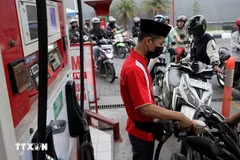
Motorcyclists wait to have their vehicles refilled at a petrol station in Surakarta city, Central Java province, Indonesia. (Photo: Xinhua/VNA)

Indonesia maintains fuel subsidies until late 2026

Indonesia will maintain its fuel subsidy policy to keep domestic fuel prices stable through the end of this year, despite rising fiscal pressure caused by currency fluctuations, according to Indonesian Deputy Minister of Energy and Mineral Resources Yuliot Tanjung.