Hantavirus classified as “dangerous communicable disease” in Thailand

The new mandate requires authorities to report suspected cases within three hours, conduct disease investigations within 12 hours, and enforce a strict 42-day quarantine for high-risk contacts.

Bangkok (VNA) - The Thai Government on May 15 raised its alert level for Hantavirus, officially classifying Hantavirus infection as a “dangerous communicable disease” amid growing global concern over the spread risk posed by the rare but highly fatal virus strain.

According to the Ministry of Public Health, the new mandate requires authorities to report suspected cases within three hours, conduct disease investigations within 12 hours, and enforce a strict 42-day quarantine for high-risk contacts.

Hantavirus, which can spread through respiratory droplets, with certain strains capable of human-to-human transmission, has emerged as a significant global concern and a serious threat, necessitating the designation, the ministry said in a statement.

To ensure a rapid and coordinated response, the ministry said it is implementing an elevated action plan focusing on surveillance, laboratory testing, medical treatment, and local implementation.

Health authorities are stepping up monitoring at international points of entry, with the Department of Disease Control finalising "Patients Under Investigation" definitions and immediate investigation protocols for domestic cases, alongside the quarantine enforcement, said Somruek Chungsaman, the ministry's permanent secretary.

Somruek said provincial public health offices and hospitals nationwide have been tasked to maintain close surveillance, ensuring facilities report suspected cases within three hours, review treatment protocols, and immediately communicate risks to local populations.

He urged anyone with a history of rodent exposure or recent travel from high-risk areas who develops a high fever and difficulty breathing to seek immediate medical attention to ensure rapid diagnosis and prevent the disease from spreading./.

VNA

See more

Scientists discover largest dinosaur species ever found in Thailand

Scientists discover largest dinosaur species ever found in Thailand

According to the researchers, Nagatitan Chaiyaphumensis belonged to the Titanosauridae family, a group of herbivorous dinosaurs characterised by their long necks and tails. The species is estimated to have measured between 27 and 30 metres in length and weighed more than 26 tonnes.

Cambodia lowers 2026 economic growth forecast to 4.2%

Cambodia lowers 2026 economic growth forecast to 4.2%

According to the medium-term fiscal framework for 2027-2029 recently published by Cambodian Prime Minister Hun Manet, Cambodia is navigating a transition against a backdrop of protracted global crises, including rising protectionism, trade wars, geopolitical and geo-economic tensions, and increasingly severe impacts of climate change and natural disasters as well.

Thailand enters 2026 rainy season

Thailand enters 2026 rainy season

According to forecasts by the Thai Meteorological Department (TMD), Thailand entered the rainy season, after key meteorological conditions met the criteria for the start of the season.

Agriculture Minister Andi Amran Sulaiman (second from the right) checked the Bulog's rental warehouse in the Romokalisari Warehouse Complex, Surabaya, East Java on May 13, 2026. (Photo: Antara)

Indonesia records highest-ever rice reserves

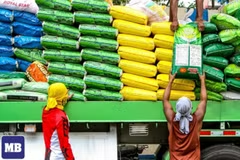
The figure marks the highest level of rice stocks in Indonesia’s history as the country steps up policies aimed at boosting agricultural output and strengthening national food security.

Philippines warns of power cuts as heat strains grids

Philippines warns of power cuts as heat strains grids

The National Grid Corporation of the Philippines (NGCP) issued a red alert, warning of potential outages of up to seven hours in 32 areas across the Visayas grid, and hour-long outages in nine areas across Luzon, including the capital Manila.

Myanmar steps up efforts to prevent cybercrime

Myanmar steps up efforts to prevent cybercrime

A Myanmar bill proposes the death penalty as the highest punishment for individuals who illegally abduct, abuse, torture or detain others to coerce them into committing online fraud. It also proposes a maximum sentence of life imprisonment for individuals directly operating scam centres or engaging in fraud involving digital currencies.

Vietnam win 3–2 over the UAE in the final Group C match of the AFC U17 Asian Cup 2026 in Saudi Arabia on early May 14 (Vietnam time). (Photo: Vietnam Football Federation)

Thai media hail Vietnam U17s after dramatic comeback victory

The Thai Youth Football fanpage published an article praising the Vietnamese “golden star warriors” for displaying extraordinary fighting spirit in overturning the match to defeat the UAE 3–2, thereby topping Group C for the first time and earning a place at the U17 World Cup in Qatar later this year.

Electric vehicles line up at charging ports in a Manila mall. (Photo: philstar.com)

Philippines moves closer to launching EV incentive programme

Secretary of Finance Frederick Go said on May 13 the EV Incentive Strategy (EVIS) may be released soon. The EVIS has already been presented to President Marcos, but the Board of Investments (BOI) is still working with other agencies in the Fiscal Incentives Review Board (FIRB) on the details of the programme.

Singaporean Prime Minister Lawrence Wong speaks at SGLaw200 Youth Forum on May 13 (Photo: channelnewsasia)

Singaporean PM calls for balance between AI safety, innovation

The PM cautioned that deeper integration of AI into sectors such as healthcare and autonomous vehicles could pose greater challenges, including wrong medical diagnoses and fatal self-driving car incidents, raising critical questions over liability for AI-related failures.

Singaporean Deputy Prime Minister Gan Kim Yong speaks at the Singapore Business Federation’s Future Economy Conference on May 13. (Photo: channelnewsasia.com)

Singapore releases new strategy to boost growth, create good jobs

The review identified major challenges, including geopolitical tensions, rapid technological advancements, global shift towards low-carbon economy, and demographic pressures. To address these issues, the ESR Committees outlined three core priorities - sharpening Singapore’s value proposition, enhancing agility and adaptability, and building resilience alongside efficiency.