Indonesia earmarks 71.3 billion USD for mega solar power project

Indonesian President Prabowo Subianto set a target of developing 100 GW of solar power between 2026 and 2028.

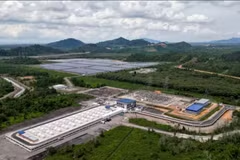
Jakarta (VNA) – Indonesia is planning one of the world's largest solar power development programmes, with a targeted capacity of up to 100 gigawatts (GW) and an estimated investment of 71.3 billion USD, as the country seeks to accelerate energy transition and reduce dependence on fossil fuels.

Indonesia’s Ministry of Energy and Mineral Resources (ESDM) said it has coordinated with the Ministry of Agrarian Affairs and Spatial Planning to prepare approximately 24,000 hectares of land on Java Island for large-scale solar power projects.

Deputy Minister of Energy and Mineral Resources Yuliot Tanjung said that authorities have completed land assessments and identified sufficient areas for the solar development programme. In the initial phase, the government will prioritise projects with a combined capacity of around 17 GW.

At the same time, Indonesia plans to develop battery energy storage systems (BESS) with a total capacity of about 33 GW to ensure grid stability as the share of renewable energy in the national power mix continues to grow.

The project forms part of Indonesia’s broader energy transition strategy. Earlier, President Prabowo Subianto set a target of developing 100 GW of solar power between 2026 and 2028.

Observers described the target as highly ambitious, noting that Indonesia’s currently installed solar power capacity stands at only about 1.5 GW. If achieved, the programme will increase the country's solar capacity by more than 66 times within just a few years.

Indonesia, Southeast Asia’s largest economy, is also among the world's major greenhouse gas emitters due to its heavy reliance on coal-fired power generation. Expanding renewable energy is therefore seen as a crucial step towards meeting its emissions reduction commitments and achieving net-zero emissions in the coming decades.

With a planned capacity of 100 GW, the project is expected not only to strengthen Indonesia’s energy security but also to position the country as one of the leading solar energy hubs in the Asia-Pacific region./.​

VNA

See more

Indonesia tightens control over e-cigarettes

Indonesia tightens control over e-cigarettes

The head of Indonesia's Food and Drug Agency (BPOM), Taruna Ikrar, warned that the country is facing an "emergency" related to youth smoking and e-cigarette use. According to the agency, the smoking rate among children and adolescents has reached 7.4%, equivalent to more than 5 million minors nationwide.

A file picture of the Battery Energy Storage System in Santong (Photo: Bernama)

Malaysia accelerates large-scale battery storage projects

Deputy Prime Minister and Minister of Energy Transition and Water Transformation Fadillah Yusof told reporters in Kuching, Sarawak state, that the growing number of solar energy projects in Malaysia has made battery storage increasingly important for managing power flows.

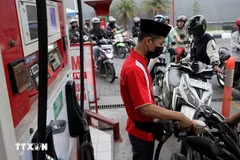
Motorcyclists wait to have their vehicles refilled at a petrol station in Surakarta city, Central Java province, Indonesia. (Photo: Xinhua/VNA)

Indonesia maintains fuel subsidies until late 2026

Indonesia will maintain its fuel subsidy policy to keep domestic fuel prices stable through the end of this year, despite rising fiscal pressure caused by currency fluctuations, according to Indonesian Deputy Minister of Energy and Mineral Resources Yuliot Tanjung.

The logo of social media platform X (Illustrative photo: AFP/VNA)

Malaysia bans social media accounts for children under 16

Under the new rules, social media platforms are required to implement age-verification systems and prevent users under 16 from creating accounts. The regulations apply to platforms with at least eight million users in Malaysia, including Facebook, Instagram, TikTok and YouTube.

Singapore economy remains resilient amid global uncertainties

Singapore economy remains resilient amid global uncertainties

Singapore is also pursuing a long-term economic strategy centred on AI and advanced technologies. The country aims to position itself as a trusted hub for developing, testing and deploying AI solutions at scale, while focusing on practical applications to improve productivity and create new industries.

RoK to pilot AI-driven telemedicine in Indonesia (Photo: healthcareitnews.com)

Indonesia, RoK advance AI-powered healthcare cooperation

The RoK government said it will continue exchanges with Indonesia through joint public-private seminars and discussions involving university hospitals, major technology firms and educational institutions to further develop cooperation frameworks.

Malaysia mobilises non-profit sector to address socio-economic challenges

Malaysia mobilises non-profit sector to address socio-economic challenges

Deputy Finance Minister Liew Chin Tong said Malaysia needs broader cooperation among non-profit organisations, social enterprises, and other socially driven organisations to tackle issues such as an aging population, climate risks, and concerns over employment and wages among the younger generation.

Singapore steps up AI adoption among SMEs

Singapore steps up AI adoption among SMEs

According to a joint statement by Enterprise Singapore and the Infocomm Media Development Authority (IMDA), the updated plan is expected to support more than 2,000 SME retailers in strengthening their competitiveness and resilience.

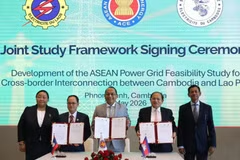
Laos and Cambodia sign an agreement to study a cross-border power grid connection under ASEAN’s regional energy integration plan on May 25, 2026. (Phot: EDL)

Laos, Cambodia advance ASEAN energy cooperation plan

By focusing on cross-border power transmission system integration between Laos and Cambodia, the project will increase capacity for clean energy exchange between the two nations and optimise energy resource management efficiently for Laos.