International media spotlight Vietnamese leader’s message on Asia-Pacific’s role

The Straits Times noted that a significant portion of his address focused on the crisis of the international order, highlighting the need to strengthen respect for international law and exercise restraint.

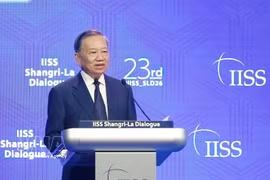
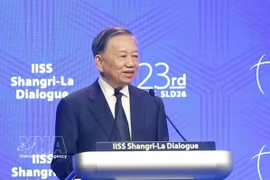
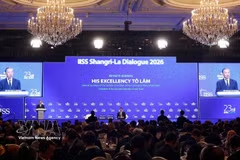
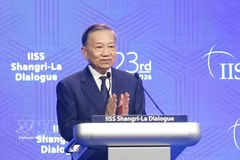
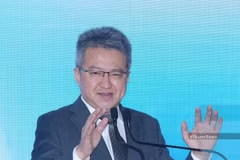
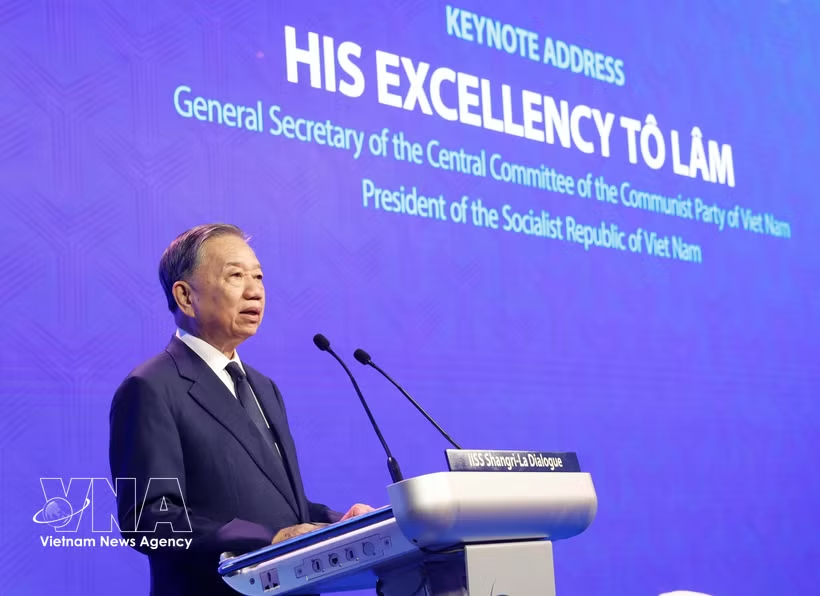
General Secretary of the Communist Party of Vietnam Central Committee and President of Vietnam To Lam delivers the keynote address at the 23rd Shangri-La Dialogue in Singapore on May 29. (Photo: VNA)

Hanoi (VNA) – International media outlets have continued to spotlight the keynote address delivered by General Secretary of the Communist Party of Vietnam Central Committee and President of Vietnam To Lam at the 23rd Shangri-La Dialogue in Singapore, underscoring his message that the Asia-Pacific should not only be a region where global challenges converge, but must also become where solutions emerge for peace, stability and sustainable development.

Singapore’s daily The Straits Times reported on May 30 that the Vietnamese leader identified three interconnected crises in the current global instability: a crisis of the international order, a crisis of development models, and a crisis of strategic trust. He stressed that these challenges are particularly evident in the Asia-Pacific, a region that has benefited greatly from globalisation but is increasingly exposed to supply-chain fragmentation, climate change, technological transformation and intensifying geo-economic competition.

The newspaper quoted the leader as saying that “precisely because it is where these challenges converge, the Asia-Pacific must also become where solutions emerge.” It also noted that a significant portion of his address focused on the crisis of the international order, highlighting the need to strengthen respect for international law and exercise restraint. In the paper’s view, these messages reflect Vietnam’s approach to emerging security and development challenges in the region.

Sharing a similar assessment of the regional and global landscape, Türkiye’s state-run Anadolu Agency (AA) emphasised that the central theme of General Secretary and President Lam’s speech was a call for greater dialogue, cooperation and self-restraint in addressing growing uncertainties in international affairs.

The agency highlighted his appeal for countries to promote a spirit of “responsible coexistence”, deepen dialogue, enhance transparency and establish more substantive mechanisms for cooperation rather than allowing divisions and mistrust to prevail.

Anadolu also drew attention to Vietnam’s vision for the region, reflected in the top leader’s statement that “dialogue must help identify risks early, facilitate information-sharing, preserve communication channels during moments of tension, and prevent disagreement from escalating into crisis,” so as to jointly shape an Asia-Pacific that is peaceful, stable, resilient and capable of mitigating risks early and from afar.

AA further noted his observation that recent tensions along strategic maritime routes in the Middle East demonstrate how conflicts in one hotspot can rapidly affect trade, energy supplies, logistics networks and socio-economic conditions across the globe.

Meanwhile, The New York Times highlighted General Secretary and President Lam’s emphasis on the intrinsic link between peace, stability and sustainable development. According to the newspaper, the Vietnamese leader argued that today’s instability stems not only from military conflicts but also from disruptions to development itself. While strengthening national defence is legitimate, sustainable security cannot rely solely on military power, nor can it be achieved through arms races. Instead, countries need development foundations that are resilient to external shocks.

Quoting international analysts, it noted that the Vietnamese leader’s keynote address at one of Asia’s leading security forums reflects the country’s aspiration to play a more proactive role in promoting dialogue, advancing cooperation and addressing shared regional and global challenges./.
VNA

See more

Thailand imposes stricter rules for online advertisers

Thailand imposes stricter rules for online advertisers

Under the regulations, platforms must establish systems to verify the identities of individuals or organisations wishing to place advertisements before they are published. The measure aims to prevent criminal groups from using advertising space to lure victims or commit technology-related crimes that are causing significant damage.

Singapore to negotiate FTA with East African bloc

Singapore to negotiate FTA with East African bloc

Singaporean President Tharman Shanmugaratnam said Singapore welcomes the East African Community (EAC)'s intention to pursue an FTA with the city-state, emphasising that it will be an important step towards enhancing trade flows between the two sides and creating new growth drivers.

Indonesia tightens fiscal spending plans for 2027

Indonesia tightens fiscal spending plans for 2027

Under the 2027 Macroeconomic Framework and Fiscal Policy Principles (KEM PPKF), the Indonesian government targets state expenditure in the range of 13.62% to 14.80% of gross domestic product (GDP).

Laos reaffirms commitment to eliminate malaria by 2030

Laos reaffirms commitment to eliminate malaria by 2030

Lao PM Sonexay Siphandone highlighted the region’s shared commitment to malaria elimination, recalling the joint declaration signed by Greater Mekong Subregion (GMS) countries in Geneva in 2018, which set a target of eliminating malaria by 2030.

A view of the international roundtable in Russia on June 8 on legal and institutional mechanisms for governmental cooperation to ensure peace and security in the East Sea (Photo: VNA)

Russian scholars propose measures to strengthen trust in addressing East Sea issue

The Russian scholars reaffirmed support for the peaceful settlement of disputes through diplomatic and legal processes, without the threat or use of force, in accordance with international law, particularly the 1982 United Nations Convention on the Law of the Sea (UNCLOS). They also emphasised the importance of maintaining peace and stability, freedom of navigation and overflight in the East Sea, and upholding the rule of law in the seas and oceans.

Dr. Kin Phea, Director General of the International Relations Institute of Cambodia (RAC). (Photo: VNA)

ASEAN Future Forum 2026: Important political message from Phnom Penh

Vietnam remains one of Cambodia’s most important neighbours in terms of security, economy, trade and people-to-people exchanges. Maintaining strong relations with Vietnam, therefore, serves Cambodia’s long-term national interests, said Dr. Kin Phea, Director General of the International Relations Institute of Cambodia (RAC).

Prime Minister Le Minh Hung delivers remarks at the opening session of the third ASEAN Future Forum. (Photo: VNA)

ASEAN Future Forum 2026 opens in Hanoi

In his welcoming remarks, Foreign Minister Le Hoai Trung said Vietnam established the forum with the aim of creating an open, substantive and forward-looking space for dialogue among ASEAN member states and international partners.

A post on the official Facebook page of the Lao Economic Daily (Photo: screenshot)

Lao media highlight deepening Vietnam–Laos cooperation

According to the reports, the Lao and Vietnamese Prime Ministers held talks on June 7, during which they briefed each other on their respective internal situations and expressed satisfaction with the socio-economic achievements recorded by the two sides. They highly valued the continued development of bilateral ties, particularly the strong political trust maintained through regular exchanges of meetings at all levels.

Fishing boats in Vietnam's Ninh Thuan province. (Illustrative photo: VNA)

ASEAN, Norway promote cooperation in sustainable blue economy development

The Norway–ASEAN cooperation project on blue economy development is seen as a first step toward building a regional cooperation platform to raise ASEAN member states’ awareness of the current state of aquaculture and fisheries development, identify policy gaps, and promote collaboration in the sustainable blue economy.