Indonesia replaces free school meal programme chief after food poisoning scandals

The free meal initiative forms part of Indonesia’s broader effort to tackle chronic malnutrition, with more than 20% of children in the country still affected by stunting caused by inadequate nutrition. Jakarta’s long-term goal is to provide meals to around 82.9 million children, pregnant women and breastfeeding mothers, equivalent to more than 30% of the national population.

Jakarta (VNA) – Indonesian President Prabowo Subianto on June 2 decided to remove Dadan Hindayana as head of the National Nutrition Agency, or BGN, which oversees the country’s free nutritious meals programme at a school in Jakarta, following a series of food poisoning incidents and allegations related to budget management.

The move came as the Indonesian Government conducts a comprehensive review of the programme, particularly its food quality standards and implementation effectiveness.

President Prabowo appointed longtime ally Nanik Sudaryati Deyang, who previously served as deputy head of the agency, to replace Dadan.

The Indonesian government affirmed that the programme will continue operating during the review and restructuring process. President Prabowo has previously pledged to take strict action against any wrongdoing uncovered during investigations.

A flagship pledge of Prabowo’s 2024 presidential campaign, the multi-billion-dollar programme aims to improve nutrition among schoolchildren, pregnant women and breastfeeding mothers. Data show that by March this year, the initiative had provided meals to more than 61 million beneficiaries.

However, implementation has been marred by repeated setbacks, with thousands of food poisoning cases reported since the programme began. Speaking before Indonesia’s parliament, Dadan acknowledged that at least 11,000 cases of food poisoning had been linked to the programme, including more than 600 people who required hospital treatment.

The incidents have triggered growing criticism from the public and civil society groups.

The free meal initiative forms part of Indonesia’s broader effort to tackle chronic malnutrition, with more than 20% of children in the country still affected by stunting caused by inadequate nutrition. Jakarta’s long-term goal is to provide meals to around 82.9 million children, pregnant women and breastfeeding mothers, equivalent to more than 30% of the national population.

The programme is also facing pressure from budget constraints amid global economic uncertainties and the impact of the ongoing crisis in the Middle East./.

VNA

See more

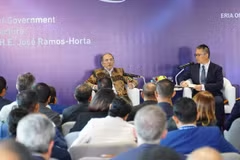
President of Timor-Leste José Ramos-Horta (L) at the leadership lecture in Jakarta on June 2 hosted by the ERIA School of Government under the Economic Research Institute for ASEAN and East Asia (ERIA). (Photo: ERIA)

Timor-Leste President shares vision for peacebuilding, ASEAN integration

Drawing on his experience as a diplomat and Nobel Peace Prize laureate, Ramos-Horta cited the reconciliation process between Timor-Leste and Indonesia as a model for peacebuilding. He paid tribute to former Indonesian leaders for their contributions to normalising bilateral ties, stressing that friendship and cooperation ultimately prevailed over past divisions and laid the foundation for Southeast Asia's stability today.

Southeast Asia tourism sustains rebound

Southeast Asia tourism sustains rebound

Indonesia welcomed 4.68 million foreigners in the first four months, an 8.24% hike from a year earlier and the highest tally for the period since the COVID-19 outbreak, its Central Bureau of Statistics said on June 3.

SAANSOOK application supports holistic health management and promotes workplace wellness to help reduce non-communicable diseases among working-age people. (Photo: SAANSOOK)

Thailand launches AI-powered tool to combat non-communicable diseases

Developed under the “DOPA” strategy – Data, Outcomes, Partners and AI-driven, the SAANSOOK application tracks four key health behaviours: eating, sleeping, exercising and relaxation. It encourages users to adopt healthier lifestyles through challenges and rewards aimed at sustaining long-term behavioural change.

Biodiesel – Malaysia’s energy security buffer: Expert

Biodiesel – Malaysia’s energy security buffer: Expert

Malaysia has officially increased the biodiesel blending mandate in Peninsular Malaysia from B10 to B15. Under the new policy, diesel sold on the domestic market contains 15% biofuel and 85% petroleum-based diesel, economist and international relations expert, senior adviser at Global Asia Consulting Samirul Ariff Othman told the Vietnam News Agency's correspondent in Kuala Lumpur.

Indonesia tightens control over e-cigarettes

Indonesia tightens control over e-cigarettes

The head of Indonesia's Food and Drug Agency (BPOM), Taruna Ikrar, warned that the country is facing an "emergency" related to youth smoking and e-cigarette use. According to the agency, the smoking rate among children and adolescents has reached 7.4%, equivalent to more than 5 million minors nationwide.

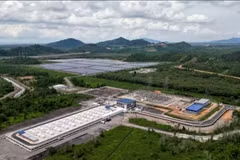
A file picture of the Battery Energy Storage System in Santong (Photo: Bernama)

Malaysia accelerates large-scale battery storage projects

Deputy Prime Minister and Minister of Energy Transition and Water Transformation Fadillah Yusof told reporters in Kuching, Sarawak state, that the growing number of solar energy projects in Malaysia has made battery storage increasingly important for managing power flows.

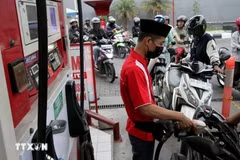
Motorcyclists wait to have their vehicles refilled at a petrol station in Surakarta city, Central Java province, Indonesia. (Photo: Xinhua/VNA)

Indonesia maintains fuel subsidies until late 2026

Indonesia will maintain its fuel subsidy policy to keep domestic fuel prices stable through the end of this year, despite rising fiscal pressure caused by currency fluctuations, according to Indonesian Deputy Minister of Energy and Mineral Resources Yuliot Tanjung.

The logo of social media platform X (Illustrative photo: AFP/VNA)

Malaysia bans social media accounts for children under 16

Under the new rules, social media platforms are required to implement age-verification systems and prevent users under 16 from creating accounts. The regulations apply to platforms with at least eight million users in Malaysia, including Facebook, Instagram, TikTok and YouTube.