Kuala Lumpur (VNA) – Malaysia’s push to expand biodiesel use is a timely and appropriate strategy amid growing uncertainty in global energy markets, but it should be viewed primarily as an energy security buffer rather than a long-term solution, according to economist and international relations expert, senior adviser at Global Asia Consulting Samirul Ariff Othman.
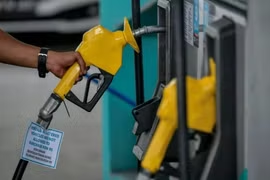
Speaking to the Vietnam News Agency's correspondents in Kuala Lumpur, Othman noted that Malaysia has officially increased the biodiesel blending mandate in Peninsular Malaysia from B10 to B15. Under the new policy, diesel sold on the domestic market contains 15% biofuel and 85% petroleum-based diesel.
The move comes as geopolitical tensions in the Middle East continue to cloud global oil supply prospects. Malaysia sees biodiesel as a way to strengthen domestic energy security, reduce reliance on imported fuel and support local industries.
The policy is particularly relevant as elevated fuel prices continue to drive up transportation costs, logistics expenses and inflationary pressures, while also increasing the fiscal burden of fuel subsidy programmes.
Malaysia is considered well positioned to expand biodiesel production thanks to its abundant palm oil supplies, established refining capacity, port infrastructure and existing biodiesel distribution network. As a result, the gradual transition from B10 to B15, and eventually to B20 and B30, is widely viewed as a practical approach.
According to Reuters, Malaysia produced approximately 975,207 tonnes of biodiesel in 2025, while its installed production capacity stood at around 2.36 million tonnes, indicating significant room for expansion.
However, Othman stressed that implementation must proceed cautiously and in phases. While biodiesel can reduce dependence on imported fossil fuels, it may also increase demand for palm oil, potentially affecting edible oil prices and requiring substantial investments in storage and distribution infrastructure.
Malaysia previously postponed nationwide implementation of B20 biodiesel in 2025, partly because of the high costs associated with upgrading infrastructure.
The expert argued that biodiesel should be regarded as a form of “strategic insurance” in an era when global oil supply chains are increasingly vulnerable to geopolitical disruptions.
At the same time, he emphasised the importance of maintaining policy discipline. Introducing mandatory biodiesel requirements too rapidly could create infrastructure bottlenecks, place upward pressure on palm oil prices and expose weaknesses in fuel distribution systems.
If managed effectively, bioenergy could become an important component of Malaysia’s long-term energy security framework. If not, the policy risks becoming a costly programme dependent on continued government subsidies, he said./.
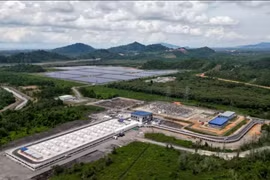
Malaysia accelerates large-scale battery storage projects
Deputy Prime Minister and Minister of Energy Transition and Water Transformation Fadillah Yusof told reporters in Kuching, Sarawak state, that the growing number of solar energy projects in Malaysia has made battery storage increasingly important for managing power flows.