Da Nang eyes role as gateway for global capital

Da Nang is pursuing a next-generation IFC focused on innovation, fintech and sustainable finance, concentrating on high-value segments rather than a traditional fully integrated financial-centre model.

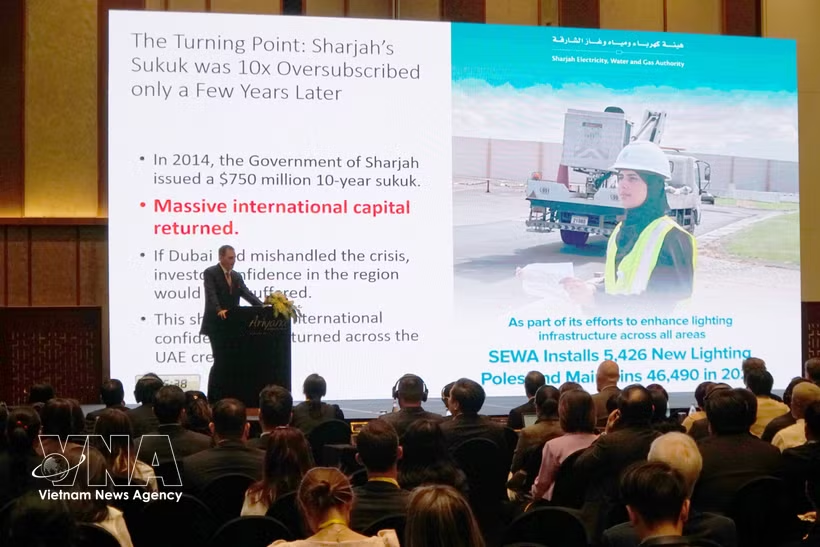
The Vietnam Financial Forum 2026 (VFF 2026) takes place in Da Nang on July 9, 2026. (Photo: VNA)

Da Nang (VNA) – The central city of Da Nang hopes to become a hub connecting Vietnam’s financial sector with emerging global trends and a gateway for international financial institutions, investment funds and businesses seeking easier access to the Vietnamese market.

Ho Ky Minh, Permanent Vice Chairman of the municipal People’s Committee, made the remarks at the opening of the Vietnam Financial Forum 2026 (VFF 2026) on July 9. The forum brought together more than 350 policymakers, international financial institutions, strategic consulting firms, fintech companies and stakeholders in global capital markets and financial infrastructure.

He said that the National Assembly’s adoption of special mechanisms and policies, together with the Government’s Decree No. 323/2025/ND-CP establishing the Vietnam International Financial Centre (VIFC), has created an important legal foundation for a financial centre operating in line with international practices.

The model is being developed in both Ho Chi Minh City and Da Nang to leverage the unique strengths of each locality while enhancing Vietnam’s position on the global financial map and mobilising resources more effectively for national development.

He stressed that Da Nang views the VIFC not merely as a financial zone, but as a new institutional space for testing advanced financial models and promoting innovation, digital transformation and green growth.

Under this strategy, the city is pursuing a next-generation IFC focused on innovation, fintech and sustainable finance, concentrating on high-value segments rather than a traditional fully integrated financial-centre model.

During the initial phase, Da Nang will prioritise five groups of financial products and services: tokenisation of real-world assets, carbon credits and carbon trading, investment funds and fund management companies, commodity exchanges, and bonds and other medium- and long-term capital-raising instruments. These areas are expected to form a modern financial ecosystem supporting capital mobilisation, green transition, infrastructure development, trade and logistics.

City leaders said an international financial centre must be built on trust, transparent institutions, high-quality human resources, advanced technology and global connectivity.

Da Nang pledged to continue improving institutions, developing infrastructure, enhancing workforce quality and expanding international cooperation to create a transparent, convenient and competitive investment environment for investors and long-term development partners at the VIFC.

Minh expressed confidence that the forum’s discussions would generate new initiatives, partnerships and projects, contributing to the development of the VIFC and strengthening Vietnam’s integration into the global financial system.

At the forum, Chris Vanloon, Chairman of the American Chamber of Commerce in Vietnam (AmCham) – Da Nang chapter, said Vietnam is moving decisively from setting a vision to implementing practical measures that enable capital to flow more efficiently. Just six months after its announcement, the VIFC has established two functional zones in two cities and built a network of founding institutional partners.

According to Vanloon, international investors are increasingly focusing on not only macroeconomic potential but also the development of both hard and soft infrastructure, including the legal framework, governance architecture, digital asset markets and sustainable finance. The rapid pace of implementation and strong reform commitments, he said, are creating an opportunity for the VIFC to become a key bridge connecting Vietnam’s financial market with global capital flows./.​

VNA

See more

Consumer spending has contributed to Vietnam's economic growth. (Photo: VNA)

ADB keeps Vietnam as Southeast Asia’s fastest-growing economy

Vietnam is projected to remain the fastest-growing economy in Southeast Asia, with the Asian Development Bank (ADB) maintaining its growth forecasts of 7.2% for 2026 and 7.0% for 2027 in its Asian Development Outlook (ADO) July 2026 released on July 8.

The Quang Ngai delegation poses for a commemorative photo with leaders of EDF following their working session in France. (Photo: VNA)

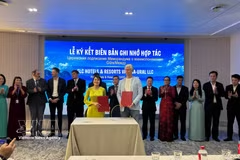
Vietnamese firms seek deeper access to UK supply chains

Speaking at the opening ceremony at Staybridge Suites London-Vauxhall in Lambeth, Vietnamese Ambassador to the UK Do Minh Hung said bilateral ties have developed strongly in recent years, culminating in the establishment of a Comprehensive Strategic Partnership during Party General Secretary To Lam’s official visit to the UK in October last year.

The Quang Ngai provincial delegation poses for a commemorative photo with leaders of EDF following their working session in France. (Photo: VNA)

Quang Ngai seeks stronger French partnership for green growth

The meetings with AFD and EDF were seen as an important step in deepening ties between Quang Ngai and French partners as the province enters a new phase of development. Through broader international cooperation, Quang Ngai aims to attract more capital, technology, management expertise and training resources to advance green industry, clean energy and sustainable infrastructure, strengthen competitiveness and move toward becoming a major industrial, energy and logistics hub in central Vietnam and the country.

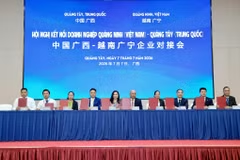
On the sidelines of the conference, 11 memoranda of understanding (MoUs), cooperation agreements, and commercial contracts were signed between businesses from Vietnam's Quang Ninh Province and China's Guangxi Zhuang Autonomous Region. (Photo: baoquangninh.vn)

Vietnamese, Chinese firms deepen cooperation across multiple sectors

At the conference, 11 pairs of businesses from Guangxi and Quang Ninh signed cooperation agreements in areas including smart border gate development, logistics infrastructure, trade in agricultural, forestry and fishery products, cross-border cultural tourism, and testing and inspection services, to enhance connectivity between Guangxi's industrial and supply chains and those of Vietnam.

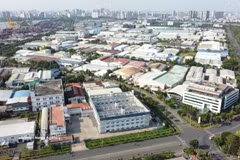
A view of Tan Thuan Export Processing Zone in Ho Chi Minh City. (Photo: VNA)

Identifying advantages to realise FDI attraction targets: experts

The positive FDI performance in the first half of 2026 provides a favourable foundation for Vietnam to realise Resolution No. 10-NQ/TW’s goals. However, to maintain advantages and improve the quality of capital inflows, Vietnam needs not only to improve the investment environment but also develop infrastructure, strengthen domestic enterprises, expand capital markets and promote substantive links between the FDI and domestic sectors.

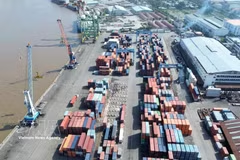
Cargo handling activities are bustling at Saigon Port. (Photo: VNA)

Creating momentum for double-digit growth target

When businesses spend less time on procedures, gain more transparent access to land and capital, and operate in a stable, predictable business environment, reform policies can be truly translated into projects, products, jobs and productivity gains.

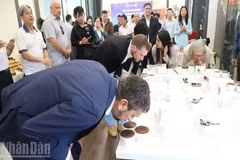
International experts sample Dak Lak's specialty coffee. (Photo: nhandan.vn)

Vietnam's specialty coffee sets sights on Chinese market

As part of the roadshow, in July, a pilot event is set to be held in Shanghai to introduce Vietnamese specialty coffee to the professional coffee community, gauge market interest and lay the groundwork for future trade promotion activities.

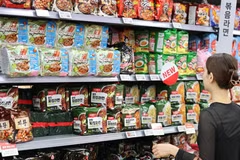
Customers shop for instant noodles at a retail store in Seoul, the Republic of Korea. (Photo: YONHAP/VNA)

RoK picks Vietnam as K-Food logistics hub for ASEAN expansion

Demand for Korean food in Vietnam has continued to grow rapidly alongside the popularity of the Korean Wave, or Hallyu, making the country a strategic market in the RoK's plan to expand agricultural and food exports to ASEAN, the RoK's Ministry of Agriculture, Food and Rural Affairs said.