RoK picks Vietnam as K-Food logistics hub for ASEAN expansion

Demand for Korean food in Vietnam has continued to grow rapidly alongside the popularity of the Korean Wave, or Hallyu, making the country a strategic market in the RoK's plan to expand agricultural and food exports to ASEAN, the RoK's Ministry of Agriculture, Food and Rural Affairs said.

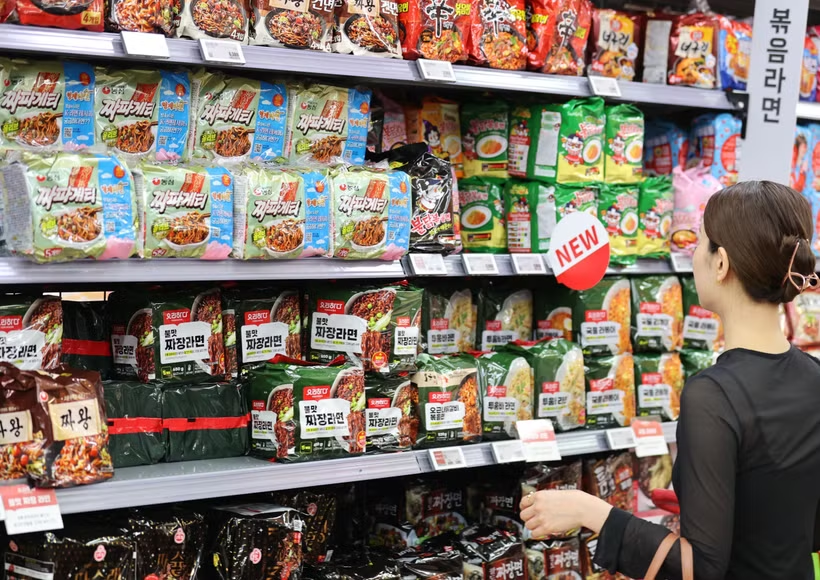
Customers shop for instant noodles at a retail store in Seoul, the Republic of Korea. (Photo: YONHAP/VNA)

Seoul (VNA) – The Republic of Korea (RoK) has selected Vietnam as a strategic hub for expanding its logistics, distribution and supply chain network for Korean food (K-Food) across the Association of Southeast Asian Nations (ASEAN).

The RoK's Ministry of Agriculture, Food and Rural Affairs (MAFRA) announced the plan on July 7 following the ASEAN K-Food Fair 2026, which took place in Hanoi on July 2–3. Vietnam is currently the RoK’s fourth-largest agri-food export market.

Demand for Korean food in Vietnam has continued to grow rapidly alongside the popularity of the Korean Wave, or Hallyu, making the country a strategic market in the RoK's plan to expand agricultural and food exports to ASEAN, the ministry said.

To strengthen its competitiveness, the RoK will accelerate the modernisation of its logistics system in Vietnam. The centrepiece is a comprehensive logistics centre in Hanoi, which began operations in June. The facility includes conventional storage as well as freezing, rapid-chilling, and cold-chain systems, enabling the preservation of quality for fresh agricultural products such as strawberries, grapes, and pears, as well as livestock products.

The RoK Government will also expand its V-Express programme, which supports the entire export process, while combining logistics and marketing assistance to reduce import and transportation costs. At the same time, it plans to step up both online and offline promotional activities in the Vietnamese market.

Another key pillar of the new strategy is shifting from a business-to-consumer (B2C) sales model to greater business-to-business (B2B) cooperation.

According to a survey by the ministry, demand in Vietnam is rising rapidly for processed foods, convenience foods, Korean-style sauces and ingredients used in Korean street food. In response, the RoK will promote large-scale supplies of food ingredients and sauces for restaurants, food service chains and institutional kitchens, rather than focusing primarily on supermarket sales as in the past.

The ministry has also held discussions with K-Mart, a Korean supermarket chain operating more than 150 stores in Vietnam, on using the company's logistics and distribution infrastructure to launch joint marketing programmes and expand the K-Food supply chain from Vietnam to neighbouring markets, including Cambodia and Laos.

During the ASEAN K-Food Fair 2026, 45 Korean agricultural and food exporters met with 107 importers from ASEAN member states, resulting in the signing of 46 memoranda of understanding worth a combined 21 million USD.

Consumer experience activities also attracted strong public interest, with Halal food, Korean street food, fresh agricultural products and the "Han River ramen" experience zone among the most popular attractions.

Jeong Gyeong-seok, Director General for Food Industry Policy at MAFRA, described Vietnam as a strategic base for expanding exports of Korean fresh produce and food ingredients. He said the RoK will continue to leverage the Hanoi logistics centre and major distribution networks to expand the K-Food supply chain not only in Vietnam but across ASEAN./.

VNA

See more

A shopper at a supermarket in Hanoi. (Photo: VNA)

Supermarkets expand promotion of OCOP, Vietnamese products

The campaign is expected to stimulate domestic consumption, boost retail sales, support economic growth, promote Vietnamese brands and encourage consumers to prioritise locally made products while attracting international visitors via shopping events.

Vietnamese Ambassador to Brazil Bui Van Nghi speaks at the seminar. (Photo: VNA)

Vietnam, Brazil seek ways to promote trade, investment cooperation

Vietnamese Ambassador to Brazil Bui Van Nghi informed that two-way trade reached 4.22 billion USD in the first six months of 2026, up 16.8% year-on-year. Brazil's exports to Vietnam exceeded 2 billion USD, rising 16.6%, while its imports from Vietnam totalled about 2.11 billion USD, an increase of 17%.

Wave Alpha, Honda Vietnam’s best-selling manual motorcycle model each month. (Photo: Bnews/VNA)

Honda Vietnam posts strong car sales growth, leads motorcycle market

The company sold 172,299 motorcycles in June, up 4.7% from the same month last year, highlighting steady consumer demand even as the market gradually shifts towards greener transport options. For the first six months of 2026, motorcycle sales reached 515,743 units, up 0.6% year-on-year.

Rice harvest in Xuan Giang commune, Ninh Binh province. (Photo: VNA)

Plan issued to develop agricultural logistics system

A key target is that by 2030, all concentrated agricultural, forestry and fisheries production areas will have access to essential services, including product traceability, quarantine, testing, quality certification, processing and market development. The move reflects growing international demand for stricter food safety, quality and traceability standards, which have become increasingly important for agricultural exports.

Delegates at the signing ceremony (Photo: VNA)

Vietnam, RoK boost micro-business cooperation

Vietnam's young population, dynamic market, and big growth potential are a perfect fit for the strengths that Korean micro-businesses bring in K-brands, technology, and service expertise, said KFME President Song Chi Young.

Cars at a public parking lot in Hai Phong city. (Photo: VNA)

Vietnam's auto sales rise 15%, hybrid, imported vehicles continue to outperform

With auto loan interest rates remaining competitive, stable vehicle supply, and an increasingly diverse product range, Vietnam's automotive market is expected to maintain its growth momentum through the remainder of 2026. SUVs, MPVs, and hybrid vehicles are likely to remain the main drivers of overall market sales.