Ho Chi Minh City (VNA) – Ho Chi Minh City is banking on new growth drivers, faster public investment disbursement and higher-quality foreign investment to achieve its target of double-digit economic growth in 2026.
The city's gross regional domestic product (GRDP) expanded 8.55% in the first half of the year, the highest six-month growth rate in a decade. However, officials said the city must grow by more than 11% in the third quarter and about 12% in the fourth quarter to meet its annual target.
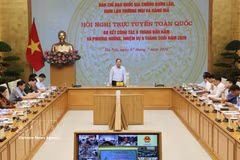
Speaking at the seventh conference of the municipal Party Committee for the 2025–2030 term on July 6, Secretary Tran Luu Quang stressed that the goal would be difficult to be achieved without breakthrough measures and new approaches. He called on the city's political system to focus on three priorities: maintaining double-digit growth, collecting 1 quadrillion VND (over 38 billion USD) in budget revenue, and fully disbursing public investment this year.
Truong Minh Huy Vu, Director of the Ho Chi Minh City Institute for Development Studies, said experiences in previous years show that growth in the final two quarters is often 0.7–1.3% higher than in the first two. If that pattern continues, the fastest possible economic pace for this year is only more than 9%, still falling short of expectations. Therefore, the city needs more new growth drivers.
He perceived that a focal task is to accelerate the circulation of both public and private capital. Public investment disbursement has reached only about 35% of the annual plan and needs further acceleration to fulfil the 100% target. Meanwhile, many strategic infrastructure projects, including those of private investors, started construction in the first half and are expected to gather momentum in the second half.
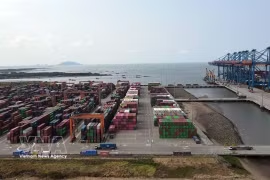
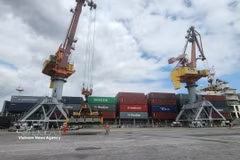
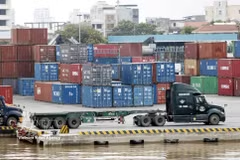
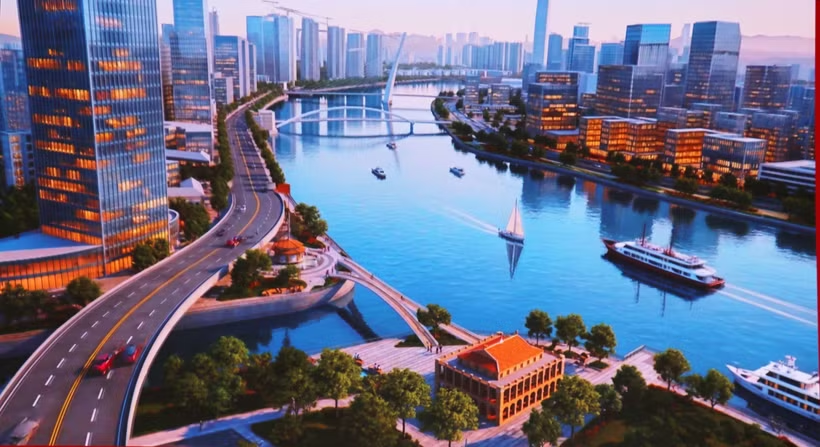
The southern metropolis also is counting on three new growth engines stemming from its expanded development space: the marine economy and logistics, supported by major port developments; the International Financial Centre, which is expected to attract global investment funds and financing; and science, technology, innovation and digital transformation, Vu noted.
Foreign direct investment (FDI) is also hoped to contribute substantially to second-half economic expansion.
Ho Chi Minh City attracted about 7.5 billion USD in registered FDI in the first six months, up 89.68% year-on-year, while more than 31,166 new businesses were established, up 14.27%.
Director of the municipal Finance Department Hoang Vu Thanh said the city will shift from prioritising the quantity of FDI to improving its quality by targeting strategic investors, multinational corporations, investment funds and technology firms. The focus will be on projects that generate technology spillovers, strengthen links with domestic enterprises and support green, digital and sustainable development.
The city aims to mobilise more than 1.24 quadrillion VND in total social investment in 2026, with FDI expected to account for about 21%.
Thanh said faster disbursement and stronger integration between foreign-invested and domestic businesses will be crucial to securing growth of above 10% in the coming time./.
VNA