Vietnam upgrades seaport network to strengthen maritime competitiveness

The country's growing maritime standing was highlighted in the Container Port Performance Index (CPPI) 2025, jointly released by the World Bank (WB) and S&P Global Market Intelligence. For the second consecutive year, Cai Mep Port and Hai Phong Port ranked among the world's 20 most efficient container ports, with Cai Mep placed 11th and Hai Phong 13th.

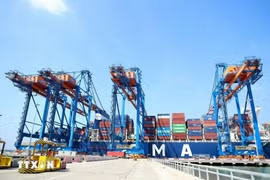
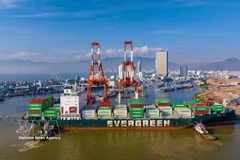
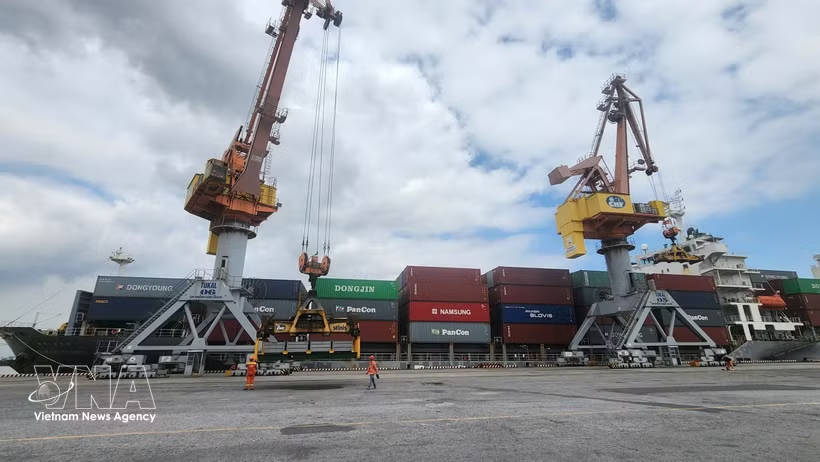
Hai Phong Port ensures a smooth flow of goods (Photo: VNA)

Hanoi (VNA) – Vietnam is accelerating the development of its seaport system and multimodal transport network as part of its strategy to become a strong maritime nation under the Party Central Committee’s Resolution No. 36-NQ/TW on the sustainable development of the marine economy to 2030, with a vision to 2045.

The country's growing maritime standing was highlighted in the Container Port Performance Index (CPPI) 2025, jointly released by the World Bank (WB) and S&P Global Market Intelligence. For the second consecutive year, Cai Mep Port and Hai Phong Port ranked among the world's 20 most efficient container ports, with Cai Mep placed 11th and Hai Phong 13th.

Hai Phong city has emerged as one of Vietnam's key logistics hubs thanks to an integrated transport network combining expressways, an international airport, a planned high-speed railway and a deep-water port capable of handling vessels of more than 200,000 deadweight tonnes (DWT) with direct connections to Europe and the Americas.

The city's port infrastructure expanded further in 2025 with the inauguration of the privately funded Hateco Hai Phong International Container Terminal (HHIT), which can simultaneously accommodate two container ships of up to 200,000 DWT. Hai Phong Port Joint Stock Company also commissioned Berths No. 3 and No. 4 at Lach Huyen Port, adding up to 1.5 million TEUs in annual handling capacity.

Director of the Vietnam Maritime and Waterways Administration Le Do Muoi said policies encouraging private investment have enabled Vietnam's seaport system to make significant strides, enhancing the country's position on the global maritime map.

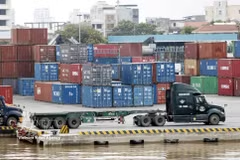
In the first half of this year, cargo throughput via Vietnam's seaports and inland waterways reached an estimated 687.5 million tonnes, up 18% year-on-year, while container throughput rose 12% to around 18 million TEUs.

Under the adjusted master plan for the seaport system for 2021–2030 with a vision to 2050, Vietnam is expected to invest more than 359 trillion VND (nearly 13.7 billion USD) in its port network.

Deputy Minister of Construction Nguyen Xuan Sang said investments by leading global port operators, including APM Terminals, PSA International and SSA Marine, have helped build a modern port system capable of receiving some of the world's largest vessels, with capacities exceeding 200,000 DWT.

He said placing seaports at the centre of logistics connectivity, promoting digital and green transformation, and developing a national logistics database are key to building an efficient and sustainable multimodal transport system. The Ministry of Construction is also finalising transport plans covering all five transport modes, while a draft Vietnam Maritime and Waterways Code introduces policies to strengthen multimodal transport and encourage greater private-sector participation.

According to the UN Trade and Development (UNCTAD), 80–90% of global merchandise trade is transported by sea, making seaports the backbone of international logistics networks linking maritime, road, rail, inland waterway and air transport.

Vietnam now has 34 seaports with 320 berths, handling more than 960 million tonnes of cargo in 2025, placing the country among the region's fastest-growing maritime markets.

Despite the progress, challenges remain, including inadequate maritime infrastructure in some localities, fragmented transport links and relatively high logistics costs.

To address these issues, the maritime sector is prioritising the development of seaports into national transport hubs, expanding multimodal connectivity and adopting integrated, data-driven logistics management. Industry representatives have also called for greater investment in rail and inland waterway links, inland container depots, logistics centres and a national logistics data platform to improve connectivity and enhance the efficiency of Vietnam's transport network./.

VNA
See more

Exports are one of the key drivers of Vietnam’s economic growth. (Photo: VNA)

Vietnam’s economic momentum reflected in new income status

According to the WB, this performance was driven primarily by a robust recovery in exports, which expanded by more than 15% during 2024–2025, and by the country’s ability to sustain strong GDP growth of 7% and 8% in two consecutive years.

Pomelo is one of the five key fruit crops in Dong Nai province. (Photo: VNA)

Agro-forestry-fishery exports poised for stronger growth

By safeguarding key production areas, expanding deep processing, promoting green production and improving climate resilience, Vietnam's agro-forestry-fishery sector will be better positioned to sustain export growth and further expand its global market share.

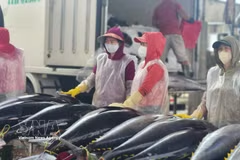
Israel is Vietnam's largest importer of tuna in the Middle East. (Photo: VNA)

Vietnam-Israel trade set to approach 4 billion USD

Israel views Vietnam as a highly promising market of more than 100 million people and an increasingly important global manufacturing hub. Both countries identified artificial intelligence (AI), cybersecurity, agricultural technology, health care and innovation as key areas for future collaboration.

Corporate employees at Trang Due Industrial Park, Hai Phong city, register for personal income tax refunds. New tax deductions have been added to the 2025 Law on Personal Income Tax. (Photo: VNA)

Government specifies new personal income tax deductions

A taxpayer without dependents can be eligible for deductions of up to 19.4 million VND (737 USD) per month, while those with one dependent can deduct up to 25.6 million VND (974 USD) per month, if certain expenses are incurred.

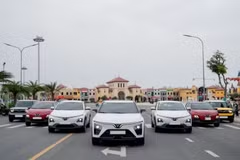
VinFast EV models. (Photo: Vinfast)

VinFast launches VF 2 urban EV priced at 7,200 USD

Vietnamese electric vehicle maker VinFast on July 5 unveiled the VF 2, a compact urban electric car priced at 188 million VND (7,200 USD), including the battery, as part of its strategy to make car ownership more accessible for Vietnamese consumers.

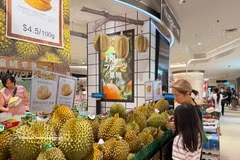
A durian stall at APITA supermarket (Photo: VNA)

Vietnamese food wins over consumers in Hong Kong

Hong Kong remained Vietnam's fifth-largest foreign investor in 2025. Bilateral trade also recorded remarkable growth of more than 70% during the year, with Vietnam's exports to Hong Kong surging by over 90%, making Vietnam the third-largest exporter to the market after mainland China and Taiwan (China).

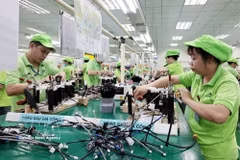
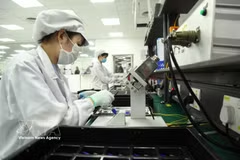
A production line for electrical wire harness assemblies at Bandai Company (Photo: VNA)

Manufacturing remains key driver of Vietnam’s economic growth in H1: NSO

The strongest first-half industrial growth since 2019 not only underscores the sector's solid recovery but also provides a firm foundation for Vietnam to sustain robust economic growth throughout 2026. With manufacturing continuing to lead, supported by improving demand, employment and production capacity, industry is expected to remain a key pillar of economic expansion.

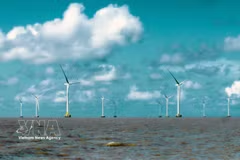
Off the coast of Ca Mau province, average wind speeds of 6.3–7 metres per second at heights of 80–100 metres provide favourable conditions for offshore wind development, with stronger winds further offshore. (Photo: VNA)

Offshore wind poised to power Vietnam's marine economy

Resolution No. 36-NQ/TW on Vietnam’s Sustainable Marine Economic Development Strategy until 2030, with a vision to 2045, calls for a green, modern and innovation-driven marine economy built on science and technology. Within this framework, offshore wind has been identified as a strategic sector capable of creating new growth momentum.

A screenshoot of the Objectif Eco article (Photo released by VNA)

Vietnam, EU move towards high-quality economic partnership

The article also highlighted the elevation of Vietnam–EU relations to a comprehensive strategic partnership in early 2026, arguing that the upgraded framework would provide fresh momentum for cooperation in trade, investment, digital transformation, the green transition, energy, climate action and supply chain resilience.

Representatives from CPTPP members attend the online CPTPP ministerial meeting and the 10th meeting of the CPTPP Commission on June 26. (Photo: moit.gov.vn)

Vietnam advances CPTPP agenda as 2026 Chair

Vietnam, as the 2026 CPTPP Chair, hosted the online CPTPP ministerial meeting and the 10th meeting of the CPTPP Commission on June 26, reported the Ministry of Industry and Trade.

A woman shops at the Vietnamese goods section of Co.opmart Ly Thuong Kiet supermarket in Ho Chi Minh City. (Photo: VNA)

Retail sales, consumer services up nearly 13% in first half

In the first six months, total retail sales and consumer service revenue amounted to an estimated 3,889.5 trillion VND, up 12.9% year-on-year. After excluding price factors, real growth stood at 7.3%, reflecting a solid recovery in domestic purchasing power and consumer demand.

An electrical wiring harness production line at Bandai Company (Photo: VNA)

FDI disbursement hits five-year high in H1

As of June 30, total registered FDI, including newly registered capital, additional capital for existing projects and foreign investors' capital contributions and share purchases, rose 61% year-on-year to 34.65 billion USD.