Nearly 20,000 smuggling, counterfeit cases handled in H1

The domestic market remained generally stable during the period, but smuggling, commercial fraud and counterfeits remained complex across many sectors and localities.

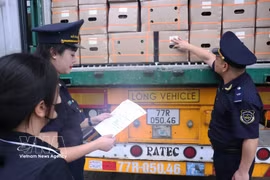
Customs officers use sniffer dogs to inspect the luggage of passengers entering Vietnam through the Nam Can International Border Gate in Nghe An province. (Photo: VNA)

Hanoi (VNA) – Market surveillance authorities across Vietnam processed nearly 20,000 cases involving smuggling, trade fraud and counterfeit goods in the first six months of 2026, according to the Ministry of Industry and Trade (MoIT).

The MoIT's Agency for Domestic Market Surveillance and Development, which is the standing body of the ministry's Steering Committee 389 on anti-smuggling, trade fraud and counterfeits, said the domestic market remained generally stable during the period, with adequate supplies of essential goods meeting production, business and consumer demand.

However, it noted, smuggling, commercial fraud and counterfeits remained complex across many sectors and localities.

Statistics show that enforcement forces under Steering Committee 389 inspected 23,715 cases in the first half of the year, uncovering 19,937 cases with 22,669 violations.

The crackdown generated more than 330 billion VND (over 12.5 million USD) for the state budget, including nearly 306 billion VND in administrative fines, over 14 billion VND in illicit gains and other revenues, and more than 18 billion VND from the auction of confiscated goods.

The total value of goods seized reached nearly 209 billion VND, including almost 82 billion VND in confiscated products and more than 127 billion VND worth of destroyed goods.

Specifically, in the fuel sector, market surveillance forces examined 179 cases and handled 84 of them, collecting more than 5 billion VND for the state budget. Common offences included failing to maintain mandatory minimum fuel reserves, operating outside the scope of business licences, and selling fuel outside authorised distribution networks.

In the second quarter alone, authorities dealt with nearly 5,400 intellectual property-related cases, imposing administrative fines of almost 66 billion VND. Most involved counterfeit products, trademark infringement, violations of industrial property rights and the sale of goods of unknown origin, particularly through e-commerce channels.

Regarding online commerce, 424 cases involving e-commerce violations were investigated and sanctioned, with total fines of about 7.9 billion VND. Frequent offences included failing to register sales websites and applications, not fully disclosing business information, and trading products without clear origin.

Meanwhile, 2,124 food safety violations were handled, resulting in fines of around 16.9 billion VND. Inspections focused on producers and traders of health supplements, dairy products, confectionery and frozen foods.

The agency noted that illegal activities are increasingly moving into the digital environment, with offenders exploiting social media, e-commerce platforms, express delivery services and transit warehouses to distribute illicit goods while frequently changing transaction accounts and business locations to evade detection.

In response, market surveillance forces stepped up regular and surprise inspections under plans issued by the Government, the MoIT and Steering Committee 389 at all levels. Enforcement efforts focused on high-risk sectors, including counterfeit and smuggled goods, e-commerce, fuel, food safety, tobacco, agricultural inputs and essential commodities.

During the six months, authorities also referred 128 criminal offences to investigation agencies. In addition, the agency received 1,339 hotline calls and 274 email reports, forwarding 29 cases involving counterfeits and IP-related violations to provincial and municipal market surveillance authorities for further action./.

VNA

See more

Consumers buy fruit at a supermarket in Vietnam. (Photo: VNA)

US highlights potential in Vietnam’s fruit market

The US was Vietnam's second-largest supplier of agricultural products, with export turnover reaching 4.7 billion USD in 2025, a remarkable increase from less than 3.5 billion USD in 2024, Fruitnet said, citing a new report by the US Department of Agriculture (USDA).

Vietnamese Ambassador to Thailand Pham Viet Hung (thitd, left) attends the opening ceremony of Grand Halal Bangkok 2026 (Photo: VNA)

Vietnamese firms seek global Halal opportunities at Bangkok exhibition

Ambassador Pham Viet Hung described Grand Halal Bangkok 2026 as an important opportunity for Vietnamese businesses to connect not only with Thailand's Halal industry but also with Halal food producers worldwide, while learning from experience of Thailand and international partners.

Marnufacturing garments for export at Hung Yen Jute and Garment Joint Stock Company. (Photo: VNA)

GDP expands 8.18%, with new growth drivers taking shape

According to the National Statistics Office under the Ministry of Finance, GDP expanded by 8.39% in the second quarter, up from 8.14% a year earlier. Growth for the first six months reached 8.18%, exceeding the 7.63% recorded in the same period of 2025. The performance reflected broad-based contributions from both the supply and demand sides of the economy.

Production line at Honda Vietnam's manufacturing facility in Dong Van II Industrial Park, Ninh Binh province. (Photo: VNA)

Vietnamese economy sustains momentum on strong industrial production

The National Statistics Office (NSO) under the Ministry of Finance reported that the manufacturing and processing sector remained the principal driver of economic growth, accounting for 33.07% of the economy's total value-added growth during the first six months of the year.

Investors conduct transactions at Bao Viet Securities' headquarters in Hanoi. (Photo: VNA)

Vietnam eyes 205.6 billion USD in stock market funding for 2026–2030

Addressing a seminar on restructuring capital mobilisation channels hosted by the Finance and Investment newspaper on July 15, Bui Hoang Hai, Vice Chairman of the State Securities Commission of Vietnam (SSC), said the domestic economy continues to face considerable external challenges in 2026, including the effects from the Middle East conflict.

Workers process farm produce at the Coastal Fisheries Development Company (Cofidec) in Ho Chi Minh City. (Photo: VNA)

Vietnam remains ASEAN’s fastest-growing economy in first half of 2026: experts

Economists at United Overseas Bank (UOB), a Singapore-based multinational bank, said Vietnam’s gross domestic product (GDP) expanded by 8.39% in the second quarter of 2026, from 7.94% in the first quarter. As a result, economic growth for the first half of the year reached 8.18%, keeping Vietnam at the top among ASEAN economies.

The interface of Vietnam's foreign supplier portal for tax registration, declaration and payment by overseas suppliers. (Photo: dientuungdung.vn)

Foreign digital service providers pay nearly 480 million USD in taxes

According to the Department of Taxation, 259 overseas suppliers have registered, declared and paid taxes through the portal. Tax revenue from the group reached 78.1% of the full-year target, surging 119% from a year earlier and making foreign suppliers the fastest-growing source of tax revenue in Vietnam's digital economy.

Ca Mau companies and households use rooftop solar to cut expenses. (Photo: VNA)

Vietnam raises rooftop solar sales cap to 50%, widens direct power deals

Rooftop solar power is entering a new phase of development with a more solid foundation. When integrated with energy storage systems and direct power purchase mechanisms, it not only contributes to supplementing distributed energy sources and reducing pressure on the national power system, but also serves as a driving force for green growth, enhances the competitiveness of the economy, and ensures energy security.

Production of electrical wiring harnesses at Bandai Vietnam Co., Ltd. in the Left Bank Industrial Park, Phu Tho province. (Photo: VNA)

Record FDI Inflows signal strong investor confidence, but absorptive capacity remains key

Vietnam's competitive advantages are evolving. Rather than relying primarily on low labour costs and tax incentives, the country's future competitiveness will increasingly depend on structural and long-term factors, including transparent institutions, policy predictability and an investment environment capable of supporting long-term strategic investors.

Vietnamese Ambassador to the RoK Vu Ho (first, left) and other participants in the conference in Seoul on July 14 (Photo: VNA)

Vietnam, RoK strengthen investment links at Seoul conference

Vietnamese Ambassador to the RoK Vu Ho said bilateral relations are currently enjoying the best conditions, underpinned by what he described as the three key factors of “favourable timing, geographical advantages, and strong public support”.

Electricity generation is monitored at the plant of the Hai Phong Thermal Power Joint Stock Company. (Photo: VNA)

Energy security “shield” must be built in layers: Expert

In an interview recently granted to the Vietnam News Agency, Dr Nguyen Van Tu, General Director of the Vietnam Petroleum Institute (VPI), said petroleum reserves are a critical line of defence, but a genuine energy security “shield” must be built in layers.