Vietnam auto market sees strong growth in EVs

Private passenger vehicles account for the overwhelming majority, with 369,849 battery electric passenger cars in operation, alongside 3,396 electric trucks and 1,571 electric buses.

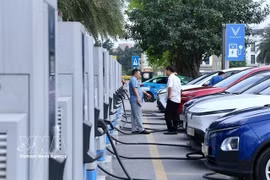
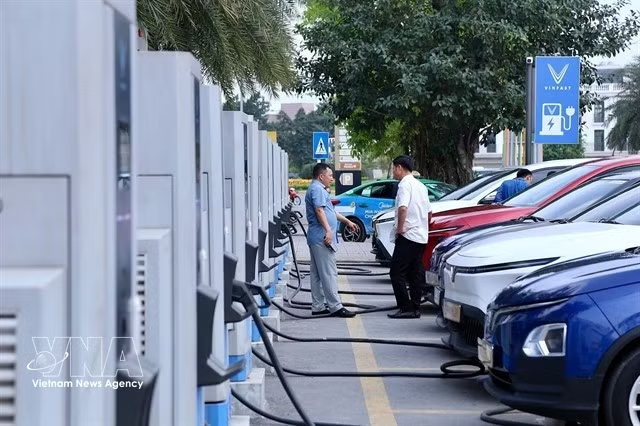
Public charging stations for electric vehicles in in Hanoi (Photo: VNA)


Hanoi (VNS/VNA) - Vietnam’s electric vehicle (EV) market has entered a strong growth phase, with nearly 375,000 EVs (excluding motorbikes) on roads nationwide as of the end of May, according to the Ministry of Construction.

Private passenger vehicles account for the overwhelming majority, with 369,849 battery electric passenger cars in operation, alongside 3,396 electric trucks and 1,571 electric buses.

As personal EVs increasingly dominate the market, the key challenge facing policymakers and businesses is to optimise the supporting ecosystem before the transition to green mobility accelerates further in the next few years.

The dominance of privately owned EVs also reflects a clear market reality: individual consumers have become the primary driving force behind Vietnam’s vehicle electrification.

Their rapid adoption is not only reshaping urban transportation in major cities such as Hanoi and Ho Chi Minh City, but also making a direct contribution to the country’s long-term goals of reducing greenhouse gas emissions and improving air quality.

With nearly 375,000 electric passenger vehicles already on the road, the market has reached a scale large enough to place positive pressure on the entire automotive value chain, from maintenance and repair services to charging infrastructure, while establishing new standards for mobility in Vietnam.

This progress is the result of a coordinated policy framework designed to accelerate the transition toward greener transportation. The Prime Minister’s Decision 876/QD-TTg and the Ministry of Construction’s action plan have provided the legal foundation for Vietnam’s green transport conversion programme.

Clear policy direction from the Government has strengthened confidence among both manufacturers and consumers, encouraging investment and accelerating the adoption of electric mobility.

However, from both a policy and infrastructure perspective, the growing EV fleet also highlights an emerging imbalance between demand and supporting infrastructure.

Feedback from consumers and businesses regarding the shortage of charging stations, lengthy charging times and relatively high vehicle ownership and operating costs points to structural challenges that Vietnam must address to sustain the current pace of growth.

With the EV fleet of 375,000 vehicles, charging stations can no longer be viewed as supplementary infrastructure — they have become an essential component of urban planning.

The Ministry of Construction is reviewing and updating its green energy transition action programme for the transport sector, with a particular focus on expanding green transport infrastructure, placing nationwide charging networks at the centre of future development.

This is a critical step, as infrastructure that fails to keep pace with vehicle adoption could quickly turn early consumer enthusiasm into frustration, ultimately slowing development of the EV market for the long term.

At the same time, the completion of Vietnam’s Smart City Criteria and the development of a Green Smart City framework will provide local governments with important tools to integrate electric mobility into sustainable urban transport systems.

In addition, unless regulators and industry stakeholders establish an appropriate pricing framework for EV charging services – supported by measures such as registration fee incentives and other non-financial benefits – the current growth momentum could gradually weaken after the initial surge in adoption.

Consequently, experts believe urban planners should prioritise two parallel objectives: expanding charging infrastructure while simultaneously developing facilities that support non-motorised transportation, thus creating a more balanced and sustainable mobility ecosystem.

Beyond charging times and vehicle costs, the transition also depends on technological advancement. Next-generation battery technologies, ultra-fast charging solutions and smarter electricity grids are expected to address many of today’s challenges. In this process, the Government will play a critical coordinating role to ensure that the transition remains affordable for mainstream consumers.

Planning for charging infrastructure should not rely solely on the strategies of individual automakers. Instead, charging networks should be developed as shared public infrastructure, comparable to fuel stations or public parking facilities within urban areas.

The Green Smart City Criteria currently being finalised by the Ministry of Construction are expected to require new residential developments and commercial buildings to incorporate EV charging facilities during the design stage, rather than relying on the fragmented approach seen today.

If Vietnam successfully addresses the challenges of infrastructure development and operating costs, it has the potential to emerge as a regional leader in green transportation.

Conversely, failing to synchronise infrastructure expansion with the rapid growth of electric vehicles would represent a missed opportunity to reshape the future of the country’s automotive industry./.

VNA
See more

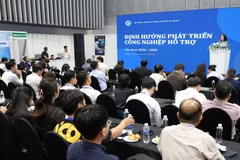
At the Ho Chi Minh City forum on supporting industries (Photo: VNA)

Supporting industries set to drive industrial growth

Supporting industries are no longer simply auxiliary manufacturing sectors. They have become the foundation for enhancing industrial self-reliance, increasing localisation, improving competitiveness and enabling businesses to integrate more deeply into regional and global supply chains.

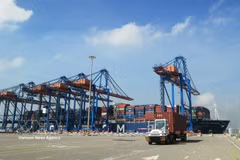
Container trucks operate at the Gemalink International Port, part of the Cai Mep port complex, in Tan Phuoc ward, Ho Chi Minh City (Photo: VNA)

Vietnam's Q2 GDP rises 8.39% amid broad-based economic growth

Releasing the country's socio-economic data for the second quarter and the first half of the year on July 3, NSO Director Nguyen Thi Huong said Vietnam sustained positive growth across most industries and sectors despite a challenging international economic environment.

Trade promotion emerges as a vital bridge connecting businesses, cooperatives and producers with domestic and international markets, helping strengthen the competitiveness of Vietnamese products. (Illustrative photo: VNA)

Trade promotion: Driving Vietnamese products further afield

Hoang Minh Chien, Deputy Director of the Trade Promotion Agency (Vietrade) under the Ministry of Industry and Trade, said trade promotion activities are undergoing a significant shift from broad-based support to more in-depth assistance, with enhancing business competitiveness at the core. Rather than merely facilitating participation in trade fairs or business matching events, current programmes focus on brand building, market intelligence, access to new technologies and compliance with international standards.

Can Gio is positioned as a "green laboratory" for energy transition (Photo: VNA)

Can Gio – a “green laboratory” for energy transition

Ho Chi Minh City is entering a new phase of development with the ambition of becoming a green, modern and smart global metropolis, in line with the spirit of the Politburo's Resolution No. 09 on building and developing the city in a new era.

Kärcher Vietnam Technology Co., Ltd. inaugurates a cleaning equipment factory (second phase) in Da Nang city, with an investment of about 484 billion VND (18.41 million USD) on July 2, 2026. (Photo: VNA)

Kärcher expands Vietnam production of cleaning equipment

Construction of the new facility, located at the Tam Hiep Port Logistics and Industrial Park in the Chu Lai Open Economic Zone, began in July 2025. Equipped with advanced manufacturing technologies, it is designed to produce cleaning equipment that meets international standards for quality, safety and sustainability.

Deputy Minister of Industry and Trade Nguyen Sinh Nhat Tan (centre) and representatives of the European Free Trade Association (EFTA) member states attend the EFTA Ministerial Meeting in Iceland. (Photo: tapchicongthuong.vn)

Vietnam, EFTA wrap up negotiations on free trade agreement

The conclusion of the negotiations will mark the beginning of a new phase of cooperation, laying a solid foundation for the promotion of trade and investment between the two sides, while also expanding collaboration in areas of mutual interest.

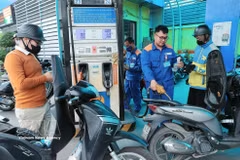
Customers purchase fuel at a Petrolimex service station. (Photo: VNA)

Petrol prices cut from 16:00 on July 2

Accordingly, the price of E5 RON92 petrol is capped at 19,730 VND (0.75 USD) per litre, down 1,055 VND, while E10 RON95-III is priced at no more than 20,415 VND per litre, down 788 VND.

Cargo at Lach Huyen Container Terminal in Hai Phong city (Photo: VNA)

World Bank upgrades Vietnam to upper-middle-income status

According to the World Bank’s latest update released on July 1, Vietnam’s gross national income (GNI) per capita reached 4,970 USD in 2025, exceeding the institution’s 4,636 USD threshold for upper-middle-income economies.

Agricultural and OCOP products of Nhan Co commune in Lam Dong province have been digitally catalogued, equipped with QR codes for origin tracing, and listed on e-commerce platforms. (Photo: VNA)

New E-Commerce Law expected to create transparent digital market

With Vietnam’s e-commerce sustaining annual growth of around 20–25% and emerging as one of Southeast Asia’s most dynamic markets, further improving the legal framework, strengthening consumer trust and fostering a fair competitive environment will help make e-commerce one of the key drivers of Vietnam’s digital economy in the near future.

The Hoa Phat Dung Quat steel factory (Photo: VNA)

Vietnamese steelmakers find growth momentum despite export challenges

Vietnam's crude steel output is forecast to reach 27 million tonnes in 2026, up 10% year-on-year. Finished steel production is projected at 33 million tonnes, with domestic consumption of 28 million tonnes and exports of 6 million tonnes. Steel imports are expected to decline, signaling improving domestic production capacity and the growing bite of market management and trade remedy measures.

Farmers harvest coffee in the Central Highlands. Coffee is among the key foreign currency earner of Vietnam. (Photo: VNA)

Agro-forestry-fishery exports rise 6% in first half of 2026

Of the six-month total, agricultural products generated 18.59 billion USD, up 0.2% year-on-year; aquatic products 5.7 billion USD, up 11.4%; forestry products 9.2 billion USD, up 4.6%; livestock products 375.8 million USD, up 34.6%; and salt 7.7 million USD, up 39.8%.