Agro-forestry-fishery exports rise 6% in first half of 2026

Of the six-month total, agricultural products generated 18.59 billion USD, up 0.2% year-on-year; aquatic products 5.7 billion USD, up 11.4%; forestry products 9.2 billion USD, up 4.6%; livestock products 375.8 million USD, up 34.6%; and salt 7.7 million USD, up 39.8%.

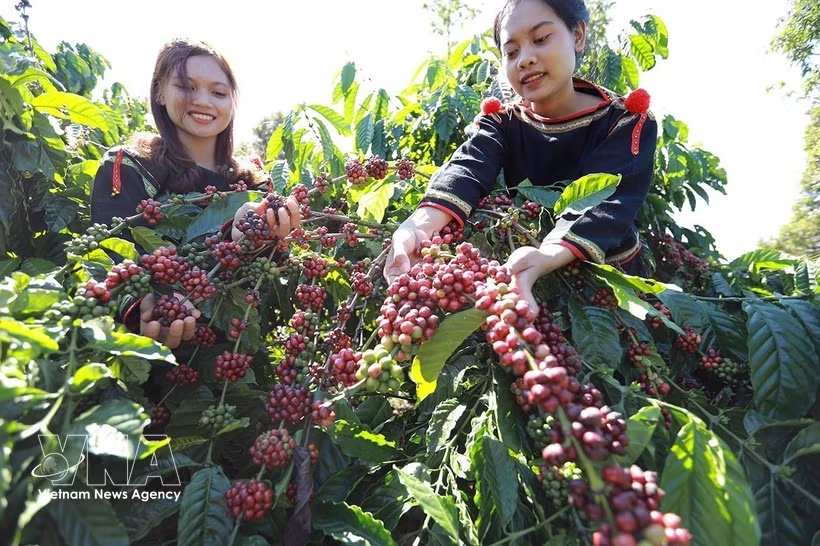
Farmers harvest coffee in the Central Highlands. Coffee is among the key foreign currency earner of Vietnam. (Photo: VNA)

Hanoi (VNA) – Vietnam's agro-forestry-fishery product exports brought home an estimated 35.88 billion USD in the first half of 2026, up 6% year-on-year, according to the Ministry of Agriculture and Environment.

Export turnover in June alone stood at 6.34 billion USD, rising 3% from May and 10.1% from the same month last year.

Of the six-month total, agricultural products generated 18.59 billion USD, up 0.2% year-on-year; aquatic products 5.7 billion USD, up 11.4%; forestry products 9.2 billion USD, up 4.6%; livestock products 375.8 million USD, up 34.6%; and salt 7.7 million USD, up 39.8%.

Despite the export growth, the sector's trade surplus narrowed to an estimated 9.2 billion USD, down 7.7% from a year earlier.

Forestry recorded the largest trade surplus of 7.36 billion USD, up 1.4%, followed by aquatic products at 4.13 billion USD, up 17%. Agricultural products posted a surplus of 1.51 billion USD, a sharp decline of 60.6% year-on-year.

Among individual commodities, six recorded trade surpluses exceeding 1 billion USD. Timber and wood products led the list with 6.73 billion USD, up 0.9%, followed by coffee at 4.58 billion USD despite a 15% decline. Fruit and vegetables, shrimp, rice and tra fish also remained among the top surplus earners.

Asia continued to be Vietnam's largest export market for agro-forestry-fishery products, accounting for 44.4% of total exports during the first six months. The Americas ranked second with 21.4%, followed by Europe with 14.4%. Africa and Oceania represented 2.4% and 1.5%, respectively.

Exports to Asia increased 11% year-on-year while shipments to Europe rose 2.2% and those to Oceania climbed 21.1%. In contrast, exports to the Americas fell 2.3%, and those to Africa dropped 17.3%.

China remained Vietnam's largest export destination, accounting for 21.3% of total turnover, followed by the US with 19% and Japan with 6.8%. Exports to China surged 23.1% while shipments to Japan edged up 1.6%. Exports to the US, however, declined 3.6%.

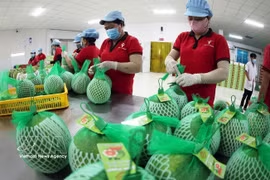
Fruit, vegetables and pepper stood out among Vietnam's key foreign currency earners.

Fruit and vegetable exports rose 17.7% to 3.65 billion USD, with China remaining the largest market, accounting for 51.2% of total exports and recording growth of 27.9%. Shipments to the US and the Republic of Korea also increased by 12.2% and 8.4%, respectively.

As many as 151,900 tonnes of pepper worth 945.9 million USD were shipped abroad during the reviewed period, up 23.3% in volume and 11.6% in value. The US, Germany and Thailand were the largest markets, with exports to Thailand soaring 95.1% and those to the US rising 19.2%.

Rice and coffee both recorded higher export volumes but lower export values due to lower average prices.

Vietnam exported 5.2 million tonnes of rice in the first half of the year, up 9.9%, but export revenue slipped 2.5% to 2.38 billion USD as the average export price fell 11.3% to 459.6 USD per tonne. The Philippines remained the largest buyer, accounting for 45% of total exports while shipments to China jumped 87%.

Coffee exports increased 9.7% in volume to 1.1 million tonnes, but earnings dropped 14.4% to 4.78 billion USD as average prices declined 22% to 4,435 USD per tonne. Germany, Italy and the US were still Vietnam's largest coffee consumers. Meanwhile, shipments to China surged 70.7%.

Cashew exports presented the opposite trend. Export volume fell 1.8% to 338,400 tonnes, but turnover rose 1.6% to 2.39 billion USD thanks to a 3.5% increase in average export prices. China, the US and the Netherlands remained the leading markets.

Cassava and cassava products also saw declines in export volumes but increases in value. Shipments declined 12% to 2 million tonnes, but earnings edged up 2.2% to 701.9 million USD as average prices rose 16.2%. China accounted for 92.4% of the total revenue.

Meanwhile, both rubber and tea witnessed lower export volumes and value. Rubber exports dropped 7.9% in volume to 639,100 tonnes and 4.3% in value to 1.23 billion USD although average export prices increased 3.9%. Tea exports fell 8.1% in volume to 53,200 tonnes and 7.3% in value to 89.5 million USD.

On the import side, Vietnam spent an estimated 26.68 billion USD on agro-forestry-fishery imports in the first six months of 2026, up 11.7% year-on-year.

Imports of livestock, forestry and agricultural products all posted double-digit growth, the ministry reported./.
VNA

See more

Agricultural and OCOP products of Nhan Co commune in Lam Dong province have been digitally catalogued, equipped with QR codes for origin tracing, and listed on e-commerce platforms. (Photo: VNA)

New E-Commerce Law expected to create transparent digital market

With Vietnam’s e-commerce sustaining annual growth of around 20–25% and emerging as one of Southeast Asia’s most dynamic markets, further improving the legal framework, strengthening consumer trust and fostering a fair competitive environment will help make e-commerce one of the key drivers of Vietnam’s digital economy in the near future.

The Hoa Phat Dung Quat steel factory (Photo: VNA)

Vietnamese steelmakers find growth momentum despite export challenges

Vietnam's crude steel output is forecast to reach 27 million tonnes in 2026, up 10% year-on-year. Finished steel production is projected at 33 million tonnes, with domestic consumption of 28 million tonnes and exports of 6 million tonnes. Steel imports are expected to decline, signaling improving domestic production capacity and the growing bite of market management and trade remedy measures.

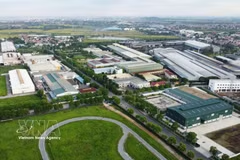
A view of the Binh Xuyen Industrial Park in Phu Tho province. (Photo: VNA)

📝 OP-ED: A new mindset on FDI – Vietnam’s answer to unfounded doubts

The resolution sends a clear and forceful signal of the Party’s consistent policy that the foreign-invested sector is an integral component of the national economy – one that is encouraged to develop over the long term, treated on an equal footing and expected to work alongside other sectors in pursuit of the country’s development goals.

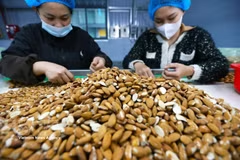
Workers sort and process almonds for export at the factory of Gold Tree Food Vietnam Co., Ltd., a wholly Chinese-owned company, in Tu Ha Industrial Park, Hue city. (Photo: VNA)

Vietnam moves to tackle double challenge in FDI attraction in next phase

The challenge was seen in the Politburo's Resolution No. 10-NQ/TW on developing the foreign-invested sector, which sets ambitious targets for the 2026–2030 period. Vietnam aims to attract 200–300 billion USD in registered FDI, equivalent to 40–50 billion USD annually, while disbursed capital is expected to reach 150–200 billion USD, or 30–40 billion USD each year.

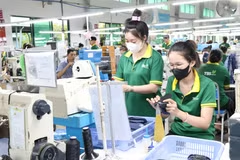
Workers at the Lefaso Tra Vinh Industrial Production and Investment JSC in Tra Cu commune, Vinh Long province (Photo: VNA)

New decree details support for FTA ecosystem members

Decree No. 240/2026/ND-CP elaborates on the enforcement of mechanisms and policies to pool resources for building and running that ecosystem and a sectoral export promotion fund, following National Assembly Resolution No. 250/2025/QH15, dated December 10, 2025, that targets sharper global economic integration.

The Hateco Hai Phong International Container Terminal (Photo: VNA)

Hai Phong ports record 11% rise in six-month cargo throughput

A milestone came on June 23, when the MATZ MAERSK, a container vessel with a reduced deadweight of 213,970.8 DWT, safely arrived at Berths No. 5 and 6 of the Lach Huyen port area, operated by Hateco Hai Phong International Container Terminal (HHIT).

Participants in the opening ceremony of the HanoiPrintPack 2026 on July 1 (Photo: VNA)

Hanoi hosts industrial exhibitions showcasing global manufacturing

The events – HanoiPlas 2026, HanoiPrintPack 2026 and Intelligent Asia Hanoi 2026, are being held concurrently for the first time, creating an integrated industrial ecosystem spanning plastics and rubber, printing and packaging, automation, electronics, precision engineering and smart manufacturing.

MTA Vietnam 2026 opens at the Saigon Exhibition and Convention Center (SECC) in Ho Chi Minh City on July 1, 2026. (Photo: VNA)

MTA Vietnam 2026 showcases latest precision engineering technologies

The event showcases advanced manufacturing technologies, equipment and solutions spanning the entire production value chain, including metalworking, sheet metal processing, mould and die manufacturing, welding, CNC machining, laser cutting, automation, metrology, heat treatment, pneumatic systems and next-generation industrial solutions.

Perspective of the Nha Rong Wharf - Khanh Hoi Cultural Park Project and Bach Dang Riverside Green Space (Photo published by VNA)

Ho Chi Minh City launches eight key projects worth 9.6 bln USD

According to the municipal People's Committee, the projects are financed through a combination of public investment, public-private partnerships (PPP) and private capital, reflecting the Government's policy of promoting private sector development.

The Law on E-commerce, which takes effect on July 1, marks a major milestone in strengthening the legal framework for the digital economy (Illustrative image. Source: VNA)

E-commerce Law takes effect on July 1, paving way for more transparent digital marketplace

The law also encourages green e-commerce, more efficient logistics and environmentally friendly packaging, while creating greater opportunities for small and medium-sized enterprises, household businesses and start-ups. E-commerce platforms are now required to verify sellers' identities, disclose information on sellers, products and transaction conditions, proactively detect violations and establish effective complaint-handling mechanisms. Consumer protection has also been reinforced through clearer rules on complaints, refunds, compensation and personal data protection.