Hanoi (VNA) – The Politburo's Resolution 10-NQ/TW on the development of the foreign-invested economic sector does more than usher in a new phase in Vietnam’s foreign direct investment (FDI) policy as it also marks an important shift in development mindset: from attracting capital as an end in itself to selecting and shaping high-quality investment flows linked to innovation, technology transfer and the strengthening of national capabilities.
At the same time, the resolution sends a clear and forceful signal of the Party’s consistent policy that the foreign-invested sector is an integral component of the national economy – one that is encouraged to develop over the long term, treated on an equal footing and expected to work alongside other sectors in pursuit of the country’s development goals.
Against a backdrop of intensifying global competition for investment and the emergence of increasingly distorted allegations surrounding Vietnam’s economic policy direction, the Politburo’s issuance of Resolution 10-NQ/TW carries particular significance. Not only does it establish a renewed development framework for the FDI sector, it also serves as a direct and persuasive response to claims that Vietnam is narrowing the role of foreign investment or favouring certain economic sectors over others.
In recent years, some distorted allegations have sought to portray Vietnam as gradually “turning its back” on foreign-invested enterprises or giving undue preference to state-owned and domestic private businesses. Resolution 10-NQ/TW directly rebuts such ungrounded arguments by affirming that the foreign-invested sector is an inseparable part of the national economy and that the State will continue to encourage its long-term development while ensuring equal treatment and fair competition with other economic sectors.
This commitment to fairness extends beyond the written text and is given concrete expression through the promise that: “The State recognises and protects intellectual property rights, property ownership rights, and investment capital… while ensuring a transparent, stable and highly predictable investment and business environment”.
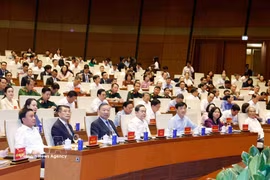
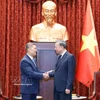
Addressing a national conference on June 30 to study, disseminate and implement Resolution 10-NQ/TW, Party General Secretary and State President To Lam stated: “We create every favourable condition for investors with capability, technology, responsibility and long-term commitment to invest and do business successfully in Vietnam.”
That spirit is further reflected in commitments to safeguard property and intellectual property rights, build a transparent and stable investment environment with greater predictability, and create favourable conditions for capable, technology-driven and long-term investors to operate with confidence in Vietnam. The decision to invite foreign investors, for the first time, to attend a Party conference dedicated to disseminating a resolution also signals a new approach – one making dialogue, partnership and co-creation the foundation of the development process.
Those commitments are grounded in nearly four decades of practical experience in which the FDI sector has accompanied Vietnam’s reform and opening-up process. That experience highlights both substantial contributions and the need for a fresh approach to investment attraction in the country’s next stage of development.
After nearly 40 years of Doi moi (renewal), the contribution of the FDI sector is difficult to dispute. As General Secretary and President Lam observed at the conference, foreign-invested enterprises have continued to expand and have not only supplemented investment resources but also helped drive economic restructuring, transform growth models, establish key industrial sectors and expand export markets. FDI has enabled Vietnam to integrate more deeply into global value chains and has become an important channel for acquiring technology and modern management practices.
Yet alongside these achievements, development realities reveal persistent limitations that require attention. Viewed objectively, the quality of FDI entering Vietnam has yet to match the potential and advantages of one of the world’s dynamic developing economies. The top leader acknowledged this directly: “The quality and effectiveness of attracting, managing and utilising foreign investment remain below the country’s potential and comparative advantages and have yet to meet the development requirements of the new phase.”
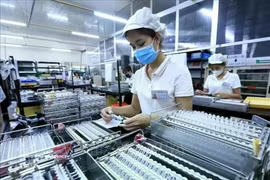
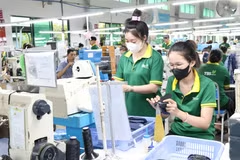
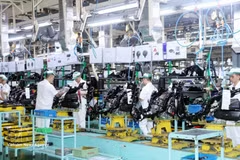
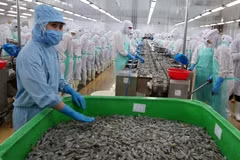
The most significant challenge remains the continued reliance on labour-, land- and resource-intensive investment. Many projects remain concentrated in processing and assembly activities, resulting in relatively low localisation rates and limited value added within Vietnam. Particularly notable is the still-fragile connection between foreign-invested firms and domestic enterprises, which has failed to generate the technological spillover effects once expected. In some localities, competition to attract investment based on volume alone and the acceptance of outdated projects in pursuit of headline growth figures have also created environmental and economic security concerns.
These shortcomings suggest that the broad-based FDI attraction model has reached its limits. Under current conditions, the central question is no longer how much capital Vietnam can attract, but how effectively it can be deployed to strengthen technological capacity, competitiveness and economic self-reliance.
As the Party and State leader suggested at the conference: “Today, Vietnam stands in a different position. We no longer ask how to obtain more foreign capital, instead, we must answer a more difficult question: how to use foreign resources effectively to strengthen internal capabilities, technological capacity, competitiveness and economic autonomy.”
It is from this reality that Resolution 10-NQ/TW establishes a new development philosophy. The resolution identifies the foreign-invested economic sector as an inseparable component of the national economy and an important driver of international integration and access to high-quality resources (capital, technology and management expertise). This represents a transition from a mindset of “attracting capital” to one of “selection and constructive cultivation”.
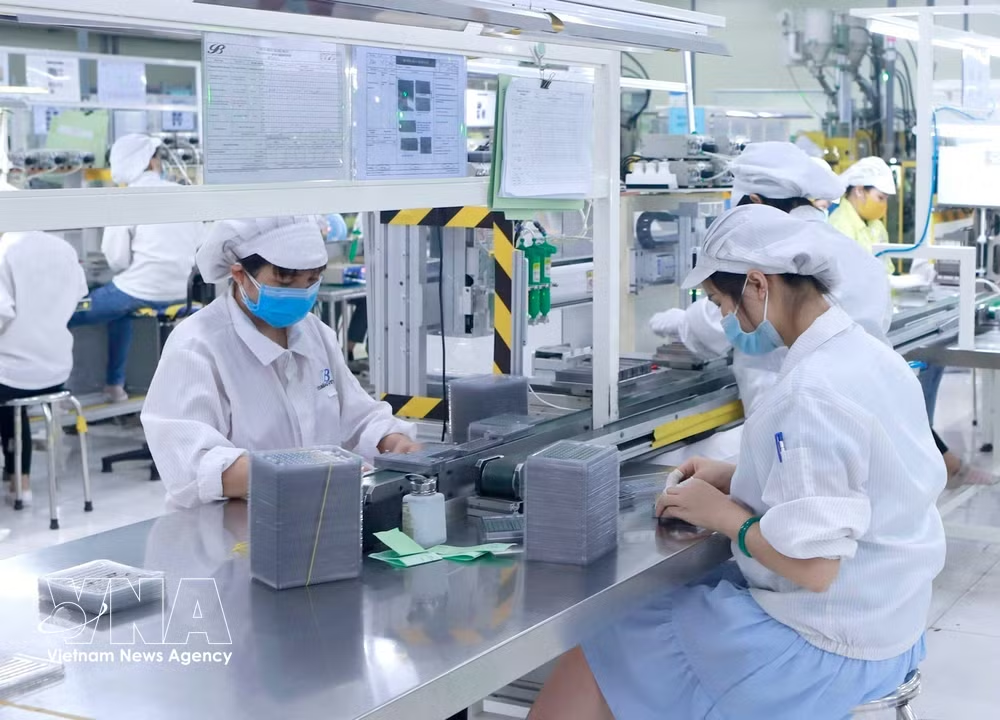
First, the resolution redefines the role of FDI. The foreign-invested sector is no longer viewed as an external “guest”, but as an inseparable part of the national economy, entitled to equal treatment and encouraged to develop over the long term. This constitutes one of the strongest political commitments yet made to the international business community and seeks to remove lingering assumptions of unequal treatment.
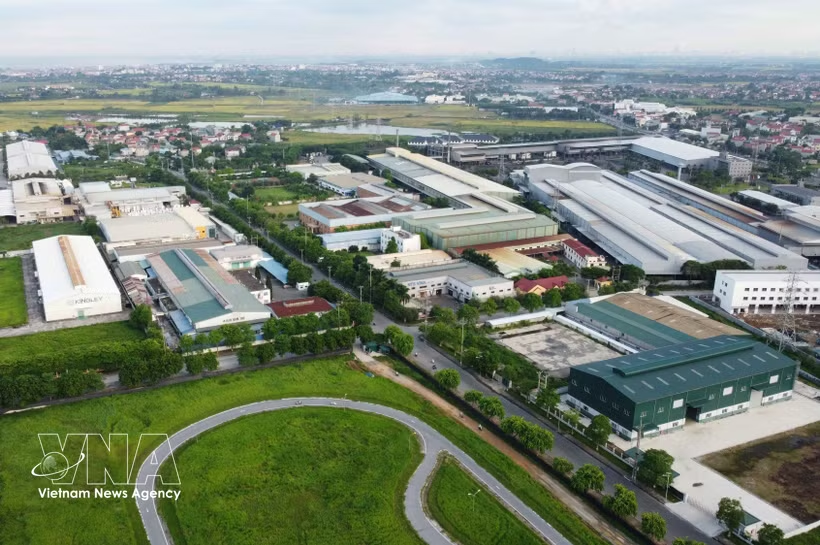
Resolution 10-NQ/TW is also designed to operate in alignment with Resolution 68-NQ/TW on the private economic sector's development and Resolution 79-NQ/TW on the state economic sector's development. By 2045, the objective for the FDI sector is to be closely integrated with both the state and private sectors in helping Vietnam become a developed, high-income country. Within this framework, the FDI sector is expected to contribute around 30% of national GDP. A key feature is the requirement that FDI ecosystem development be linked to a broader strategy for domestic enterprise development. The target of enabling 10,000 Vietnamese firms to participate in FDI supply chains by 2030 reflects an ambition to elevate domestic capacity. The intention is not for FDI to remain isolated “high-tech islands” within an underdeveloped domestic economy, but to act as a force pulling both private and state-owned enterprises forward.
Second, the resolution confirms a shift away from simple capital attraction towards building a “national strategic investment platform”. Vietnam is no longer seeking investment through a logic of simply “filling available space”. Instead, the focus is on industrial clusters, value chains and innovation ecosystems. FDI is to be more closely integrated with capital markets, international financial centres and free trade zones to create broader synergies. The principal criteria have also been redefined: making high technology, value added and the capacity to participate in supply chains as the key benchmarks, rather than relying solely on total registered capital.
Third comes the principle of “no trade-offs”. This message runs throughout General Secretary and President Lam’s guidance: “We do not compete by lowering standards or trading away the environment, natural resources, social welfare and economic security for short-term growth; we must compete through institutional quality, modern infrastructure, highly skilled human capital, low compliance costs, professional public services and a stable, predictable business environment.” The principles of green development, circular economy and social responsibility have been, and continue to be, embedded in legislation as priority criteria for attracting investment.
The new mindet set out in Resolution 10-NQ/TW has the potential to create a significant breakthrough and further enhance the contribution of foreign-invested enterprises to Vietnam’s economy.
Yet turning these ambitions into reality will depend not only on sound policy but also on effective implementation. Vietnam requires a determined and substantive roadmap built around four pillars: institutional and administrative reform; high-quality human capital development; strategic “green and digital” infrastructure; and stronger linkages between domestic and foreign enterprises.
Resolution 10-NQ/TW can therefore be seen as a declaration of Vietnam’s ambition for national prosperity. With targets to attract between 200 - 300 billion USD in the 2026–2030 period, and with the FDI sector expected to contribute around 30% of GDP by 2045, Vietnam is setting demanding but achievable milestones.
To translate the resolution into action, the Party's decisive leadership and effective governance by the Government, ministries and local authorities will be critical. As the top leader emphasised, every cadre and Party member must shift from a “management mindset” to “service-oriented and constructive” one.
Vietnam is seeking to build a fair and modern playing field in which all sources of growth are valued and fully utilised. With alignment in vision and determination in implementation, the FDI sector, together with the state and private sectors, is expected to form a stable three-pillar foundation capable of carrying Vietnam towards its ambitions for 2045.
That, ultimately, is the clearest answer to lingering scepticism and a reaffirmation that Vietnam remains a safe, reliable and promising destination for high-quality global investment./.