E10 biofuel gets off to a promising start after one month of nationwide rollout

Petrolimex supplied nearly 500,000 cubic metres of E10 biofuel during the first month of implementation, equivalent to its average monthly gasoline sales in the first five months of 2026.

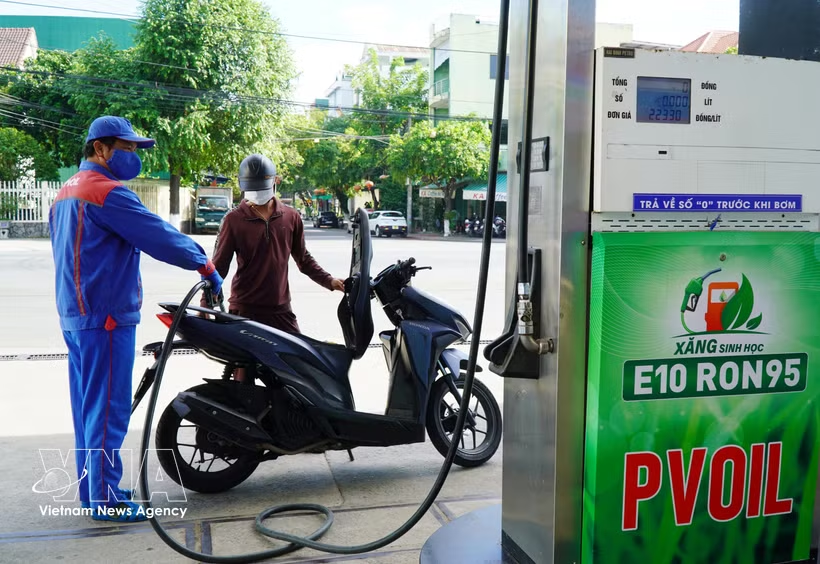
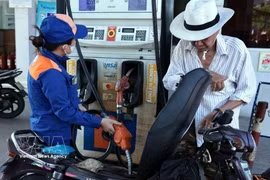
Sales of E10 biofuel gradually reach levels comparable to those previously recorded for conventional RON95 petrol. (Photo: VNA)

Hanoi (VNA) – After one month of nationwide sales, E10 biofuel has shown encouraging early results, with strong public support for the country's clean energy transition and growing consumer confidence in the quality of the new fuel.

Businesses ensure stable E10 supply

According to the Vietnam National Petroleum Group (Petrolimex), the country's largest fuel distributor, the company supplied nearly 500,000 cubic metres of E10 biofuel during the first month of implementation, equivalent to its average monthly gasoline sales in the first five months of 2026. Initial results indicate rising demand for E10, a smooth transition across the retail network and a stable supply without major market disruptions.

To secure sufficient ethanol for blending, Petrolimex prepared its sourcing plans well in advance and maintained close coordination with suppliers to monitor supply, prices and logistics. The company also diversified procurement through both domestic and imported ethanol, using sea and road transport to improve flexibility and reduce dependence on any single supplier.

At the same time, Petrolimex reviewed storage, transportation and blending capacity across its network while strengthening coordination throughout the supply chain to ensure stable, safe and quality-compliant E10 distribution.

The company added that allowing fuel distributors to use designated independent testing organisations and introducing a mechanism to handle remaining stocks of unleaded gasoline before the transition helped remove operational bottlenecks and improve supply flexibility.

Similarly, the PetroVietnam Oil Corporation (PVOIL) said it had upgraded its blending facilities and expanded ethanol storage capacity to around 43,000 cubic metres, sufficient to meet blending demand for about two months. Alongside maximising domestic ethanol supplies, the company has secured imports from the US and Brazil to ensure adequate feedstock for the E10 rollout.

PVOIL has also converted all 13 of its blending facilities from batch-by-batch conformity certification to a system-based certification model, significantly shortening post-blending approval times and improving supply responsiveness. In addition, the company has introduced comprehensive quality management procedures covering blending, storage, distribution and retail to ensure that its E10 and E5 biofuels comply with both corporate standards and Vietnam's national technical regulations.

Representatives of both Petrolimex and PVOIL said they will continue selling E5 RON92 biofuel alongside E10.

Public support and consumer confidence grow

Nguyen Duc Dung, a representative of a transport company in Hanoi, said his business supports the government's policy as E10 contributes to environmental protection and strengthens Vietnam's energy security. However, he noted that E10 has slightly higher fuel consumption than RON95 petrol, affecting operating costs.

He said the company is considering restructuring its fleet, including replacing some vehicles with electric ones. Nevertheless, a more competitive pricing policy for E10 could offset the higher fuel consumption and encourage businesses to continue using the biofuel, he added.

After one month of nationwide implementation, consumer confidence in E10 has also improved markedly. Tran Van Dung, a customer who has been using E10 gasoline at a Petrolimex station on Tran Quang Khai Street in Hanoi, said his Honda CR-V has continued to run smoothly after one month on the biofuel. To assess its impact more thoroughly, he also took the vehicle to an authorised service centre for inspection, where technicians found no abnormalities in the engine or other vehicle components.

According to the Ministry of Industry and Trade (MoIT), nearly all petrol-powered cars and motorcycles currently manufactured, assembled, imported and officially distributed in Vietnam are compatible with both E5 and E10 biofuels under existing technical standards.

Nguyen Thanh Binh, Vice Chairman and Secretary General of the Vietnam Automobile, Motorcycle and Bicycle Association, said E10 has been tested and certified under Vietnam's National Standard TCVN 8401:2024, which is aligned with international ASTM and ISO standards. The Vietnam Association of Motorcycle Manufacturers (VAMM) also said that popular models produced by its members such as Honda, Yamaha, Piaggio, SYM and Suzuki are compatible with Euro 4 and Euro 5-grade E10 RON95 without requiring any technical modifications.

Assoc. Prof. Dr. Pham Huu Tuyen, Director of the Research Centre For Propulsion Systems and Autonomous Vehicles at Hanoi University of Science and Technology, said E10 poses no technical risks to vehicle performance. The fuel has been widely used and tested in many countries for years, including higher ethanol blends such as E20.

He described E10 as a practical solution for Vietnam's transition towards carbon neutrality and greener transport, as it can deliver immediate environmental benefits by utilising the existing vehicle fleet without requiring technical modifications, provided users continue to follow manufacturers' maintenance recommendations.

Fine-tuning E10 pricing mechanism

Since the fuel price adjustment on June 18, 2026, the MoIT and the Ministry of Finance (MoF) have published the reference price for E10 RON95-III, enabling businesses to expand supply more proactively.

However, Petrolimex noted that the initial pricing mechanism still has limitations and should continue to be reviewed and refined to encourage consumers to switch to biofuels while ensuring that businesses' additional costs are adequately reflected, thereby supporting stable supply and the sustainable development of the E10 market.

Nguyen Thanh Nam, Deputy Director General of the MoIT’s Agency for Domestic Market Management and Development, said domestic ethanol production remains insufficient to fully meet long-term demand, making imports necessary. Some blending facilities have yet to become fully operational, while some consumers still have concerns about E10's compatibility with older vehicles and specialised gasoline-powered equipment.

He said the ministry will continue working with other ministries, industry associations and businesses to closely monitor supply and demand for E10, E5, base petrol and fuel ethanol, ensure stable supplies, accelerate the commissioning of remaining blending facilities and strengthen domestic ethanol production capacity.

The MoIT will also step up oversight of ethanol quality, petrol blending, distribution and retail operations, while completing a comprehensive database on vehicle compatibility with E10. It will publish a full list of compatible vehicles and technical guidance for specialised vehicle categories.

At the same time, public communication efforts will be strengthened to provide accurate information and enhance public awareness of the benefits, effectiveness and safety of E10 biofuel./.
VNA

See more

The Law on E-commerce, which takes effect on July 1, marks a major milestone in strengthening the legal framework for the digital economy (Illustrative image. Source: VNA)

E-commerce Law takes effect on July 1, paving way for more transparent digital marketplace

The law also encourages green e-commerce, more efficient logistics and environmentally friendly packaging, while creating greater opportunities for small and medium-sized enterprises, household businesses and start-ups. E-commerce platforms are now required to verify sellers' identities, disclose information on sellers, products and transaction conditions, proactively detect violations and establish effective complaint-handling mechanisms. Consumer protection has also been reinforced through clearer rules on complaints, refunds, compensation and personal data protection.

Delegates sample green durian curry at the event. (Photo: VNA)

Dak Lak puts durian in spotlight with culinary innovation

The event brought together internationally renowned culinary experts and chefs from Vietnam, Thailand and Malaysia – three of the world's leading durian-producing and exporting countries. They presented seven innovative dishes blending Dak Lak durian with the culinary traditions of the three nations, ranging from appetisers and main courses to desserts.

Illustrative Image (Photo: VNA)

Lao Cai border trade surges, durian exports hit record high

Export value through border gates in the northern province of Lao Cai reached 636 million USD during the six-month period, up 62% from a year earlier and accounting for more than half of the province's total border trade. Agricultural products remained the dominant export category, making up over 90% of outbound shipments.

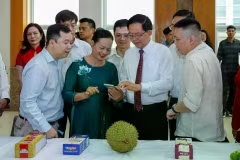
Deputy Prime Minister Ho Quoc Dung and other participants experience Vietnam's agricultural product traceability system on a durian. (Photo: danviet.vn)

National traceability system to strengthen reputation of Vietnamese farm produce: Deputy PM

Deputy Prime Minister Ho Quoc Dung praised the Ministry of Agriculture and Environment for developing and putting the system into operation, saying it would improve transparency across the agricultural supply chain, enable the tracing of product origins and help safeguard the quality and reputation of Vietnamese agricultural products in international markets.

Fireworks over the Han River in Da Nang. The central city is scheduled to host the Vietnam Financial Forum 2026 on July 9–10. (Photo: VNA)

Vietnam Financial Forum 2026 to be held in Da Nang this July

The high-level forum will serve as a platform for in-depth discussions on key issues shaping Vietnam's financial sector, including capital market modernisation, digital finance, financial infrastructure, sustainable investment and venture capital.

Vu Dai Thang, Chairman of the Hanoi People’s Committee, speaks at the national conference on studying, disseminating and implementing the Politburo’s Resolution No. 10-NQ/TW on developing the foreign-invested economic sector, held in Hanoi on June 30, 2026. (Photo: VNA)

Local authorities, FDI businesses propose measures to advance foreign-invested economic sector

Chairman of the Ho Chi Minh City People’s Committee Nguyen Van Duoc proposed priorities linked to the Vietnam International Financial Centre (VIFC) to draw new-generation, high-quality capital flows. These include shifting from a project-attraction approach towards building an investment ecosystem and positioning the IFC as a strategic instrument for implementing Vietnam’s new-generation FDI strategy.

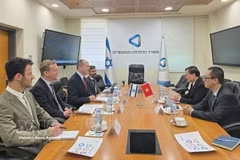
At a working session between Vietnamese Ambassador to Israel Nguyen Ky Son and Israeli Minister of Economy and Industry Nir Barkat. (Photo: VNA)

Vietnam, Israel vow to speed up free trade deal

During January-May, Vietnam-Israel trade neared 1.6 billion USD. Vietnam's exports to Israel jumped 30.6% year-on-year to 462 million USD. If the current growth momentum holds, full-year trade is on track to reach around 3.9 billion USD, with Vietnam's exports set to surpass 1 billion USD for the first time.

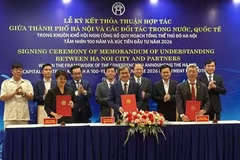
A memorandum of understanding is signed between the Hanoi People's Committee and AMD Vietnam Corporation, SunEdu Joint Stock Company, a member of SunElectronics Group, on cooperation in training and developing high-quality human resources. (Photo courtesy of the organising committee)

Hanoi unveils 276 investment projects under 100-year development vision

According to the municipal People's Committee, Hanoi's investment attraction strategy is shifting from prioritising capital volume to focusing on investment quality. In the coming period, the city will seek strategic investors capable of driving growth through high-value projects in semiconductors, integrated circuit design, artificial intelligence (AI), big data, biotechnology, new materials, research and development (R&D), innovation centres, modern logistics, green finance, financial technology (fintech), education and training, and specialised healthcare.

Shopping via Co.op Online is becoming increasingly popular among consumers. (Photo: sggp.org.vn)

E-commerce helps expand market access for Vietnamese products

E-commerce is becoming an essential pillar of the digital economy as Vietnamese businesses are shifting from online sales to building digital commerce ecosystems, connecting production, logistics, and distribution to expand their markets and participate more deeply in the global value chain.

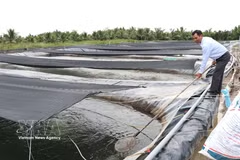
A tilapia fingerling nursery operated by Cuu Long Fisheries JSC in Vinh Kim commune, Vinh Long province. (Photo: VNA)

Vietnam's tilapia exports maintain strong growth

Vietnam's tilapia export revenue in the first five months of 2026 hit 62 million USD, more than doubling that in the same period last year, reflecting a strong recovery in international demand

Authorities in Ho Chi Minh City conduct regular inspections to ensure fishing vessels that fail to meet operational requirements are prevented from sailing to the sea. (Photo: VNA)

Ho Chi Minh City rolls out digital fishing logs in renewed push against IUU fishing

Under the rollout plan, the 234 vessels of 24 metres or more must complete installation before July 1, followed by the 1,963 vehicles between 15 and under 24 metres by September 1, and the 626 others between 12 and under 15 metres by January 1 next year. All the vessels will be required to use the system throughout their fishing trips.

Border guards at the Lao Cai International Border Gate uncover and seize multiple cases involving the illegal transport of foreign currency through the Lao Cai International Road Border Gate. (Photo: VNA)

Vietnam adopts action plan to combat money laundering, terrorist financing

Ministries are required to develop, issue and effectively implement sector-specific policies and action plans by September 2026 to mitigate money laundering risks in line with the national action plan on addressing risks related to money laundering, terrorist financing and proliferation financing for the 2023–2028 period.