Hai Phong (VNS/VNA) - Public-private partnerships are playing an increasingly important role in promoting efficient fertiliser use, helping cut greenhouse gas emissions, improve rice yields and farmers' incomes, while advancing sustainable rice production in Vietnam.
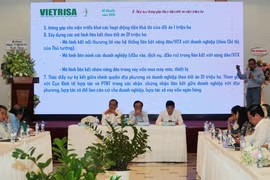
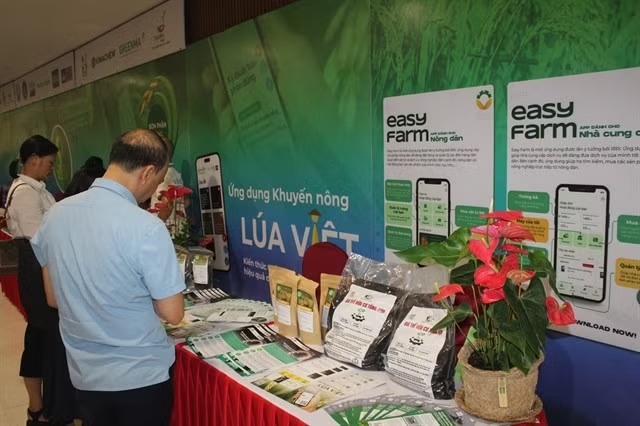
The message was highlighted at a seminar and technology exhibition themed ‘Right Fertiliser Application for High-Efficiency, Low-Emission Rice Cultivation’, jointly organised by the International Rice Research Institute (IRRI) and the Hai Phong Department of Agriculture and Environment on June 30.
The event was held under the USDA-funded Right Fertiliser Use Project, implemented by IRRI in Vietnam. It also supports the Government's low-emission crop production strategy for 2025–35, with a vision to 2050, by improving fertiliser efficiency, boosting productivity and farmers' incomes, and reducing greenhouse gas emissions.
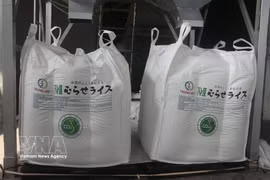
Unlike a conventional technical workshop, the programme served as a platform for public-private collaboration, combining expert discussions with exhibitions showcasing advanced fertilisers, biotechnology, mechanisation and digital farming solutions.
The format enabled farmers, cooperatives and local authorities to directly access new technologies and practical solutions, encouraging wider technology transfer and adoption.
Clemen Gehlhar, senior agricultural programme manager at the US Department of Agriculture (USDA), said improving fertiliser-use efficiency would be essential to building a productive and sustainable agricultural sector.
Through the Right Fertiliser Use Project, USDA is working with IRRI and Vietnamese partners to promote proven technologies that enable farmers to use fertilisers more efficiently, increase incomes and reduce greenhouse gas emissions.
She stressed that close cooperation among government agencies, businesses and farmers would be key to scaling up successful models nationwide.
From the private sector, Le Van Hai, general director of BiOWiSH Vietnam, said the company was collaborating with domestic fertiliser manufacturers to integrate US-developed microbial technology into inorganic and organic fertiliser products.
The combination of local production capacity and biotechnology enhances nutrient uptake, reduces fertiliser losses, improves soil health, increases yields and contributes to lower emissions, supporting the country's sustainable agriculture goals, according to Hai.
Nguyen Van Hung, IRRI's senior science specialist and project leader of the Right Fertiliser Use Project, said the institute was working closely with private-sector partners to develop integrated nutrient management packages combining enhanced fertilisers, biotechnology, mechanisation and digital technologies.
Through these partnerships, IRRI had established sustainable rice production models tailored to different ecological zones, particularly in the Mekong Delta and the Red River Delta.
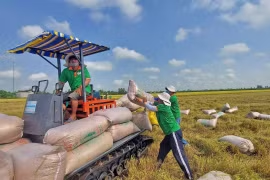
Results from eight pilot models under the Government's one-million-hectare high-quality, low-emission rice programme in the Mekong Delta, together with three pilot sites in the Red River Delta, showed that seeding rates fell by around 50%, nitrogen fertiliser use dropped by at least 30%, and pesticide use declined by about 20%, while farmers' yields and profits increased by more than 10%.
Pham Quoc Trung, general director of MTK/Innovar Ag, said the event demonstrated the value of connecting public agencies, researchers and businesses. Developing next-generation fertilisers based on the principles of ‘right fertiliser application’ would improve nutrient-use efficiency, soil health and overall farm productivity, he said.
A representative of BOF/AMT Import-Export Company said combining inorganic fertilisers, organic fertilisers and biological solutions would offer an effective pathway to improve nutrient efficiency, restore soil quality and reduce emissions in rice cultivation.
The company expressed its commitment to continuing cooperation with IRRI, USDA and other partners through public-private initiatives to foster innovation and green agricultural development.
Scaling up successful models
As one of the Red River Delta's major rice-producing localities, Hai Phong is gradually transforming its crop sector towards higher quality, greater efficiency and stronger environmental sustainability.
Luong Thi Kiem, deputy director of the city's Department of Agriculture and Environment, praised the support of IRRI, USDA and the business community in bringing scientific advances, modern technologies and innovative nutrient management solutions closer to farmers.
She said the event not only facilitated knowledge sharing but also created opportunities for technology transfer and wider adoption of high-efficiency, low-emission rice farming models across the city.
Nguyen Van Khien, chairman of the Farmers' Association of Tan An commune, said farmers were most interested in solutions that are practical, easy to apply and capable of reducing production costs.
Based on the 2026 Spring Crop pilot under the Right Fertiliser Use Project, farmers found that proper nutrient management improved crop growth, increased fertiliser efficiency, lowered input costs and generated higher profits, he said, adding that they hoped to gain greater access to new technologies and products suited to local farming conditions.
Experts at the event agreed that integrating nutrient management, biotechnology, mechanisation and digital technologies would enhance productivity, reduce greenhouse gas emissions and accelerate the transition towards greener, more sustainable rice production./.
VNA