Hanoi (VNS/VNA) - For years, Hanoi has pursued a straightforward solution to its overcrowded urban core: move the universities to the outskirts of the city.
But as campuses shift to satellite towns, students and experts warn that the policy is transferring buildings without creating the communities needed to make the move work.
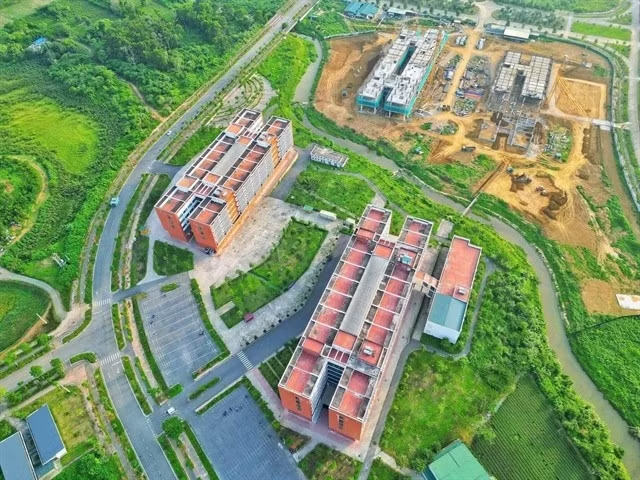
Under city planning guidelines, universities are to gradually relocate to areas such as Hoa Lac, Xuan Mai and Son Tay, where land is plentiful and long-term development is feasible.
Vietnam National University, Hanoi is already expanding its Hoa Lac campus, and other institutions are establishing footholds in the neighbouring provinces of Ninh Binh and Bac Ninh.
The planning rationale is hard to dispute. Inner-city land is scarce, most universities have no room to expand, and arterial roads are chronically gridlocked during peak hours. Relocating thousands of students and faculty would meaningfully reduce pressure on the city centre.
What the plans have been slower to address is what awaits those students at the other end. Le Thi Minh Hang, a student at the Academy of Finance, said the prospect of moving to Hoa Lac left her uneasy.
"My biggest worry is that when something comes up, things won't be as easy to sort out," she said.
Those concerns have real-world weight. Vu Hai Minh, a first-year student living at Hoa Lac, fell ill with food poisoning late one night and could not locate a nearby clinic or pharmacy.
Unfamiliar with the area, he called his family for guidance. He recovered by the following day, but the episode exposed the gaps in basic services that students at newer campuses routinely navigate.
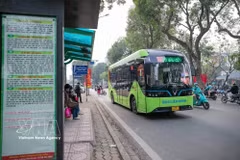
Transport compounds the problem. Bus services connecting Hoa Lac to central Hanoi remain limited in frequency and schedule flexibility. Riding a motorbike means commutes of dozens of kilometres each way.
And part-time work, readily available in the inner city, is scarce in outlying areas, forcing students to choose between forgoing income or continuing to commute for it.
The result is a half-measure: students study on the outskirts but return to the city centre for employment, healthcare and leisure, preserving much of the congestion the policy was designed to relieve.
Associate Professor Nguyen Thuong Lang from the School of Trade and International Economics at the National Economics University said the missing ecosystem is where the current approach falls short.
"The relocation must be student-centred. If we move the campus but not the community around it, we haven't really solved anything," he said.
Lang argued that a genuine university town cannot consist solely of lecture halls and dormitories. It requires healthcare facilities, commercial centres, recreational spaces, libraries, cultural venues and, above all, a local job market that gives students access to internships and part-time work without returning downtown.
Without those elements, peripheral campuses function as isolated enclaves rather than self-sustaining knowledge hubs.
He called on the government to introduce sufficiently attractive incentives – in land use, credit and taxation – to draw private investment into university-zone development and create employment on-site.
Lang also pointed to metro or urban rail connections between central Hanoi and Hoa Lac as essential to cutting commute times and making the distance psychologically manageable.
The relocation drive is irreversible, Lang said, but its success cannot be measured by how many institutions have moved or how much inner-city land has been freed up, only by the quality of life at the destination.
"As long as students study on the outskirts while commuting downtown for work and a social life, the relocation is only half done," he said./.
See more
Hanoi rolls out 2,460 more AI surveillance cameras
The system comprises 1,107 cameras for detecting traffic violations, 960 for vehicle flow monitoring, 112 for intersection monitoring, 251 pan-tilt-zoom (PTZ) cameras and 30 for detecting speed violations. A total of 930 camera poles have been installed at 238 major intersections, gateways and urban areas across the capital.
Remains of Vietnamese martyrs brought home from Cambodia
Over a 105-day mission from March 26 to June 30, Team K72 collected information, conducted field searches and excavations, and recovered the remains of 62 Vietnamese volunteer soldiers and experts in Cambodia's Kratie and Kampong Thom provinces.
Documentary explores legacy behind Ho Chi Minh City's name
Produced by Ho Chi Minh City Television Film Studio (TFS), the documentary pays tribute to the late leader while exploring the historical and emotional significance of the city's name.
New traffic rules to require child safety restraints from August 15
From August 15, drivers carrying children under the age of 10 and shorter than 1.35 metres without appropriate child restraint systems will receive a warning. The requirement does not apply to vehicles used for commercial passenger transportation.
Free bus fares expected to encourage shift away from private vehicles
From July 1, Ho Chi Minh City will waive fares on 134 bus routes, including 109 subsidised and 25 non-subsidised services, with the policy remaining in effect through the end of 2026.
Vietnamese students in Laos pay tribute to war martyrs in Quang Tri
At the memorial monument inside the Quang Tri Ancient Citadel Special National Relic Site, the delegation solemnly offered flowers and incense in memory of heroic martyrs who fought and sacrificed their lives for national independence, freedom and lasting peace.
Photo exhibition showcases Ho Chi Minh City’s 50 years of growth
More than a display of photographs and archival materials, the event serves as an epic narrative, vividly retracing the city’s more than 300-year journey of exploration, development and defence, alongside five decades of achievements under the name Ho Chi Minh City.
French cyclist to ride 19,000 kilometres to Vietnam in mountain challenge
The 29-year-old from France's southeastern Savoie region will begin his expedition on July 6. Rather than taking the shortest route, he has set himself a unique challenge: conquering the highest road pass in every country he crosses before continuing on to Vietnam.
Five decades of Ho Chi Minh City: From people’s aspiration to century growth vision
Over five decades, the southern economic hub has demonstrated resilience, intellect, and a dynamic, innovative spirit worthy of its identity as a heroic city.
Vietnam steps up crackdown on tech-enabled trafficking, online scam rings
The plan aims to mobilise the involvement of the entire political system, ministries, local authorities and the public to combat human trafficking, while implementing key tasks set out in the Prime Minister's Human Trafficking Prevention and Control Programme for 2026–2030, with a vision to 2035, while ensuring the effective enforcement of the 2024 Law on Human Trafficking Prevention and Control (amended in 2025).
Vietnamese professionals, students' association in US unveils new development strategy
The new vision, known as VPS 2.0, is built on three core principles: creating value for the community, promoting decentralised leadership, and empowering individuals and teams to drive positive impact.
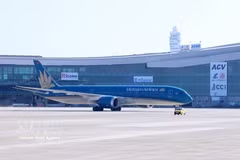
Vietnam Airlines operates special flight carrying rescue teams, relief supplies to Venezuela
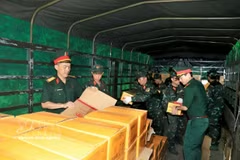
The flight is carrying 124 personnel from the Ministry of National Defence and the Ministry of Public Security, along with 10 search-and-rescue dogs and approximately 25 tonnes of humanitarian supplies, specialised equipment and rescue gear to support relief operations in the earthquake-affected areas.
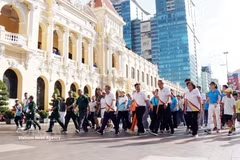
Heritage walk marks 50 years of city bearing President Ho Chi Minh’s name
The event aimed to promote physical exercise movements in the spirit of President Ho Chi Minh's teachings, improve public health, and foster civic pride and a shared sense of responsibility for the city's development.
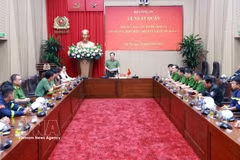
Vietnam's Ministry of Public Security deploys rescue team to Venezuela
Speaking at the ceremony, Deputy Minister Senior Lieutenant General Le Van Tuyen said the deployment reflects not only humanitarian support but also international solidarity and the traditional friendship between Vietnam and Venezuela.
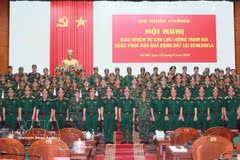
Ministry assigns mission to military relief team heading to earthquake-hit Venezuela
An 82-member military contingent was assigned to carry out humanitarian assistance and disaster relief operations in Venezuela, marking Vietnam’s third overseas military deployment for international disaster response.
Series of events in France honours President Ho Chi Minh
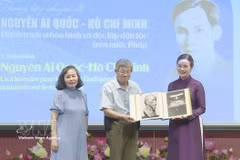
The programme included the opening of a thematic exhibition, the launch of the bilingual Vietnamese–French photo book on Nguyen Ai Quoc – Ho Chi Minh and France, a ceremony to receive archival photographs donated by overseas Vietnamese families who welcomed the late Vietnamese leader during his 1946 visit to the European country, and an artistic performance dedicated to his life and legacy.
Vietnam deploys military disaster relief team to earthquake-hit Venezuela
During the mission, the Vietnamese force will use search dogs to locate victims trapped under collapsed structures, conduct urban search-and-rescue operations, provide emergency medical assistance to survivors, and carry out other humanitarian tasks to help Venezuelan authorities and local communities recover from the disaster.
Border Guard High Command meets with rescue team ahead of mission in Venezuela
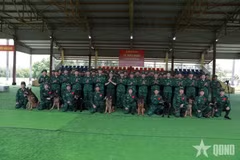
Under a decision by the Ministry of National Defence, Vietnam is dispatching 82 personnel, along with equipment and supplies, to support search-and-rescue efforts and post-earthquake recovery in Venezuela. The Border Guard force contributes a unit comprising 10 personnel and eight search dogs.
Top leader’s letter honours Vietnamese family values
Party General Secretary and State President To Lam wrote that every Vietnamese family will maintain these cherished traditional values through concrete daily actions: respecting grandparents and parents; loving and caring for children; spouses being faithful, equal, and sharing; and generations listening to, respecting, and supporting each other. Preserving the family means preserving family traditions, culture, and the enduring strength of the nation.
Nationwide campaign launched to build drug-free communes, wards and special zones
Drug crimes are becoming increasingly sophisticated and transnational, with criminal organisations making extensive use of digital technology. The fight against drugs must therefore undergo fundamental changes in both mindset and methods, said Deputy Prime Minister Pham Thi Thanh Tra.