Hanoi ready to implement Capital Law 2026, unlocking new development momentum

The effectiveness of the Capital Law 2026 will be measured not by the number of legal documents issued but by tangible improvements in governance and public administration, better services for people and businesses, faster administrative procedures, stronger investment attraction and higher economic growth.

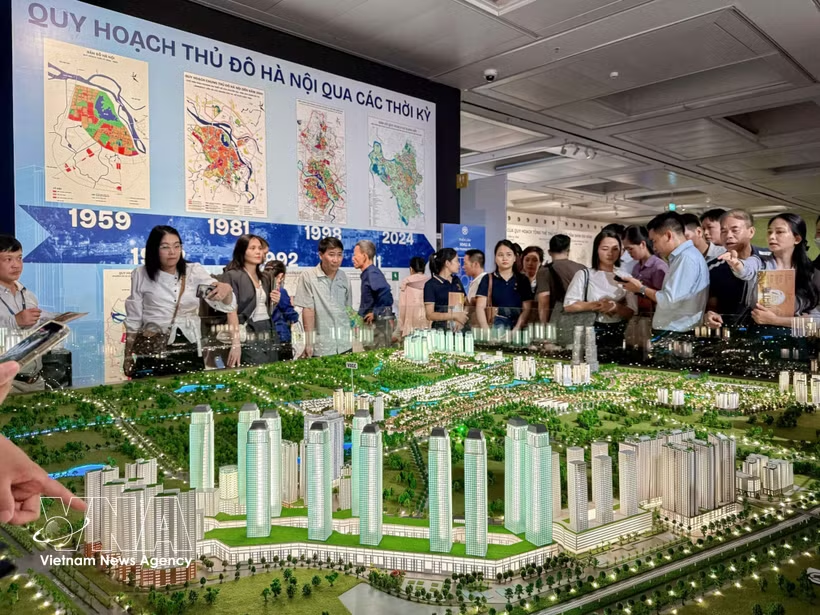
Hanoi residents are interested in exploring the 100-year urban planning vision for the capital city. (Photo: VNA)

Hanoi (VNA) – Hanoi is set to usher in a new phase of development as the Capital Law 2026 takes effect on July 1, introducing an unprecedented set of special mechanisms and policies aimed at expanding the city's development space and reinforcing its role as Vietnam’s political-administrative centre and a key growth engine for the Red River Delta and the country.

More than two months after the National Assembly passed the law on April 23, the city has moved swiftly to complete the institutional, organisational and human resource preparations needed to ensure its immediate implementation.

Early preparations to ensure immediate enforcement

Unlike many previous laws that required lengthy periods for guiding documents to be issued, the Capital Law 2026 has been prepared for immediate enforcement following its adoption. The legislation grants Hanoi an extensive range of special mechanisms and stronger decentralisation, enabling the city to exercise greater autonomy in governance and development.

Shortly after the law was passed, the Standing Board of the Hanoi Party Committee issued a directive on its implementation, while the municipal People's Committee adopted plans to review legal documents, conduct public communication and training, and organise implementation with clearly defined tasks, timelines and responsibilities for each agency. The city also established a dedicated task force to oversee, monitor and inspect implementation to ensure both progress and quality in drafting the guiding documents.

The workload has been substantial. The law introduces new mechanisms covering organisational structure, finance and budget management, investment, planning, urban development, science and technology, culture, environment and talent attraction. To ensure these provisions can be applied immediately upon the law taking effect, Hanoi has simultaneously completed dozens of implementing resolutions and decisions.

Ahead of July 1, the municipal People's Council approved 59 resolutions to implement the law, including 45 adopted during its fourth session, creating a comprehensive policy framework that will take effect simultaneously with the Capital Law. At the same time, the municipal People's Committee issued implementing decisions within its authority, ensuring a complete legal basis for enforcement.

The resolutions adopted by the People's Council go beyond implementing guidance by translating the law into concrete policies on transit-oriented development (TOD), urban renewal and redevelopment, low-emission zones, land management, housing development, investment promotion, science and technology, innovation, digital transformation, green transport, environmental protection and high-quality human resource development. These measures are expected to remove longstanding institutional bottlenecks and create new opportunities for Hanoi's future growth.

Chairman of the Hanoi People's Committee Vu Dai Thang said that while the Capital Law creates new development space and grants Hanoi special mechanisms for breakthrough progress, the resolutions of the People's Council and decisions of the People's Committee transform the law's objectives into practical governance and management tools.
vnanet-potal-dong-dao-nguoi-dan-tham-quan-trien-lam-quy-hoach-tong-the-thu-do-ha-noi-tam-nhin-100-nam-8855777.jpg
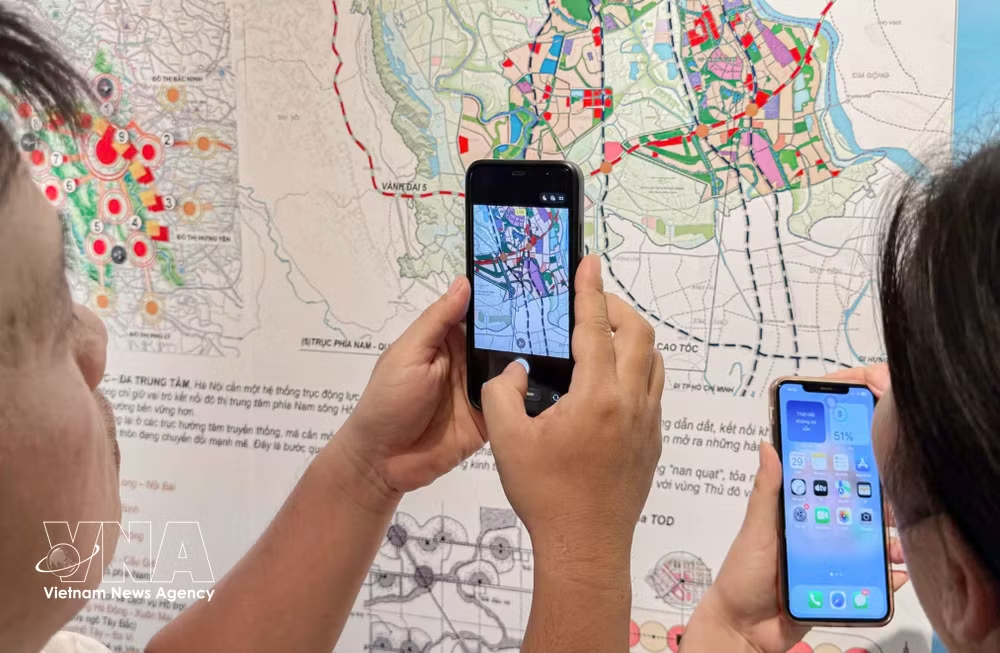
The exhibition of 100-year vision master planning of Hanoi is underway at the Hanoi Museum.
(Photo: VNA)

The city's comprehensive preparations demonstrate its determination to minimise the gap between policymaking and enforcement, ensuring the law does not take effect without the necessary guidance or face delays in practical application.

Building a capable implementation workforce

City authorities have stressed that even the most progressive legislation cannot achieve its objectives without a thorough understanding among those responsible for implementing it. As a result, Hanoi launched an extensive programme of public communication, dissemination and training immediately after the law was passed.

According to Nguyen Cong Anh, Deputy Director of the Hanoi Department of Justice, communication efforts have been closely aligned with the dissemination of the Party and State's major policies on Hanoi's development in the new period.

The city has organised more than 250 dissemination conferences attended by over 50,000 participants, distributed more than 14,000 legal information materials, published over 1,560 articles on government agencies' websites and broadcast more than 1,000 radio programmes each week through the grassroots broadcasting system. Additional communication activities have included online competitions on the Capital Law, digital and social media campaigns, and outreach through legal experts and official presenters.

On June 27, Hanoi organised a citywide conference, featuring both in-person and online participation, to disseminate resolutions implementing the Capital Law to all 126 commune- and ward-level administrations, attracting more than 5,000 delegates.

These efforts demonstrate that Hanoi has prepared not only the necessary institutional framework but also the human resources required for effective implementation, particularly grassroots officials who will be responsible for delivering the law's policies to residents and businesses.

Although substantial work has been completed ahead of July 1, city leaders have repeatedly stressed that this marks only the beginning. Thang emphasised that issuing resolutions and decisions is not the final objective but merely the starting point. The effectiveness of the Capital Law, he said, will be measured not by the number of legal documents issued but by tangible improvements in governance and public administration, better services for people and businesses, faster administrative procedures, stronger investment attraction and higher economic growth.

The city has also made clear that all levels of government must act proactively without delay or shifting responsibilities.

As a result, July 1 marks not only the formal entry into force of the Capital Law 2026 but also the beginning of a new development chapter for Hanoi. Ultimately, the law's success will be judged not by the number of special mechanisms it introduces, but by tangible improvements in socio-economic development, a more favourable investment environment, more effective public administration and, above all, greater satisfaction among residents and businesses benefiting from its implementation./.
VNA

See more

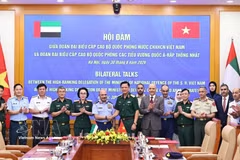
Sen. Lieut. Gen. Nguyen Truong Thang, Deputy Minister of National Defence of Vietnam (seventh, left), Lieut. Gen. Ibrahim Nasser Mohammed Al Alawi, Undersecretary of the UAE Ministry of Defence (sixth, left) and other delegates pose for a group photo (Photo: VNA)

Vietnam, UAE sign MoU on defence industry cooperation

Defence cooperation has recorded positive progress in line with the Vietnam–UAE Comprehensive Partnership. During recent high-level meetings and exchanges, leaders of the two countries reached an important common understanding on strengthening bilateral defence cooperation, including defence industry collaboration, while continuing to support major events hosted by each side.

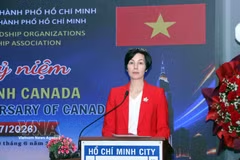
Canadian Consul General in Ho Chi Minh City Annie Dubé speaks at the gathering marking the 159th anniversary of Canada's National Day in Ho Chi Minh City on June 30. (Photo: VNA)

Ho Chi Minh City, Canada strengthen people-to-people friendship

Canada currently has nearly 300 valid foreign direct investment (FDI) projects in Vietnam with total registered capital of 4.87 billion USD. It is also Vietnam's second-largest trading partner in the Americas, with two-way trade reaching approximately 8.5 billion USD in 2025.

Permanent Deputy Prime Minister Pham Gia Tuc speaks at the hybrid conference on studying and implementing the Politburo’s Resolution No. 10-NQ/TW on developing the foreign-invested economic sector on June 30. (Photo: VNA)

Vietnam shifts FDI attraction strategy towards higher quality, greater efficiency

Vietnam’s approach is undergoing a fundamental transformation. While attracting international resources was the central priority over the past nearly four decades, the next phase will focus on enhancing the effectiveness of those resources in synergy with domestic capacities to strengthen development capabilities, economic resilience and national competitiveness.

Speaker of the Algerian Council of the Nation Azzouz Nasri (right) receives outgoing Vietnamese Ambassador to Algeria Tran Quoc Khanh. (Photo: VNA)

Algeria eyes stronger parliamentary ties with Vietnam

Nasri affirmed that Algeria, under the leadership of President Abdelmadjid Tebboune, attaches importance to effectively implementing the Strategic Partnership with Vietnam by enhancing political dialogue; expanding economic, trade and investment cooperation; and promoting cultural and people-to-people exchanges.

Party General Secretary and State President To Lam (3rd from left, first row) and other leaders at the conference. (Photo: VNA)

National conference held to disseminate Politburo's Resolution No. 10-NQ/TW

Party General Secretary and State President To Lam attended and delivered a keynote speech at the event, which was linked to nearly 35,000 venues from central to commune levels, government agencies and military units, attracting almost 2.1 million delegates. It was broadcast live on Vietnam Television and Voice of Vietnam channels.

The success of the two-tier local administration model will be measured by the pace of local development and the satisfaction of citizens. (Photo: VNA)

Leaner organisation, sharper governance create new growth drivers

One year after the implementation of the two-tier local administration model, Vietnamese localities are entering a phase focused on improving governance quality, utilising resources, and translating institutional changes into substantive development momentum.

At the reception for Canadian Ambassador Jim Nickel in Hanoi on June 29, 2026 (Photo: VNA)

Vietnam wishes to elevate ties with Canada to new level: PM

Prime Minister Le Minh Hung urged Canada to open its market wider to Vietnamese goods, particularly agro-forestry-fishery products, while extending cooperation in training quality workforce in artificial intelligence, quantum technology, and semiconductors.

Vietnamese Deputy Prime Minister and Minister of National Defence General Phan Van Giang (right) receives Malaysian Ambassador Dato' Tan Yang Thai. (Photo: qdnd.vn)

Vietnam, Malaysia seek to deepen defence cooperation

Vietnam-Malaysia relations, including defence cooperation, have made important strides in recent years. Political and diplomatic ties have been reinforced through regular high-level exchanges and contacts, while economic, trade, and investment cooperation has continued to deliver positive results.

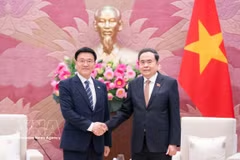
NA Chairman Tran Thanh Man (R) and Director of the Kimhakmin E-roun Institute for Economic Research Prof. Kim Hak-min (Photo: VNA)

NA Chairman expects to tap RoK’s innovation experience

Chairman Man pointed to the RoK’s four-decade transformation into a developed economy fueled by sci-tech, innovation and digitalisation, saying that he expects the two nations to expand cooperation and further accelerate Vietnam’s own innovation drive.

Party General Secretary and State President To Lam reviews the guard of honour at the ceremony marking the 80th anniversary of the artillery-missile force on June 29. (Photo: VNA)

Top leader calls for modern artillery-missile force capable of meeting new challenges

He urged the Artillery-Missile Command to develop a force that is strong in political, ideological and organisational foundations, with absolute loyalty to the Party, the nation and the people, thorough understanding of the Party's military and defence guidelines and directives on safeguarding the Fatherland and building a revolutionary, regular, elite and modern army.

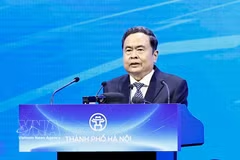
National Assembly Chairman Tran Thanh Man speaks at the conference to announce the Capital Master Plan with a 100-year vision and promote investment opportunities for 2026 in the capital city. (Photo: VNA)

NA Chairman calls on Hanoi to turn master plan vision into tangible development projects

Chairman Man described the publication of the master plan as more than the unveiling of a development blueprint. It sends a strong message of action and demonstrates the city's determination to translate the resolutions of the 14th National Party Congress and the 18th Hanoi Party Congress into reality, in line with Party General Secretary and State President To Lam’s directive that “Hanoi must do what it commits to do, do it quickly, correctly, effectively and thoroughly.”

An art performance at the Vietnam Culture Week in Cambodia in 2026. (Photo: VNA)

Resolution helps advance people-to-people diplomacy: insider

A member of the Standing Board of the Vietnam – Cambodia Friendship Association Central Committee stressed the need to strengthen coordination among Party diplomacy, State diplomacy and people-to-people diplomacy, while integrating foreign affairs more closely with national defence and security safeguarding to build comprehensive diplomacy and create synergy.