Vietnam shifts FDI attraction strategy towards higher quality, greater efficiency

Vietnam’s approach is undergoing a fundamental transformation. While attracting international resources was the central priority over the past nearly four decades, the next phase will focus on enhancing the effectiveness of those resources in synergy with domestic capacities to strengthen development capabilities, economic resilience and national competitiveness.

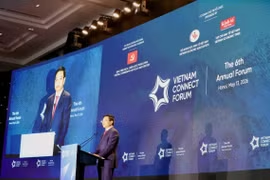
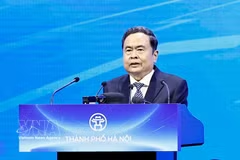
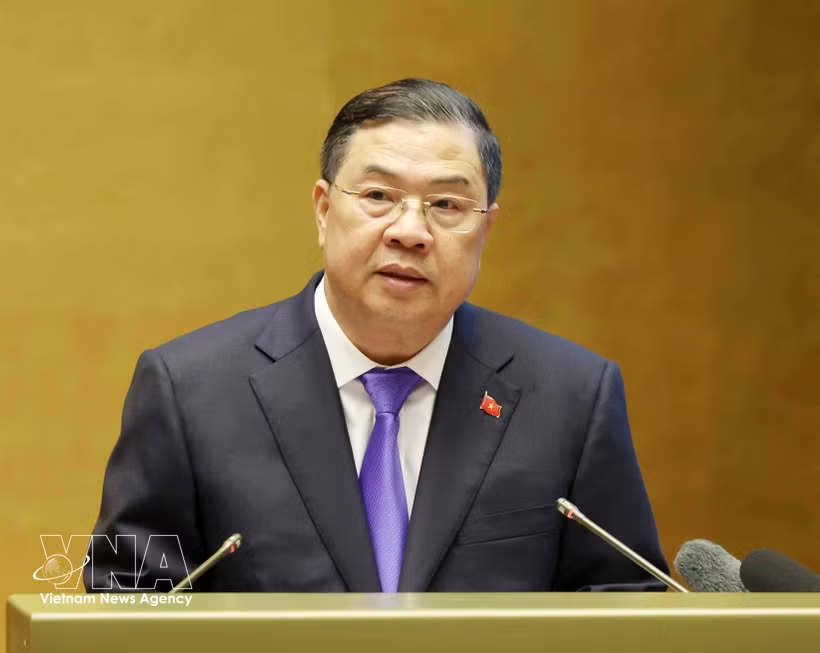
Permanent Deputy Prime Minister Pham Gia Tuc speaks at the hybrid conference on studying and implementing the Politburo’s Resolution No. 10-NQ/TW on developing the foreign-invested economic sector on June 30. (Photo: VNA)

Hanoi (VNA) - Vietnam is recalibrating its foreign direct investment (FDI) attraction strategy towards higher quality and greater efficiency, shifting from a focus on attracting capital to effectively leveraging international resources in combination with domestic strengths to drive new growth momentum, heard a national conference on June 30.

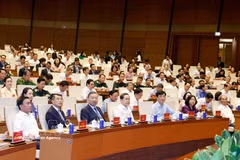
The message was delivered at the hybrid conference on studying and implementing the Politburo’s Resolution No. 10-NQ/TW on developing the foreign-invested economic sector, where delegates also viewed a documentary on four decades of FDI attraction in Vietnam before hearing a presentation by Permanent Deputy Prime Minister Pham Gia Tuc.

New development mindset

Tuc said Vietnam’s approach is undergoing a fundamental transformation. While attracting international resources was the central priority over the past nearly four decades, the next phase will focus on enhancing the effectiveness of those resources in synergy with domestic capacities to strengthen development capabilities, economic resilience and national competitiveness.

The resolution sets out guiding principles that underpin a major shift in development mindset. Rather than focusing solely on attracting FDI, it adopts a broader approach to developing the foreign-invested economic sector, covering direct and indirect investment, capital markets and international financial institutions, while treating the foreign-invested sector as an integral part of the national economy.

It also shifts the emphasis from the scale of investment to its quality, efficiency and added value, prioritising projects using advanced technologies, innovation, modern governance and stronger spillover effects.

Investment incentives will move from input-based to performance-based policies, linked to commitments on technology transfer, research and development, workforce training, domestic business linkages, green transition and sustainable development.

Another key change is integrating various international capital flows, including FDI, portfolio investment, capital markets, international financial centres and new development models such as free trade zones, to improve resource mobilisation and allocation, Tuc said.

The resolution also calls for transforming the State's role from investment management to creating a favourable investment and development environment through institutional reform, better governance, improved infrastructure, high-quality human resources and a stronger innovation ecosystem, to facilitate both domestic and international resources to thrive.

It further seeks to replace competition among localities for investment with stronger national-level coordination, enhanced regional connectivity and closer links between foreign-invested and domestic enterprises, and greater leverage of growth poles and innovation hubs to enhance the national economy's development efficiency.
vnanet-r.jpg
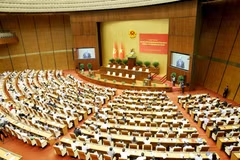
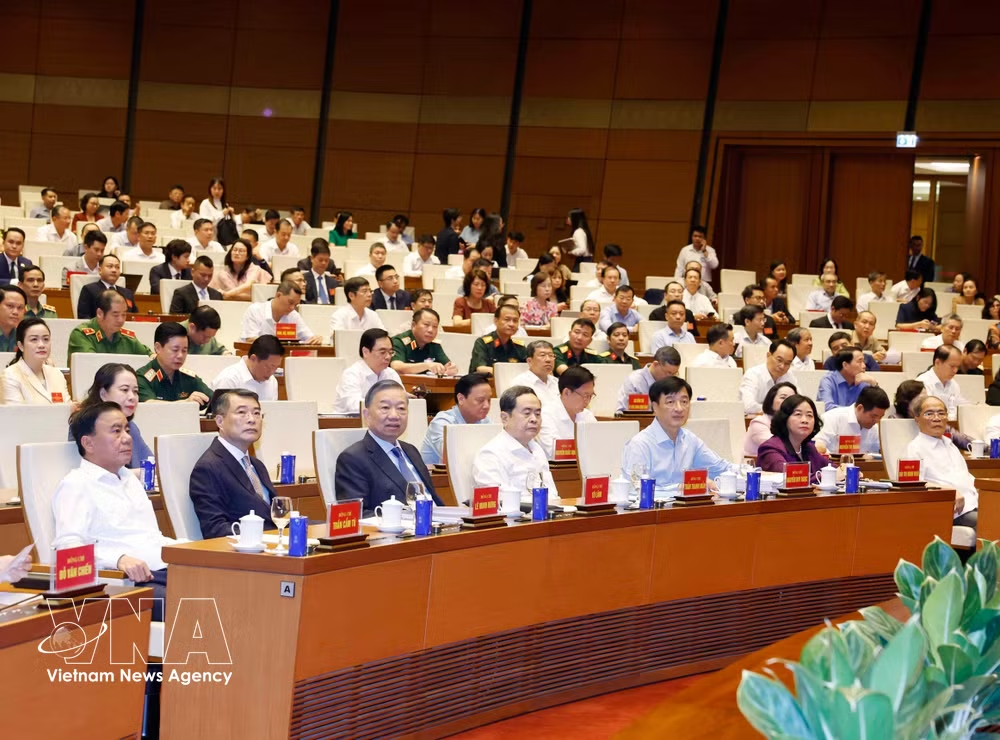
Party General Secretary and State President To Lam, and other delegates attend the hybrid conference on studying and implementing the Politburo’s Resolution No. 10-NQ/TW on developing the foreign-invested economic sector on June 30. (Photo: VNA)

Targets and breakthroughs

The resolution sets the overarching goal of making Vietnam a competitive destination for high-quality medium- and long-term foreign investment, while ensuring that foreign capital contributes more effectively to technology transfer, workforce development, stronger linkages with domestic economic areas, and deeper integration into global supply chains. It also seeks to help establish a new growth model driven by science, technology, innovation, and digital transformation, while enhancing national competitiveness, strengthening strategic self-reliance, and elevating the country's position and prestige.

By 2030, Vietnam targets 200-300 billion USD in newly registered FDI, including 150-200 billion USD in disbursed capital. Around 75% of newly registered investment is expected to come from developed economies with strengths in technology, capital and modern governance. The average localisation rate in key industries is targeted at 45-50%, with around 10,000 Vietnamese firms joining supply chains of foreign-invested enterprises. The country also aims to upgrade its stock market to emerging market status before 2030.

By 2045, the foreign-invested sector is expected to develop efficiently and sustainably, with strong linkages to the state-owned and private sectors, accounting for about 25% of total social investment and contributing around 30% of GDP. Vietnam aims to become a regional hub for manufacturing, services, innovation, and corporate management for multinational corporations, thereby strengthening its position in global value chains.

To achieve these goals, the resolution outlines breakthrough areas, including reforming development mindset, improving institutions, developing human resources and infrastructure, attracting next-generation investment, strengthening linkages with domestic businesses, promoting innovation, developing capital markets, and modernising national governance.

Tuc stressed that these priorities form a unified action programme in which institutional reform serves as the key breakthrough, while high-quality human resources, infrastructure and modern governance provide the foundation for successful implementation.

He called on Party committees, government agencies, ministries, localities, the business community and socio-political organisations to translate the resolution into concrete action plans, ensuring coordinated implementation to usher in a new stage of high-quality and sustainable development for Vietnam's foreign-invested economic sector./.
VNA

See more

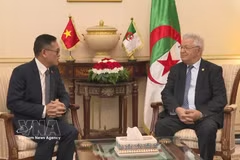
Speaker of the Algerian Council of the Nation Azzouz Nasri (right) receives outgoing Vietnamese Ambassador to Algeria Tran Quoc Khanh. (Photo: VNA)

Algeria eyes stronger parliamentary ties with Vietnam

Nasri affirmed that Algeria, under the leadership of President Abdelmadjid Tebboune, attaches importance to effectively implementing the Strategic Partnership with Vietnam by enhancing political dialogue; expanding economic, trade and investment cooperation; and promoting cultural and people-to-people exchanges.

Party General Secretary and State President To Lam (3rd from left, first row) and other leaders at the conference. (Photo: VNA)

National conference held to disseminate Politburo's Resolution No. 10-NQ/TW

Party General Secretary and State President To Lam attended and delivered a keynote speech at the event, which was linked to nearly 35,000 venues from central to commune levels, government agencies and military units, attracting almost 2.1 million delegates. It was broadcast live on Vietnam Television and Voice of Vietnam channels.

The success of the two-tier local administration model will be measured by the pace of local development and the satisfaction of citizens. (Photo: VNA)

Leaner organisation, sharper governance create new growth drivers

One year after the implementation of the two-tier local administration model, Vietnamese localities are entering a phase focused on improving governance quality, utilising resources, and translating institutional changes into substantive development momentum.

At the reception for Canadian Ambassador Jim Nickel in Hanoi on June 29, 2026 (Photo: VNA)

Vietnam wishes to elevate ties with Canada to new level: PM

Prime Minister Le Minh Hung urged Canada to open its market wider to Vietnamese goods, particularly agro-forestry-fishery products, while extending cooperation in training quality workforce in artificial intelligence, quantum technology, and semiconductors.

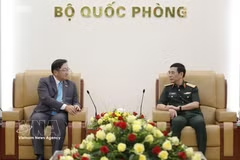
Vietnamese Deputy Prime Minister and Minister of National Defence General Phan Van Giang (right) receives Malaysian Ambassador Dato' Tan Yang Thai. (Photo: qdnd.vn)

Vietnam, Malaysia seek to deepen defence cooperation

Vietnam-Malaysia relations, including defence cooperation, have made important strides in recent years. Political and diplomatic ties have been reinforced through regular high-level exchanges and contacts, while economic, trade, and investment cooperation has continued to deliver positive results.

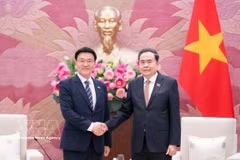
NA Chairman Tran Thanh Man (R) and Director of the Kimhakmin E-roun Institute for Economic Research Prof. Kim Hak-min (Photo: VNA)

NA Chairman expects to tap RoK’s innovation experience

Chairman Man pointed to the RoK’s four-decade transformation into a developed economy fueled by sci-tech, innovation and digitalisation, saying that he expects the two nations to expand cooperation and further accelerate Vietnam’s own innovation drive.

Party General Secretary and State President To Lam reviews the guard of honour at the ceremony marking the 80th anniversary of the artillery-missile force on June 29. (Photo: VNA)

Top leader calls for modern artillery-missile force capable of meeting new challenges

He urged the Artillery-Missile Command to develop a force that is strong in political, ideological and organisational foundations, with absolute loyalty to the Party, the nation and the people, thorough understanding of the Party's military and defence guidelines and directives on safeguarding the Fatherland and building a revolutionary, regular, elite and modern army.

National Assembly Chairman Tran Thanh Man speaks at the conference to announce the Capital Master Plan with a 100-year vision and promote investment opportunities for 2026 in the capital city. (Photo: VNA)

NA Chairman calls on Hanoi to turn master plan vision into tangible development projects

Chairman Man described the publication of the master plan as more than the unveiling of a development blueprint. It sends a strong message of action and demonstrates the city's determination to translate the resolutions of the 14th National Party Congress and the 18th Hanoi Party Congress into reality, in line with Party General Secretary and State President To Lam’s directive that “Hanoi must do what it commits to do, do it quickly, correctly, effectively and thoroughly.”

An art performance at the Vietnam Culture Week in Cambodia in 2026. (Photo: VNA)

Resolution helps advance people-to-people diplomacy: insider

A member of the Standing Board of the Vietnam – Cambodia Friendship Association Central Committee stressed the need to strengthen coordination among Party diplomacy, State diplomacy and people-to-people diplomacy, while integrating foreign affairs more closely with national defence and security safeguarding to build comprehensive diplomacy and create synergy.

Delegates attend a conference to disseminate and implement the Politburo’s Resolution on carrying out the foreign policy orientations set forth by the 14th National Party Congress. (Photo: VNA)

Diplomacy considered as driver of national development

More importantly, diplomacy is no longer limited to expanding relations or attracting external resources. It is increasingly expected to directly create new opportunities, conditions and drivers for development. Every diplomatic activity is therefore aimed at enhancing national competitiveness, innovation capacity, international integration and Vietnam’s position in global value chains.