50 years of Ho Chi Minh City: A convergence of diverse cultural values

Residents say Ho Chi Minh City presents diverse landscapes ranging from agricultural and eco-tourism areas to industrial zones, logistics hubs, coastal urban centres and protected natural environments, each contributing its own distinctive character.

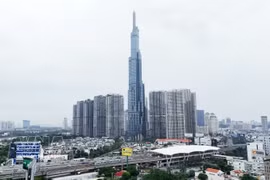
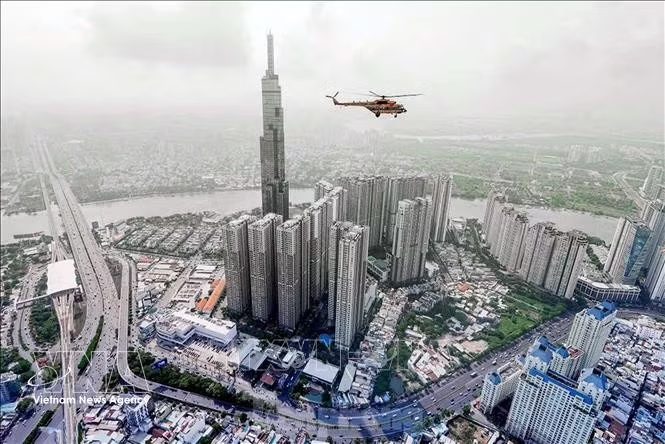
A bird's-eye view of Ho Chi Minh City (Photo: VNA)

Ho Chi Minh City (VNA) – Ho Chi Minh City has evolved into Vietnam’s leading economic and cultural hub, driven not only by economic growth and global integration but also by the formation of an open, diverse urban identity rooted in cultural convergence.

Cultural values shape city's identity

Experts say the city’s reform spirit has been sustained by deeply rooted cultural values rather than institutional changes alone. The defining characteristics of Saigon - Ho Chi Minh City residents - dynamism, openness, pragmatism, innovation, and compassion -have underpinned successive waves of reform, from the early Doi Moi (Renewal) experiments to recent special development mechanisms.

Researchers from the Ho Chi Minh City Cadre Academy argue that these values, forged through more than three centuries of migration and cultural exchange among Vietnamese, Chinese, Khmer and Cham communities, have become the city's key internal strength.

Four enduring traits - creativity, openness, pragmatism, and compassion - have consistently shaped its approach to governance and institutional innovation.

They identify three major phases over the past five decades: the pioneering reforms in the early 1980s that contributed to the 1986 “Doi Moi” policy, the pilot implementation of special mechanisms, and the current push for breakthrough reforms under recent Party resolutions and the proposed Special Urban Law.

Cultural diversity as engine of development

Over the past half-century, Ho Chi Minh City has become a space where multiple cultural traditions converge and evolve, reinforcing its reputation as a centre of innovation and international integration.

Following the merger with the former Binh Duong and Ba Ria–Vung Tau provinces, the expanded city now covers more than 6,772 sq.km with a population of over 14 million, creating a broader cultural landscape alongside its enlarged economic space.

According to experts, the new metropolis encompasses three distinctive cultural sub-regions: the historic Saigon core, characterised by commerce and innovation; Binh Duong, known for its traditional craft villages, industry and migrant workforce; and Ba Ria - Vung Tau - Con Dao, defined by maritime culture, port and energy industries, and revolutionary heritage. Together, these layers enhance the city's resilience, attractiveness and cultural competitiveness.

Scholars note that these cultural sub-regions collectively shape the city's identity while enriching its multicultural character.

Dr. Le Thi Linh Trang of the Ho Chi Minh City Cadre Academy said the three cultural sub-regions are closely interconnected and have collectively shaped Ho Chi Minh City's identity over the past 50 years. From its historic urban core and industrial–craft areas to its coastal and island communities rich in historical heritage, the city has emerged as an open, diverse and culturally dynamic urban space with a strong capacity for renewal.

Residents say the expanded city presents diverse landscapes ranging from agricultural and eco-tourism areas to industrial zones, logistics hubs, coastal urban centres and protected natural environments, each contributing its own distinctive character.

Looking towards its long-term vision of becoming a global megacity, experts view these cultural assets as a vital source of endogenous development. Shared historical memory strengthens social cohesion, particularly among migrants, while diverse cultural traditions enrich the city's cuisine, commerce, crafts, tourism and creative industries.

They add that, with modern investment and management, cultural heritage - from Cho Lon's commercial streets and Binh Duong's craft villages to coastal communities, Con Dao's historical sites and migrant culinary traditions - can become a powerful driver of cultural industries, tourism and sustainable urban development./.


VNA
See more

Delegates explore agricultural extension applications and low-emission rice production solutions at the seminar. (Photo courtesy of the Hai Phong Department of Agriculture and Environment)

Public-private partnerships drive low-emission rice farming

Experts agreed that integrating nutrient management, biotechnology, mechanisation and digital technologies will enhance productivity, reduce greenhouse gas emissions and accelerate the transition towards greener, more sustainable rice production.

Rescuers search for survivors trapped beneath the rubble. (Photo published by VNA)

Venezuela quake: Vietnamese team intensifies search efforts

Personnel from the Vietnam People's Army and the People's Public Security Force were deployed to different locations. In addition to their assigned missions, they also responded to requests from victims' families by searching nearby areas for those still missing.

The humanitarian aid handover ceremony on June 30 (Photo: VNA)

Vietnam delivers humanitarian aid to earthquake-hit Venezuela

The total volume of relief supplies amounted to 45.6 tonnes, including 35 tonnes of emergency rations, 4 tonnes of medicines, 2 tonnes of canned meat, four generators, 500 tents, 10 large relief shelters, and 50,000 rolls of medical bandages.

Delegates press the button to inaugurate the upgraded Command Information Centre and surveillance camera system. (Photo: Nhan dan)

Hanoi rolls out 2,460 more AI surveillance cameras

The system comprises 1,107 cameras for detecting traffic violations, 960 for vehicle flow monitoring, 112 for intersection monitoring, 251 pan-tilt-zoom (PTZ) cameras and 30 for detecting speed violations. A total of 930 camera poles have been installed at 238 major intersections, gateways and urban areas across the capital.

Members of the Vietnamese team conduct a field survey in La Guaira to assess the situation and prepare for the deployment of personnel and equipment for search-and-rescue operations. (Photo: qdnd.vn)

Vietnamese team surveys hardest-hit area in Venezuela earthquakes

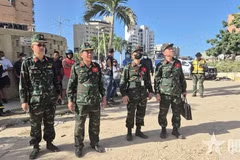
The head of the delegation, accompanied by several team members and representatives of the Venezuelan side, subsequently conducted a field survey in La Guaira to assess the situation and prepare for the deployment of personnel and equipment for search-and-rescue operations.

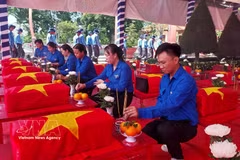
A solemn ceremony is held at the Vinh Hung–Tan Hung Martyrs' Cemetery in Tay Ninh province to receive the remains of 173 Vietnamese volunteer soldiers and experts who laid down their lives in Cambodia. (Photo: VNA)

Remains of Vietnamese martyrs brought home from Cambodia

Over a 105-day mission from March 26 to June 30, Team K72 collected information, conducted field searches and excavations, and recovered the remains of 62 Vietnamese volunteer soldiers and experts in Cambodia's Kratie and Kampong Thom provinces.

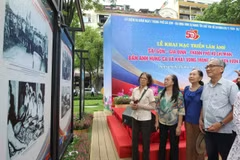
A view of a photo exhibition opened in Ho Chi Minh City on June 29, 2026, to commemorate the 50th anniversary of the city of Saigon–Gia Dinh officially renamed after President Ho Chi Minh. (Photo: VNA)

Photo exhibition showcases Ho Chi Minh City’s 50 years of growth

More than a display of photographs and archival materials, the event serves as an epic narrative, vividly retracing the city’s more than 300-year journey of exploration, development and defence, alongside five decades of achievements under the name Ho Chi Minh City.

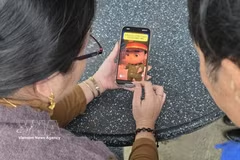
Residents are watching a short animated clip created using AI by the police in Bo Trach commune, Quang Tri province, to raise public awareness and provide warnings about crimes. (Photo: VNA)

Vietnam steps up crackdown on tech-enabled trafficking, online scam rings

The plan aims to mobilise the involvement of the entire political system, ministries, local authorities and the public to combat human trafficking, while implementing key tasks set out in the Prime Minister's Human Trafficking Prevention and Control Programme for 2026–2030, with a vision to 2035, while ensuring the effective enforcement of the 2024 Law on Human Trafficking Prevention and Control (amended in 2025).

Representatives of overseas Vietnamese families in France present the Ho Chi Minh Relic Site at the Presidential Palace with valuable archival documents and photographs of President Ho Chi Minh preserved in France. (Photo: VNA)

Series of events in France honours President Ho Chi Minh

The programme included the opening of a thematic exhibition, the launch of the bilingual Vietnamese–French photo book on Nguyen Ai Quoc – Ho Chi Minh and France, a ceremony to receive archival photographs donated by overseas Vietnamese families who welcomed the late Vietnamese leader during his 1946 visit to the European country, and an artistic performance dedicated to his life and legacy.