Ho Chi Minh City pioneers innovation, creating growth momentum for nation: official

Chairman of the municipal People’s Committee Nguyen Van Duoc said that the 50 years since Saigon – Gia Dinh officially took the name of Ho Chi Minh have been a proud and historic journey.

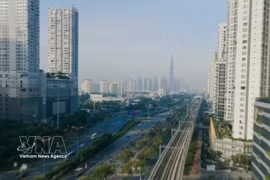
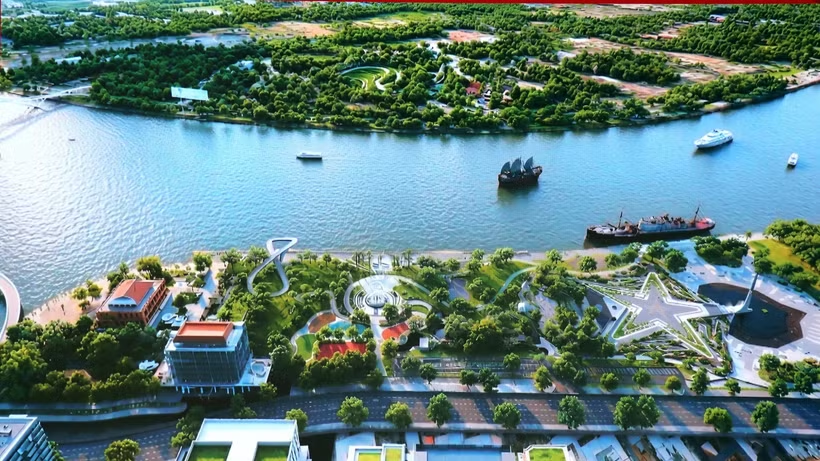
A perspective of the Nha Rong Wharf – Khanh Hoi Cultural Park and Bach Dang Wharf public space project, which will form a cultural and historical corridor along the Saigon River in Ho Chi Minh City. (Photo: VNA)

Ho Chi Minh City (VNA) – As Ho Chi Minh City marks the 50th anniversary of officially named after President Ho Chi Minh (July 2, 1976–2026), Chairman of the municipal People’s Committee Nguyen Van Duoc has highlighted the southern metropolis’s remarkable achievements over the past five decades, describing it as both the country’s leading economic engine and a testing ground for innovative development policies.

In an interview granted to the Vietnam News Agency (VNA), Duoc said that the 50 years since Saigon – Gia Dinh officially took the name of Ho Chi Minh have been a proud and historic journey. The city has continuously upheld its revolutionary tradition, unyieldingness, dynamism, creativity and spirit of compassion, and overcome countless challenges to achieve strong breakthroughs. The comprehensive achievements across socio-economic and defence – security aspects have not only given a strong facelift to the city but also and firmly consolidated its position as the country's leading economic locomotive, a key growth driver, and a major centre for finance, trade, science and technology.

According to the official, the city’s economic transformation has been particularly striking. From an average annual growth rate of just 0.91% during the 1976–1980 period, Ho Chi Minh City experienced rapid expansion following the country’s Doi Moi (renewal) process, recording annual growth of 12.62% during 1991–1995. In 2025, the city’s gross regional domestic product (GRDP) increased by an estimated 8.03%, accounting for roughly one-quarter of the national gross domestic product (GDP), and it expanded 8.27% in the first quarter of 2026.

He noted that the city’s economic structure has shifted towards modern services, which now contribute more than 52% of its economy.

Since the promulgation of the Law on Foreign Investment in late 1987, Ho Chi Minh City has remained Vietnam’s leading destination for foreign direct investment (FDI), attracting 20,259 projects with total registered capital of nearly 142 billion USD from 152 countries and territories. In the first half of 2026 alone, it secured over 6.8 billion USD in FDI, equivalent to 62% of its annual target.

Duoc also pointed to major advances in urban development. Landmark infrastructure projects, including Nguyen Van Linh Boulevard, the East – West Boulevard, the Saigon River Tunnel and Phu My Bridge, have significantly transformed the city’s landscape. The official launch of Metro Line No. 1 (Ben Thanh – Suoi Tien) at the end of 2024 was described as a historic milestone, ushering in a new era of modern public transportation.

At the same time, model urban areas such as Phu My Hung and Thu Thiem, together with export processing zones, industrial parks and high-tech parks, have helped shape a modern, civilised and internationally integrated metropolis.
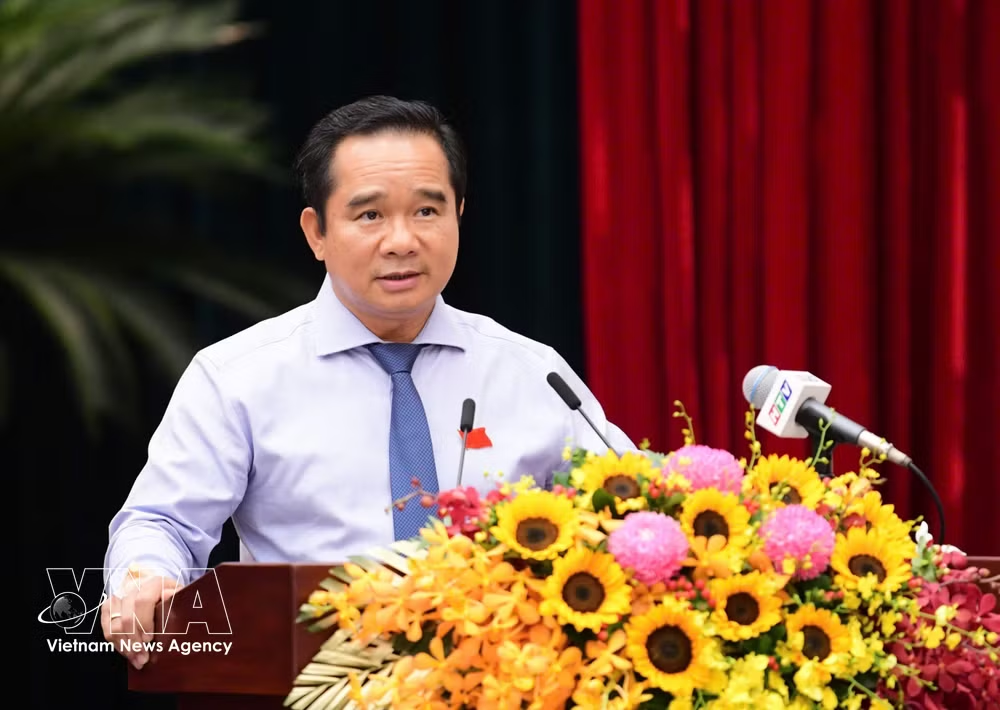
vnanet-nguyenvanduoc.jpg
Chairman of the Ho Chi Minh City People’s Committee Nguyen Van Duoc (Photo: VNA)

On socio-cultural affairs, the chairman stressed that the city has consistently pursued economic growth in tandem with social progress and equity. He cited UNESCO’s recognition of Ho Chi Minh City as a Global Learning City in 2024 and ongoing efforts to establish itself as a high-quality healthcare hub in ASEAN as evidence of this commitment.

Regarding national defence and security, he said the city has always maintained political stability and social order, and strengthened the all-people national defence and security safeguarding postures. The effectiveness and efficiency of the two-tier local administration system have been enhanced, providing a safe and seamless environment that supports the city’s fast and sustainable development.

It can be affirmed that the city’s remarkable achievements over the past 50 years come as a result of the whole-hearted dedication, burning desire and strong sense of responsibility of successive generations of leaders, together with the spirit of great solidarity, self-reliance and resilience of its people. They serve as a firm foundation for Ho Chi Minh City to sustain its momentum, achieve new breakthroughs and move forward confidently in the new era of the nation’s rise, the city leader stated.

Reflecting on the city’s role in national development, Duoc described Ho Chi Minh City as a “policy laboratory” that has often pioneered reforms later adopted nationwide. He recalled that the city had been at the forefront of innovation before the launch of Doi Moi in 1986 and had pioneered initiatives such as the establishment of the country’s first export processing zone, Tan Thuan, in 1991.

The official also highlighted the city's deeply humanistic spirit as seen in efforts to eliminate poverty and build charity houses for the disadvantaged.

He noted that it is currently implementing a range of breakthrough mechanisms and policies approved by the National Assembly, including special development mechanisms, the resolution for the development of an international financial centre, and another aimed at accelerating the development of metro lines.

For the coming period, Duoc said the city will keep thoroughly grasping the Politburo's Resolution No. 09-NQ/TW on its development, staying determined to uphold its pionnering role in economic growth and innovation.

To do so, it will focus on five focal tasks, including building a new growth model driven by science and technology, innovation and digital transformation; taking the lead in institutional reforms through greater power decentralisation and enhanced local autonomy; modernising urban infrastructure with an emphasis on metro systems and transit-oriented development; improving residents’ quality of life through better housing, health care and education; and fostering a high-quality workforce and promoting the city’s culture of thinking big, acting bold and daring to take responsibility.

Asked about the significance of the 50th anniversary, Duoc said the city’s greatest source of pride lies not only in its achievements but also in its enduring efforts to live up to the honour of bearing President Ho Chi Minh’s name.

Guided by the principle of “for the whole country and joining hands with the whole country”, the city remains committed to sharing resources and supporting other localities in national development.

As the country enters a new era of development, Duoc affirmed that the Party organisation, administration and people of Ho Chi Minh City are determined to work together to build a civilised, modern and compassionate metropolis worthy of the trust of the entire people and the honour of bearing the name of the great leader of Vietnam, he remarked./.
VNA

See more

An overview of the working session between ASEAN Committee in Canberra and the Australian Department of Home Affairs (Photo: VNA)

ASEAN Committee in Canberra seeks closer cooperation with Australia's Home Affairs Department

Vietnamese Ambassador to Australia Pham Hung Tam proposed that Australia extend the visa validity period for ASEAN graduates of master's degree programmes from two years to three years in the country from two years to three years. He also urged Australia to soon grant transit visa exemptions for Vietnamese citizens, similar to those already available to nationals of several other ASEAN countries.

The June 30 conference announcing a series of strategic plans of Quang Ninh and receive recognition of Quang Ninh as a tier-1 urban area. (Photo: VNA)

Quang Ninh unveils strategic plans, sets sights on becoming national urban hub

Under a master plan, Quang Ninh's urban development will be organised around three corridors, four socio-economic zones and five growth centres, including Ha Long, Van Don, Mong Cai, Quang Yen, and the Yen Tu–Ha Long Bay heritage complex. The province will adopt a multi-centre urban model placing people and heritage, including Ha Long Bay and the Yen Tu scenic complex, at its core.

Vietnamese Ambassador to the US Nguyen Quoc Dung (fourth, right) chairs a business rountable with three leading economic promotion organisations of Minnesota. (Photo: VNA)

Vietnamese, US localities strengthen cooperation across multiple fields

Vietnamese Ambassador to the US Nguyen Quoc Dung called on the state to continue supporting the Vietnamese community in Minnesota, encourage local businesses to expand investment and operations in Vietnam, and promote sister-city and sister-province partnerships between Minnesota and Vietnamese localities.

The conference reviews the one-year implementation of the overall organisational model of the political system and the three-tier administration model. (Photo: VNA)

Conference reviews one-year implementation of three-tier administration model

The event was held in a hybrid format, with the main venue at the Dien Hong Hall of the National Assembly building and online connection to 3,651 venues across ministries, central agencies, socio-political organisations, and headquarters of provincial, municipal, commune, ward and special-zone administrations nationwide.

General Secretary of the Communist Party of Vietnam Central Committee and President of Vietnam To Lam (L) and General Secretary of the Communist Party of China Central Committee and President of China Xi Jinping at the signing ceremony of cooperation documents between the two countries during the former’s state visit to China in April 2026. (Photo: VNA)

Congratulations extended on Communist Party of China’s 105th founding anniversary

In the message, the CPV Central Committee congratulated the CPC on its achievements over the past 105 years in uniting and leading the Chinese people to overcome numerous difficulties and challenges and secure remarkable accomplishments. These include the founding of the People's Republic of China, the implementation of the reform and opening-up policy, the advancement of socialism with Chinese characteristics into a new era, and the improvement of the role and international standing of the Party and State.

Party General Secretary and State President To Lam speaks at the first meeting of the Central Steering Committee for Foreign Affairs and International Integration. (Photo: VNA)

Foreign affairs should better serve national development: Top leader

Party General Secretary and State President To Lam underscored that Vietnam’s development goals for 2030, with a vision to 2045, require foreign affairs and international integration to become more proactive, with stronger forecasting capacity, timely and accurate policy advice, and swift action.

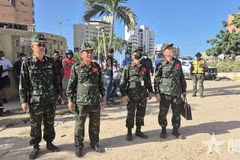
Vietnamese team conducts a field survey in La Guaira to assess the situation and prepare for the deployment of personnel and equipment for search-and-rescue operations. (Photo: qdnd.vn)

Vietnamese team surveys hardest-hit area in Venezuela earthquakes

The head of the delegation, accompanied by several team members and representatives of the Venezuelan side, subsequently conducted a field survey in La Guaira to assess the situation and prepare for the deployment of personnel and equipment for search-and-rescue operations.

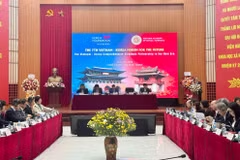
A view of the 7th Vietnam–Korea Forum for the Future (Photo: baochinhphu.vn)

Vietnam, RoK seek to strengthen scientific research cooperation

The forum provided a platform for academic exchange, policy dialogue and networking among research institutions, policymakers, experts, scholars and relevant organisations from both countries. It also aimed to put forward policy recommendations to further advance the Vietnam–RoK Comprehensive Strategic Partnership in the new development phase.

Head of the CPV Central Committee's Commission for Internal Affairs Le Minh Tri (R) and Chinese Ambassador to Vietnam He Wei. (Photo: VNA)

Party official hosts Chinese Ambassador

Vietnam and China further consolidate strategic mutual trust between the two Parties and countries, effectively turn the important common perceptions reached by their top leaders into action, and carry out bilateral diplomatic programmes.

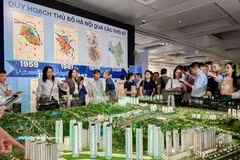
Hanoi residents are interested in exploring the 100-year urban planning vision for the capital city. (Photo: VNA)

Hanoi ready to implement Capital Law 2026, unlocking new development momentum

The effectiveness of the Capital Law 2026 will be measured not by the number of legal documents issued but by tangible improvements in governance and public administration, better services for people and businesses, faster administrative procedures, stronger investment attraction and higher economic growth.

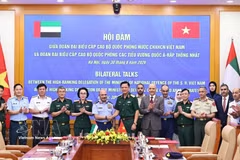
Sen. Lieut. Gen. Nguyen Truong Thang, Deputy Minister of National Defence of Vietnam (seventh, left), Lieut. Gen. Ibrahim Nasser Mohammed Al Alawi, Undersecretary of the UAE Ministry of Defence (sixth, left) and other delegates pose for a group photo (Photo: VNA)

Vietnam, UAE sign MoU on defence industry cooperation

Defence cooperation has recorded positive progress in line with the Vietnam–UAE Comprehensive Partnership. During recent high-level meetings and exchanges, leaders of the two countries reached an important common understanding on strengthening bilateral defence cooperation, including defence industry collaboration, while continuing to support major events hosted by each side.

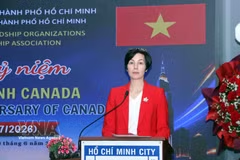
Canadian Consul General in Ho Chi Minh City Annie Dubé speaks at the gathering marking the 159th anniversary of Canada's National Day in Ho Chi Minh City on June 30. (Photo: VNA)

Ho Chi Minh City, Canada strengthen people-to-people friendship

Canada currently has nearly 300 valid foreign direct investment (FDI) projects in Vietnam with total registered capital of 4.87 billion USD. It is also Vietnam's second-largest trading partner in the Americas, with two-way trade reaching approximately 8.5 billion USD in 2025.

Permanent Deputy Prime Minister Pham Gia Tuc speaks at the hybrid conference on studying and implementing the Politburo’s Resolution No. 10-NQ/TW on developing the foreign-invested economic sector on June 30. (Photo: VNA)

Vietnam shifts FDI attraction strategy towards higher quality, greater efficiency

Vietnam’s approach is undergoing a fundamental transformation. While attracting international resources was the central priority over the past nearly four decades, the next phase will focus on enhancing the effectiveness of those resources in synergy with domestic capacities to strengthen development capabilities, economic resilience and national competitiveness.

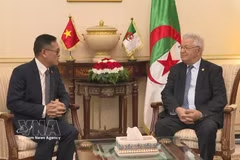
Speaker of the Algerian Council of the Nation Azzouz Nasri (right) receives outgoing Vietnamese Ambassador to Algeria Tran Quoc Khanh. (Photo: VNA)

Algeria eyes stronger parliamentary ties with Vietnam

Nasri affirmed that Algeria, under the leadership of President Abdelmadjid Tebboune, attaches importance to effectively implementing the Strategic Partnership with Vietnam by enhancing political dialogue; expanding economic, trade and investment cooperation; and promoting cultural and people-to-people exchanges.

Party General Secretary and State President To Lam (3rd from left, first row) and other leaders at the conference. (Photo: VNA)

National conference held to disseminate Politburo's Resolution No. 10-NQ/TW

Party General Secretary and State President To Lam attended and delivered a keynote speech at the event, which was linked to nearly 35,000 venues from central to commune levels, government agencies and military units, attracting almost 2.1 million delegates. It was broadcast live on Vietnam Television and Voice of Vietnam channels.