One year on, Vietnam's three-tier administration model delivers major governance gains

Nguyen Duy Ngoc, Politburo member, Secretary of the Party Central Committee, Chairman of its Organisation Commission and head of the steering committee for the review, said the reform has marked a qualitative shift in national governance towards a more modern, efficient and service-oriented administration.

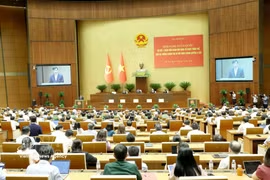
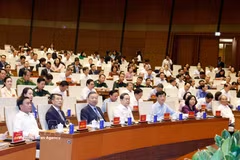
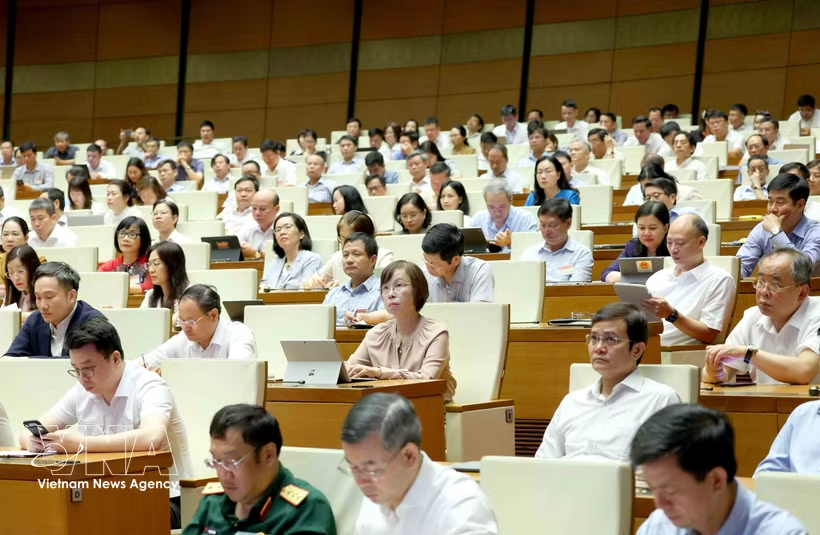
Officials attend the July 1 conference reviewing the one-year implementation of the overall organisational model of the political system and the three-tier administration model. (Photo: VNA)

Hanoi (VNA) – Vietnam has achieved significant progress after one year of operating its new three-tier administration system, with streamlined institutions, stronger decentralisation, improved public services and fresh momentum for socio-economic development, according to a report presented at a national conference on July 1.

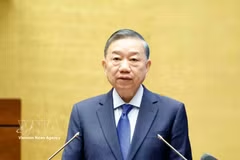
The conference, chaired by Party General Secretary and State President To Lam, reviewed one year of implementing the new organisational model of the political system and the three-tier administration model.

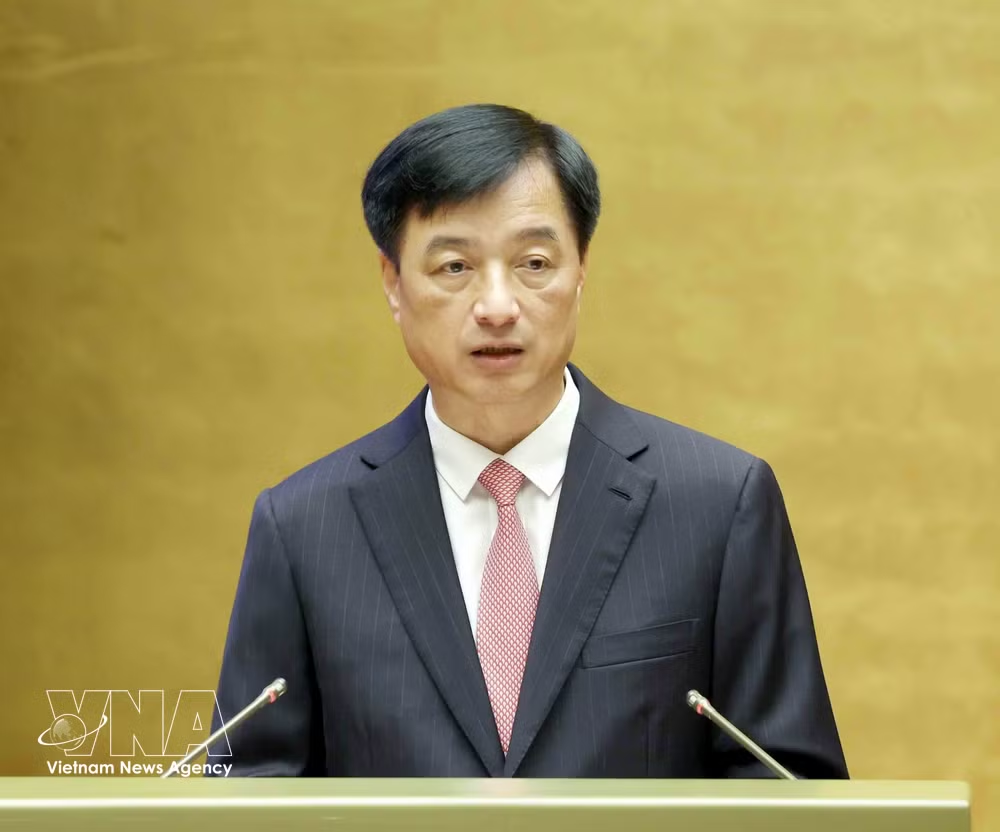
Addressing the event, Nguyen Duy Ngoc, Politburo member, Secretary of the Party Central Committee, Chairman of its Organisation Commission and head of the steering committee for the review, said the reform has marked a qualitative shift in national governance towards a more modern, efficient and service-oriented administration.

July 1, 2025 marked a historic turning point with the launch of a comprehensive reform of the organisational structure, officially transitioning to a three-tier administrative model comprising the central, provincial and commune levels.
vnanet-potal-hoi-nghi-toan-quoc-so-ket-1-nam-van-hanh-mo-hinh-to-chuc-tong-the-cua-he-thong-chinh-tri-va-mo-hinh-chinh-quyen-3-cap-8859383.jpg
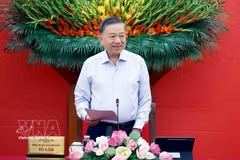
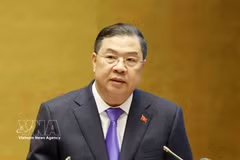
Politburo member, Secretary of the Party Central Committee, Chairman of its Organisation Commission Nguyen Duy Ngoc, who is also head of the steering committee for the review, speaks at the conference. (Photo: VNA)

Ngoc emphasised that the implementation of the reform was carried out with determination of the Party Central Committee, the Politburo, the Secretariat, and Party committees at both the central and local levels.

He highlighted six major achievements of the past year.

First, Party regulations and state legal documents were swiftly revised and issued in a comprehensive and coordinated manner, laying the groundwork for the smooth, efficient and effective functioning of the new administrative system.

Second, the restructuring and streamlining of the oranisational apparatus were carried out swiftly and in a coordinated and decisive manner, marking a strategic breakthrough toward a leaner political system. The reform has helped streamline the organisational structure, remove intermediate administrative layers and create new space for development.

Third, personnel arrangements were carried out alongside the reorganisation and streamlining of the administrative apparatus.

Fourth, administrative reform and digital transformation were accelerated across the entire political system to ensure the effective operation of the new model.

Fifth, the management of public finances and assets was implemented in a coordinated and timely manner to ensure the necessary resources for the smoothly and effective operation of the three-tier administration model.

Sixth, this reform has helped drive socio-economic development and improve people's living conditions. Despite challenges related to natural disasters, economic fluctuations, and the enormous workload involved in the transition process, the new model has proven its effectiveness and created a new dynamic for development. Macroeconomic stability has been maintained, with major economic balances ensured.

Ngoc emphasised that under the leadership of the Party Central Committee, the Politburo, and the Secretariat, headed by the Party General Secretary and State President To Lam, the reform aimed at streamlining the organisation of the political system has achieved significant results and received support from officials, Party members, and the public.

According to him, after one year of operation, the new model has demonstrated its advantages over the previous system, marking a step forward in both theory and practice, and a shift from administrative management to a development-oriented approach.

He further stated that the streamlining of the political system's apparatus had brought about profound transformations. He emphasized, however, that this reform is now entering a new phase aimed at further refining its operation to better serve citizens and businesses.

The streamlining of the organisational apparatus has brought major changes to the structure of the political system, he said. However, he emphasised the process does not end with the completion of the restructuring. The next phase requires continued refinement to improve efficiency and effectiveness, better serving citizens and businesses./.
VNA

See more

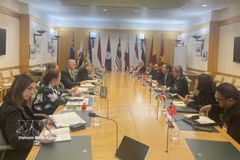
An overview of the working session between ASEAN Committee in Canberra and the Australian Department of Home Affairs (Photo: VNA)

ASEAN Committee in Canberra seeks closer cooperation with Australia's Home Affairs Department

Vietnamese Ambassador to Australia Pham Hung Tam proposed that Australia extend the visa validity period for ASEAN graduates of master's degree programmes from two years to three years in the country from two years to three years. He also urged Australia to soon grant transit visa exemptions for Vietnamese citizens, similar to those already available to nationals of several other ASEAN countries.

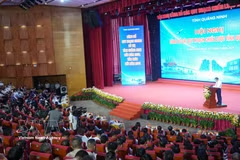
The June 30 conference announcing a series of strategic plans of Quang Ninh and receive recognition of Quang Ninh as a tier-1 urban area. (Photo: VNA)

Quang Ninh unveils strategic plans, sets sights on becoming national urban hub

Under a master plan, Quang Ninh's urban development will be organised around three corridors, four socio-economic zones and five growth centres, including Ha Long, Van Don, Mong Cai, Quang Yen, and the Yen Tu–Ha Long Bay heritage complex. The province will adopt a multi-centre urban model placing people and heritage, including Ha Long Bay and the Yen Tu scenic complex, at its core.

Vietnamese Ambassador to the US Nguyen Quoc Dung (fourth, right) chairs a business rountable with three leading economic promotion organisations of Minnesota. (Photo: VNA)

Vietnamese, US localities strengthen cooperation across multiple fields

Vietnamese Ambassador to the US Nguyen Quoc Dung called on the state to continue supporting the Vietnamese community in Minnesota, encourage local businesses to expand investment and operations in Vietnam, and promote sister-city and sister-province partnerships between Minnesota and Vietnamese localities.

General Secretary of the Communist Party of Vietnam Central Committee and President of Vietnam To Lam (L) and General Secretary of the Communist Party of China Central Committee and President of China Xi Jinping at the signing ceremony of cooperation documents between the two countries during the former’s state visit to China in April 2026. (Photo: VNA)

Congratulations extended on Communist Party of China’s 105th founding anniversary

In the message, the CPV Central Committee congratulated the CPC on its achievements over the past 105 years in uniting and leading the Chinese people to overcome numerous difficulties and challenges and secure remarkable accomplishments. These include the founding of the People's Republic of China, the implementation of the reform and opening-up policy, the advancement of socialism with Chinese characteristics into a new era, and the improvement of the role and international standing of the Party and State.

Party General Secretary and State President To Lam speaks at the first meeting of the Central Steering Committee for Foreign Affairs and International Integration. (Photo: VNA)

Foreign affairs should better serve national development: Top leader

Party General Secretary and State President To Lam underscored that Vietnam’s development goals for 2030, with a vision to 2045, require foreign affairs and international integration to become more proactive, with stronger forecasting capacity, timely and accurate policy advice, and swift action.

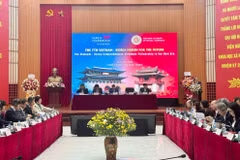
A view of the 7th Vietnam–Korea Forum for the Future (Photo: baochinhphu.vn)

Vietnam, RoK seek to strengthen scientific research cooperation

The forum provided a platform for academic exchange, policy dialogue and networking among research institutions, policymakers, experts, scholars and relevant organisations from both countries. It also aimed to put forward policy recommendations to further advance the Vietnam–RoK Comprehensive Strategic Partnership in the new development phase.

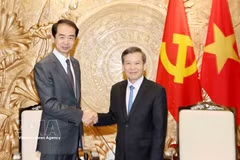
Head of the CPV Central Committee's Commission for Internal Affairs Le Minh Tri (R) and Chinese Ambassador to Vietnam He Wei. (Photo: VNA)

Party official hosts Chinese Ambassador

Vietnam and China further consolidate strategic mutual trust between the two Parties and countries, effectively turn the important common perceptions reached by their top leaders into action, and carry out bilateral diplomatic programmes.

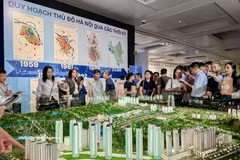
Hanoi residents are interested in exploring the 100-year urban planning vision for the capital city. (Photo: VNA)

Hanoi ready to implement Capital Law 2026, unlocking new development momentum

The effectiveness of the Capital Law 2026 will be measured not by the number of legal documents issued but by tangible improvements in governance and public administration, better services for people and businesses, faster administrative procedures, stronger investment attraction and higher economic growth.

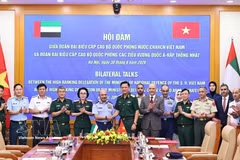
Sen. Lieut. Gen. Nguyen Truong Thang, Deputy Minister of National Defence of Vietnam (seventh, left), Lieut. Gen. Ibrahim Nasser Mohammed Al Alawi, Undersecretary of the UAE Ministry of Defence (sixth, left) and other delegates pose for a group photo (Photo: VNA)

Vietnam, UAE sign MoU on defence industry cooperation

Defence cooperation has recorded positive progress in line with the Vietnam–UAE Comprehensive Partnership. During recent high-level meetings and exchanges, leaders of the two countries reached an important common understanding on strengthening bilateral defence cooperation, including defence industry collaboration, while continuing to support major events hosted by each side.

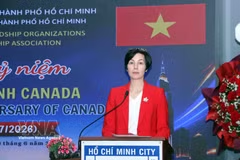
Canadian Consul General in Ho Chi Minh City Annie Dubé speaks at the gathering marking the 159th anniversary of Canada's National Day in Ho Chi Minh City on June 30. (Photo: VNA)

Ho Chi Minh City, Canada strengthen people-to-people friendship

Canada currently has nearly 300 valid foreign direct investment (FDI) projects in Vietnam with total registered capital of 4.87 billion USD. It is also Vietnam's second-largest trading partner in the Americas, with two-way trade reaching approximately 8.5 billion USD in 2025.

Permanent Deputy Prime Minister Pham Gia Tuc speaks at the hybrid conference on studying and implementing the Politburo’s Resolution No. 10-NQ/TW on developing the foreign-invested economic sector on June 30. (Photo: VNA)

Vietnam shifts FDI attraction strategy towards higher quality, greater efficiency

Vietnam’s approach is undergoing a fundamental transformation. While attracting international resources was the central priority over the past nearly four decades, the next phase will focus on enhancing the effectiveness of those resources in synergy with domestic capacities to strengthen development capabilities, economic resilience and national competitiveness.

Speaker of the Algerian Council of the Nation Azzouz Nasri (right) receives outgoing Vietnamese Ambassador to Algeria Tran Quoc Khanh. (Photo: VNA)

Algeria eyes stronger parliamentary ties with Vietnam

Nasri affirmed that Algeria, under the leadership of President Abdelmadjid Tebboune, attaches importance to effectively implementing the Strategic Partnership with Vietnam by enhancing political dialogue; expanding economic, trade and investment cooperation; and promoting cultural and people-to-people exchanges.

Party General Secretary and State President To Lam (3rd from left, first row) and other leaders at the conference. (Photo: VNA)

National conference held to disseminate Politburo's Resolution No. 10-NQ/TW

Party General Secretary and State President To Lam attended and delivered a keynote speech at the event, which was linked to nearly 35,000 venues from central to commune levels, government agencies and military units, attracting almost 2.1 million delegates. It was broadcast live on Vietnam Television and Voice of Vietnam channels.

The success of the two-tier local administration model will be measured by the pace of local development and the satisfaction of citizens. (Photo: VNA)

Leaner organisation, sharper governance create new growth drivers

One year after the implementation of the two-tier local administration model, Vietnamese localities are entering a phase focused on improving governance quality, utilising resources, and translating institutional changes into substantive development momentum.