Domestic, international airlines wish to operate at Long Thanh airport

Vietnam’s aviation market is expected to gain an additional 8.6 million passengers by 2030, including about 3.2 million additional passengers across the Tan Son Nhat–Long Thanh airport system.

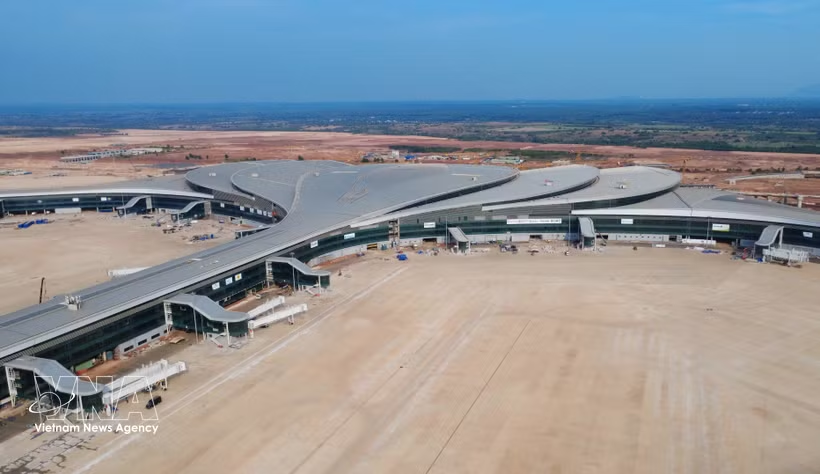
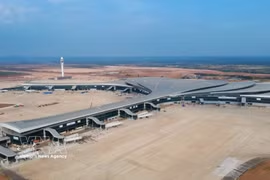
The aircraft apron and the main structure of the passenger terminal at Long Thanh airport have been largely completed. (Photo: VNA)

Dong Nai (VNA) – Airports Corporation of Vietnam (ACV) announced on July 1 that it had held discussions with relevant stakeholders on operational scenarios for Long Thanh International Airport, with most domestic and international airlines expressing a wish to launch services at the airport once it enters operation.

Long Thanh airport is being developed in Long Thanh ward, the southern city of Dong Nai, across an area of 5,000 hectares with a planned capacity of 100 million passengers and 5 million tonnes of cargo annually over three development phases. Located approximately 40–43 km from Ho Chi Minh City’s bustling Tan Son Nhat International Airport, it is set to become Vietnam’s largest airport and is intended to serve as a regional aviation hub. The first phase is expected to be completed by the end of this year.

For international carriers, ACV units have worked with representatives of the association of airlines operating at Tan Son Nhat Airport (SGN AOC), the International Air Transport Association (IATA), and 34 international airlines including Korean Air, All Nippon Airways, Cathay Pacific and Japan Airlines to discuss and prepare operational plans at Long Thanh in line with the schedule.

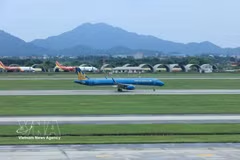
For domestic carriers, ACV has held discussions with Vietravel Airlines regarding plans to launch commercial services at Long Thanh from late 2026 and increase frequencies from the summer 2027 schedule. It has also worked with Vietjet Air and Vietnam Airlines on operational arrangements.

Under the proposed plans, Vietjet Air has committed to operating at least two international routes from Long Thanh during Phase 1, while Vietnam Airlines has proposed transferring a number of international services from Tan Son Nhat to Long Thanh, representing around 12% of the carrier’s international flight portfolio.

For the trial operation phase prior to commercial launch, ACV has also requested Vietnam Airlines to support aircraft availability for operational testing.

According to ACV, alongside the redistribution of selected existing routes from Tan Son Nhat once Long Thanh becomes operational, efforts to develop new direct international services are expected to contribute an additional 2 million passengers annually to Long Thanh by 2030.

Potential new routes are expected to focus on North America, Europe, Oceania, the Middle East, South Asia and Central Asia.

To ensure the new airport’s operational readiness and maximise its advantages from the outset, ACV has established its Long Thanh international airport, aviation fuel and air cargo branches to manage and operate key airport infrastructure. Recruitment for these units is currently underway and is expected to be completed in July.

ACV has also signed a consultancy agreement with the Incheon Airport consortium to support the development of operating and management plans for the airport. Preparatory work covering operational frameworks, core procedures, commercial policy, business planning and financial strategy has been completed.

The corporation is now progressing operational testing and handover arrangements, with three rounds of trial operations scheduled for September, October and November.
vnanet-long-thanh-2.jpg
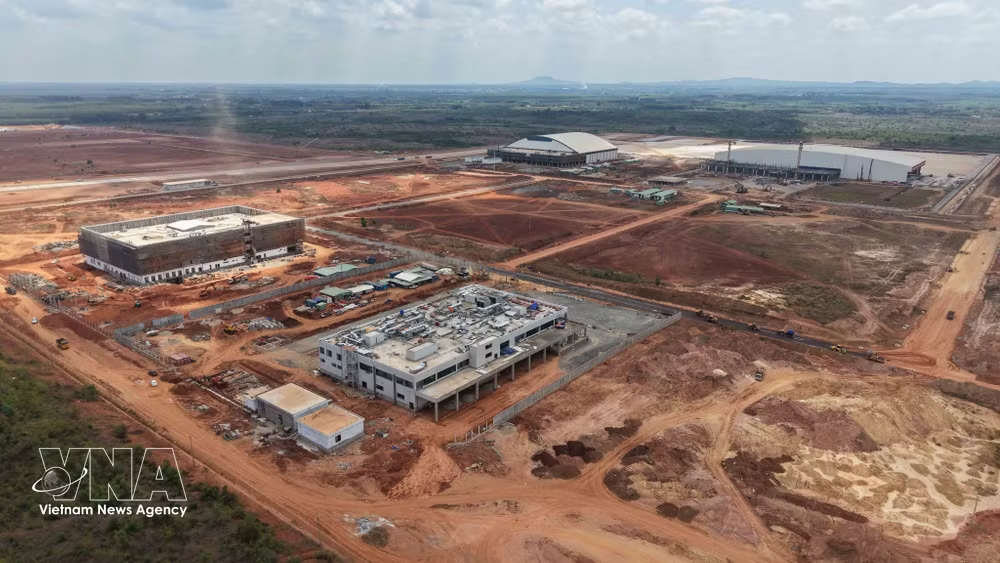
Aviation support service facilities are under construction at Long Thanh airport. (Photo: VNA)

According to ACV, the coordinated operational model between Long Thanh and Tan Son Nhat airports has been designed around a principle of market-based segmentation, with each airport serving distinct market segments, rather than mechanically shifting all traffic from Tan Son Nhat to Long Thanh.

The approach is intended to ensure continued efficient operations at Tan Son Nhat while allowing Long Thanh to achieve stable operations and realise its advantages from the early stages.

Under the current strategy, Tan Son Nhat will continue to focus on domestic services and short- to medium-haul international routes, while Long Thanh is positioned as a major international gateway that will gradually attract new international services, particularly in markets offering medium- and long-term growth potential.

ACV cited IATA forecasts indicating that international passenger demand to Vietnam is expected to remain on a positive growth trajectory through to 2040.

Markets including China, Hong Kong (China), Japan, the Republic of Korea, Malaysia, Singapore, Taiwan (China), Thailand, the US and Australia currently account for around 75% of Vietnam’s international passenger traffic.

Based on these projections, Vietnam’s aviation market is expected to gain an additional 8.6 million passengers by 2030, including about 3.2 million additional passengers across the Tan Son Nhat–Long Thanh airport system./.
VNA

See more

An overview of the working session between the Kazakh delegation and the Can Tho City People's Committee on July 16. (Photo: VNA)

Kazakhstan explores agricultural by-product recycling project in Can Tho city

The proposed project would use rice husks as its primary feedstock, with an estimated one million tonnes processed annually using advanced technology developed in Kazakhstan. At present, the top priority is to secure a stable supply of raw materials from rice-producing provinces across the Mekong Delta.

Consumers buy fruit at a supermarket in Vietnam. (Photo: VNA)

US highlights potential in Vietnam’s fruit market

The US was Vietnam's second-largest supplier of agricultural products, with export turnover reaching 4.7 billion USD in 2025, a remarkable increase from less than 3.5 billion USD in 2024, Fruitnet said, citing a new report by the US Department of Agriculture (USDA).

Vietnamese Ambassador to Thailand Pham Viet Hung (thitd, left) attends the opening ceremony of Grand Halal Bangkok 2026 (Photo: VNA)

Vietnamese firms seek global Halal opportunities at Bangkok exhibition

Ambassador Pham Viet Hung described Grand Halal Bangkok 2026 as an important opportunity for Vietnamese businesses to connect not only with Thailand's Halal industry but also with Halal food producers worldwide, while learning from experience of Thailand and international partners.

Marnufacturing garments for export at Hung Yen Jute and Garment Joint Stock Company. (Photo: VNA)

GDP expands 8.18%, with new growth drivers taking shape

According to the National Statistics Office under the Ministry of Finance, GDP expanded by 8.39% in the second quarter, up from 8.14% a year earlier. Growth for the first six months reached 8.18%, exceeding the 7.63% recorded in the same period of 2025. The performance reflected broad-based contributions from both the supply and demand sides of the economy.

Production line at Honda Vietnam's manufacturing facility in Dong Van II Industrial Park, Ninh Binh province. (Photo: VNA)

Vietnamese economy sustains momentum on strong industrial production

The National Statistics Office (NSO) under the Ministry of Finance reported that the manufacturing and processing sector remained the principal driver of economic growth, accounting for 33.07% of the economy's total value-added growth during the first six months of the year.

Investors conduct transactions at Bao Viet Securities' headquarters in Hanoi. (Photo: VNA)

Vietnam eyes 205.6 billion USD in stock market funding for 2026–2030

Addressing a seminar on restructuring capital mobilisation channels hosted by the Finance and Investment newspaper on July 15, Bui Hoang Hai, Vice Chairman of the State Securities Commission of Vietnam (SSC), said the domestic economy continues to face considerable external challenges in 2026, including the effects from the Middle East conflict.

Workers process farm produce at the Coastal Fisheries Development Company (Cofidec) in Ho Chi Minh City. (Photo: VNA)

Vietnam remains ASEAN’s fastest-growing economy in first half of 2026: experts

Economists at United Overseas Bank (UOB), a Singapore-based multinational bank, said Vietnam’s gross domestic product (GDP) expanded by 8.39% in the second quarter of 2026, from 7.94% in the first quarter. As a result, economic growth for the first half of the year reached 8.18%, keeping Vietnam at the top among ASEAN economies.

The interface of Vietnam's foreign supplier portal for tax registration, declaration and payment by overseas suppliers. (Photo: dientuungdung.vn)

Foreign digital service providers pay nearly 480 million USD in taxes

According to the Department of Taxation, 259 overseas suppliers have registered, declared and paid taxes through the portal. Tax revenue from the group reached 78.1% of the full-year target, surging 119% from a year earlier and making foreign suppliers the fastest-growing source of tax revenue in Vietnam's digital economy.

Ca Mau companies and households use rooftop solar to cut expenses. (Photo: VNA)

Vietnam raises rooftop solar sales cap to 50%, widens direct power deals

Rooftop solar power is entering a new phase of development with a more solid foundation. When integrated with energy storage systems and direct power purchase mechanisms, it not only contributes to supplementing distributed energy sources and reducing pressure on the national power system, but also serves as a driving force for green growth, enhances the competitiveness of the economy, and ensures energy security.

Production of electrical wiring harnesses at Bandai Vietnam Co., Ltd. in the Left Bank Industrial Park, Phu Tho province. (Photo: VNA)

Record FDI Inflows signal strong investor confidence, but absorptive capacity remains key

Vietnam's competitive advantages are evolving. Rather than relying primarily on low labour costs and tax incentives, the country's future competitiveness will increasingly depend on structural and long-term factors, including transparent institutions, policy predictability and an investment environment capable of supporting long-term strategic investors.