New administrative system must deliver new governance capacity: Top leader

The Party and State leader described the restructuring as a broad, complex and far-reaching reform affecting almost every agency and public servant from the central to grassroots levels. While praising the significant initial achievements, he stressed that the results marked only the beginning and warned against complacency.

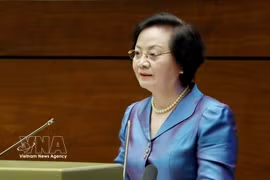
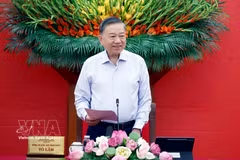
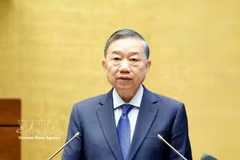
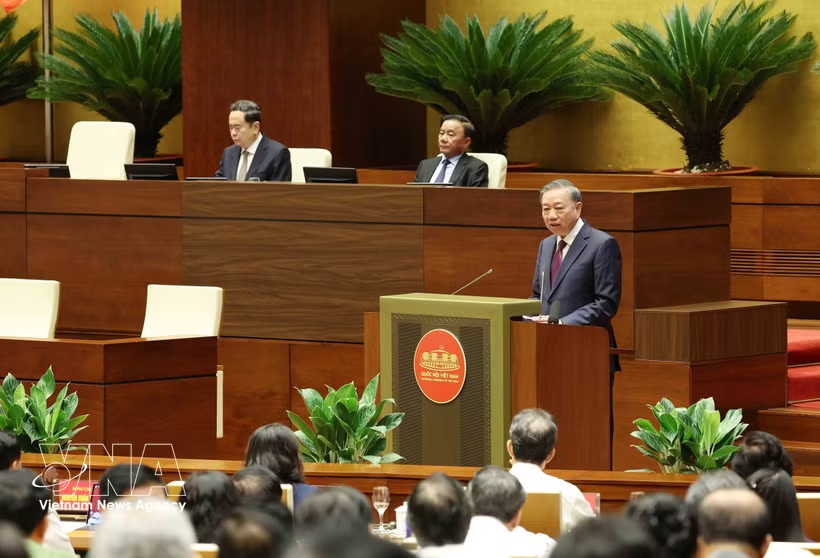
Party General Secretary and State President To Lam addresses the conference on July 1. (Photo: VNA)

Hanoi (VNA) – Party General Secretary and State President To Lam on July 1 stressed the need for shifting the focus of Vietnam's ongoing institutional reform towards improving the performance, public service capacity and development-oriented governance of the newly restructured apparatus.

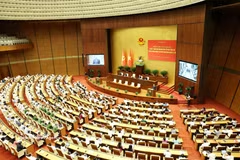
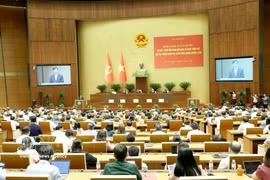
Speaking at a national conference, which was held in person at the National Assembly's headquarters in Hanoi and connected online to 3,651 locations nationwide and brought together more than 557,000 delegates to review one year of the operation of the political system's overall organisational model and the three-tier government model, the top leader stressed that streamlining the political system to make it more efficient and effective was a strategic reform essential to the country's long-term development.

The Party and State leader described the restructuring as a broad, complex and far-reaching reform affecting almost every agency and public servant from the central to grassroots levels. While praising the significant initial achievements, he stressed that the results marked only the beginning and warned against complacency.

He urged continued efforts to improve the operation of the new model by further refining legal and institutional frameworks based on practical bottlenecks. Party and Government agencies, ministries, sectors and localities were instructed to comprehensively review regulations governing organisational structures, functions, responsibilities and coordination mechanisms to eliminate overlaps, duplication and regulatory gaps.

The leader stressed the need for continued renovation of the Party's leadership methods, emphasising strategic direction, institution-building, personnel management, inspection and performance evaluation, while avoiding unnecessary administrative intervention in the work of state agencies and mass organisations.

Regarding the two-tier local government model, he said provincial authorities should focus on strategic planning, regional coordination and resource allocation, while commune-level authorities must serve as the frontline of public governance, responding promptly to the needs of citizens and businesses and addressing emerging local issues.
vnanet-potal-hoi-nghi-toan-quoc-so-ket-1-nam-van-hanh-mo-hinh-to-chuc-tong-the-cua-he-thong-chinh-tri-va-mo-hinh-chinh-quyen-3-cap-8859415.jpg
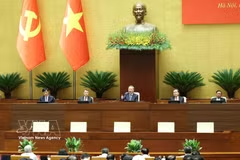
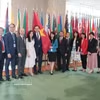
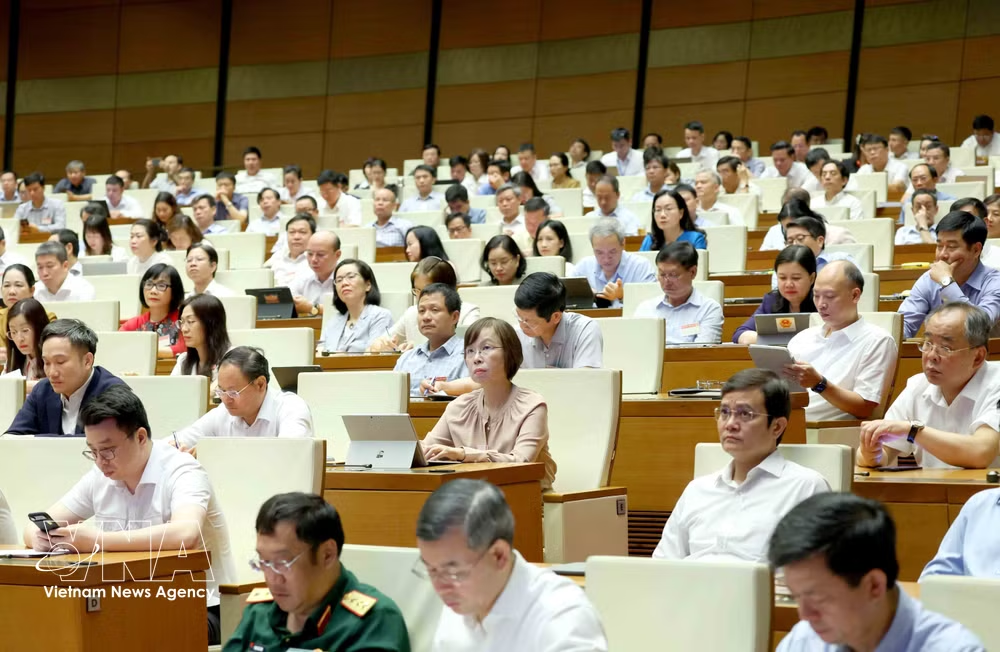
Officials attend the conference on July 1. (Photo: VNA)

He also called for organisational structures and staffing levels to be tailored to population size, urbanisation and regional characteristics rather than applying uniform standards, while encouraging research into urban core administrative models capable of coordinating infrastructure, public services and regional development.

The leader stressed that decentralisation must be accompanied by adequate authority, resources and accountability. Assigning responsibilities without providing sufficient personnel, funding, data and management tools should be avoided. He emphasised that decentralisation should involve the transfer of authority, resources and responsibility, supported by stronger inspection, auditing and transparency.

General Secretary and State President Lam highlighted the importance of building a capable civil service suited to the new governance model, with grassroots administrative capacity serving as a key measure of the reform's success, along with accelerated digital transformation across the political system.

He urged the Vietnam Fatherland Front and socio-political organisations to strengthen their grassroots engagement and establish effective mechanisms to collect and respond to feedback from citizens and businesses, making public opinion an important channel for monitoring the performance of local authorities.

The leader also stressed the need to efficiently manage public assets, offices and administrative records following the restructuring, calling for surplus facilities to be repurposed transparently, with priority given to education, healthcare, culture, sports and social welfare. Administrative records should be properly preserved, digitised and managed to safeguard the legitimate rights of organisations, citizens and businesses.

He called for strong inspection and supervision through both field monitoring and data-driven governance, including the development of performance indicators covering administrative processing times, on-time completion rates, public satisfaction, and the efficiency of commune-level administrations.

At the same time, he stressed the need to protect officials who act responsibly and innovatively within the law while strictly dealing with those who abuse the reform process for personal gain or evade responsibility.

For cross-sector issues, he asked for a clearer allocation of responsibilities based on the principle that each task should have one lead agency, one accountable authority, one shared data source and one integrated coordination process, backed by clear accountability mechanisms. He also urged continued reforms in cadre evaluation, talent development and personnel management to build a civil service capable of meeting the demands of modern governance.

He instructed relevant agencies to promptly incorporate the conference's recommendations into action plans, with clearly defined tasks, responsibilities, timelines, resources, performance indicators and monitoring mechanisms.

The Party General Secretary and State President concluded that the new organisational model must deliver new governance capacity, with decentralisation matched by greater accountability, digital data supporting new management methods, and the restructured administrative system providing higher-quality public services for citizens and businesses.

He expressed confidence that the political system and the three-tier government model will continue to be refined and operate effectively, contributing to a modern, transparent, development-oriented and people-centred national governance system./.
VNA

See more

Party General Secretary and State President To Lam (centre) chairs the conference. (Photo: VNA)

Politburo sets six priorities for implementing Resolution No. 57

After 18 months of implementing Resolution No. 57, ministries, sectors and localities have adopted innovative and effective approaches that have generated positive momentum, while winning broad support from businesses, the scientific community and the public for policies on science, technology, innovation and digital transformation.

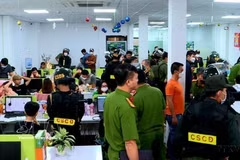
Police in Tan Binh district, Ho Chi Minh City, in coordination with the Department of Cybersecurity and High-Tech Crime Prevention under the Ministry of Public Security, searched multiple locations and placed 86 suspects in temporary criminal detention for investigation into alleged telecom and online fraud. (Photo: VNA)

New Cybersecurity Law strengthens protection of citizens' rights in digital age

The law also introduces more comprehensive provisions on data security, information system protection and measures to prevent, detect and address cybersecurity violations. It prioritises prevention, enhances early warning and incident response capabilities, and links cybersecurity with maintaining social order and security amid rapid digital transformation.

An overview of the the July 1 national conference reviewing the one-year operation of the three-tier administration model (Photo: VNA)

Localities propose reforms to improve three-tier government model

A Hanoi official called for further decentralisation to commune-level authorities in line with resource allocation, continued streamlining of organisational structures to eliminate unnecessary intermediary layers, further refining the Party organisations’ model to align with the state administrative system, greater autonomy for non-business public service units, and wider participation of businesses and social organisations in delivering suitable public services.

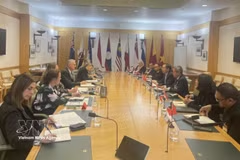
An overview of the working session between ASEAN Committee in Canberra and the Australian Department of Home Affairs (Photo: VNA)

ASEAN Committee in Canberra seeks closer cooperation with Australia's Home Affairs Department

Vietnamese Ambassador to Australia Pham Hung Tam proposed that Australia extend the visa validity period for ASEAN graduates of master's degree programmes from two years to three years in the country from two years to three years. He also urged Australia to soon grant transit visa exemptions for Vietnamese citizens, similar to those already available to nationals of several other ASEAN countries.

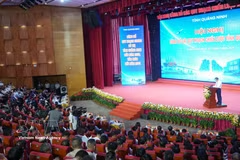
The June 30 conference announcing a series of strategic plans of Quang Ninh and receive recognition of Quang Ninh as a tier-1 urban area. (Photo: VNA)

Quang Ninh unveils strategic plans, sets sights on becoming national urban hub

Under a master plan, Quang Ninh's urban development will be organised around three corridors, four socio-economic zones and five growth centres, including Ha Long, Van Don, Mong Cai, Quang Yen, and the Yen Tu–Ha Long Bay heritage complex. The province will adopt a multi-centre urban model placing people and heritage, including Ha Long Bay and the Yen Tu scenic complex, at its core.

Vietnamese Ambassador to the US Nguyen Quoc Dung (fourth, right) chairs a business rountable with three leading economic promotion organisations of Minnesota. (Photo: VNA)

Vietnamese, US localities strengthen cooperation across multiple fields

Vietnamese Ambassador to the US Nguyen Quoc Dung called on the state to continue supporting the Vietnamese community in Minnesota, encourage local businesses to expand investment and operations in Vietnam, and promote sister-city and sister-province partnerships between Minnesota and Vietnamese localities.

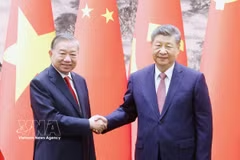
General Secretary of the Communist Party of Vietnam Central Committee and President of Vietnam To Lam (L) and General Secretary of the Communist Party of China Central Committee and President of China Xi Jinping at the signing ceremony of cooperation documents between the two countries during the former’s state visit to China in April 2026. (Photo: VNA)

Congratulations extended on Communist Party of China’s 105th founding anniversary

In the message, the CPV Central Committee congratulated the CPC on its achievements over the past 105 years in uniting and leading the Chinese people to overcome numerous difficulties and challenges and secure remarkable accomplishments. These include the founding of the People's Republic of China, the implementation of the reform and opening-up policy, the advancement of socialism with Chinese characteristics into a new era, and the improvement of the role and international standing of the Party and State.

Party General Secretary and State President To Lam speaks at the first meeting of the Central Steering Committee for Foreign Affairs and International Integration. (Photo: VNA)

Foreign affairs should better serve national development: Top leader

Party General Secretary and State President To Lam underscored that Vietnam’s development goals for 2030, with a vision to 2045, require foreign affairs and international integration to become more proactive, with stronger forecasting capacity, timely and accurate policy advice, and swift action.

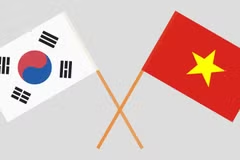
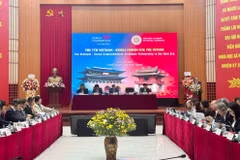
A view of the 7th Vietnam–Korea Forum for the Future (Photo: baochinhphu.vn)

Vietnam, RoK seek to strengthen scientific research cooperation

The forum provided a platform for academic exchange, policy dialogue and networking among research institutions, policymakers, experts, scholars and relevant organisations from both countries. It also aimed to put forward policy recommendations to further advance the Vietnam–RoK Comprehensive Strategic Partnership in the new development phase.

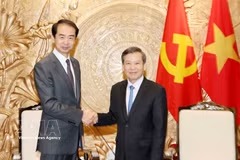
Head of the CPV Central Committee's Commission for Internal Affairs Le Minh Tri (R) and Chinese Ambassador to Vietnam He Wei. (Photo: VNA)

Party official hosts Chinese Ambassador

Vietnam and China further consolidate strategic mutual trust between the two Parties and countries, effectively turn the important common perceptions reached by their top leaders into action, and carry out bilateral diplomatic programmes.

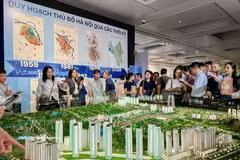
Hanoi residents are interested in exploring the 100-year urban planning vision for the capital city. (Photo: VNA)

Hanoi ready to implement Capital Law 2026, unlocking new development momentum

The effectiveness of the Capital Law 2026 will be measured not by the number of legal documents issued but by tangible improvements in governance and public administration, better services for people and businesses, faster administrative procedures, stronger investment attraction and higher economic growth.

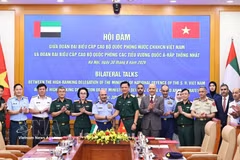
Sen. Lieut. Gen. Nguyen Truong Thang, Deputy Minister of National Defence of Vietnam (seventh, left), Lieut. Gen. Ibrahim Nasser Mohammed Al Alawi, Undersecretary of the UAE Ministry of Defence (sixth, left) and other delegates pose for a group photo (Photo: VNA)

Vietnam, UAE sign MoU on defence industry cooperation

Defence cooperation has recorded positive progress in line with the Vietnam–UAE Comprehensive Partnership. During recent high-level meetings and exchanges, leaders of the two countries reached an important common understanding on strengthening bilateral defence cooperation, including defence industry collaboration, while continuing to support major events hosted by each side.

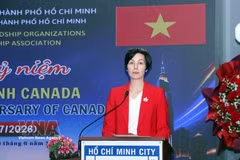
Canadian Consul General in Ho Chi Minh City Annie Dubé speaks at the gathering marking the 159th anniversary of Canada's National Day in Ho Chi Minh City on June 30. (Photo: VNA)

Ho Chi Minh City, Canada strengthen people-to-people friendship

Canada currently has nearly 300 valid foreign direct investment (FDI) projects in Vietnam with total registered capital of 4.87 billion USD. It is also Vietnam's second-largest trading partner in the Americas, with two-way trade reaching approximately 8.5 billion USD in 2025.