New E-Commerce Law expected to create transparent digital market

With Vietnam’s e-commerce sustaining annual growth of around 20–25% and emerging as one of Southeast Asia’s most dynamic markets, further improving the legal framework, strengthening consumer trust and fostering a fair competitive environment will help make e-commerce one of the key drivers of Vietnam’s digital economy in the near future.

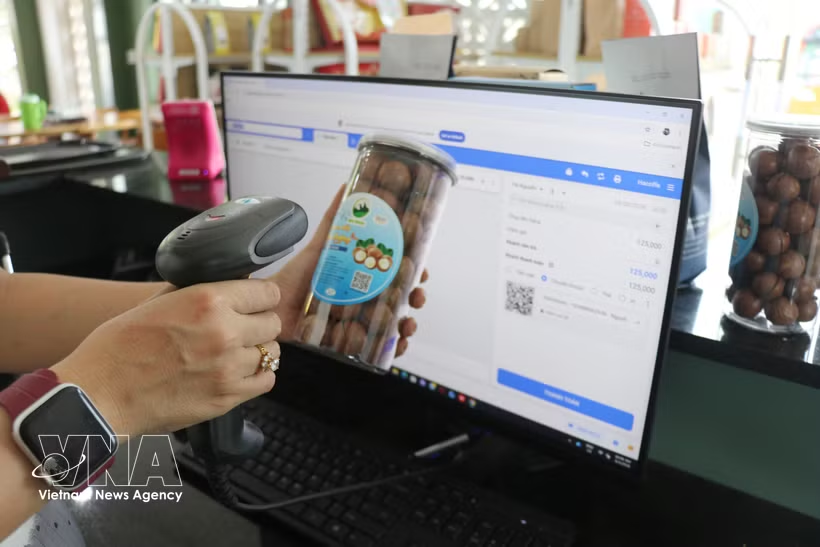
Agricultural and OCOP products of Nhan Co commune in Lam Dong province have been digitally catalogued, equipped with QR codes for origin tracing, and listed on e-commerce platforms. (Photo: VNA)

Ho Chi Minh City (VNA) – Vietnam’s e-commerce sector is expected to enter a new stage of development as the Law on E-Commerce officially took effect on July 1, providing a more comprehensive legal framework for online business activities and addressing persistent challenges in the rapidly expanding digital market.

According to a report by YouNet ECI, a leading e-commerce consulting and data analytics firm in Vietnam, the combined transaction value of the four largest e-commerce platforms in the country – Shopee, TikTok Shop, Tiki and Lazada – exceeded 458 trillion VND (17.4 billion USD) in 2025, up 26% from the previous year. Vietnam’s e-commerce sector has maintained an annual growth rate of 20–25%, among the highest in Southeast Asia.

While the rapid expansion of e-commerce has created new opportunities for businesses to reach consumers at lower costs and on a larger scale, it has also brought challenges, including counterfeit and imitation goods, products of unclear origin, misleading advertising and unfair competition.

Nguyen Tan Phong, Vice Chairman of the Vietnam E-commerce Association, said one of the most significant aspects of the new law is its role in addressing long-standing regulatory “grey areas” in the digital economy.

According to him, the legislation clearly defines different forms of online business activities, ranging from sales conducted through social media and e-commerce platforms to intermediary digital services. It also establishes clearer responsibilities for stakeholders participating in the online marketplace.

Under the law, sellers are required to verify their identities and ensure that products offered on digital platforms meet regulations on origin and quality. Content creators involved in advertising and livestream sales must provide transparent information and comply with relevant advertising regulations and professional standards.

Phong said seller identification requirements will help curb fraudulent activities, facilitate regulatory oversight and improve the handling of violations. More importantly, he noted, these measures are aimed at strengthening consumer confidence, a key foundation for the sustainable development of e-commerce.

Representing digital platforms, Nguyen Lam Thanh of TikTok Vietnam said a clearer legal framework will contribute to a more transparent and sustainable business environment.

He noted that consumer trust is essential for market expansion, while legitimate businesses need a fair environment to compete. According to Thanh, major platforms highly value the improvements in Vietnam’s legal framework and are committed to complying with Vietnamese regulations.

Businesses have also welcomed the new law. Luu Nga, Creative Director of fashion brand Elise, said legitimate manufacturers and retailers have long faced intense pressure from unofficial imports and products of unclear origin sold at exceptionally low prices through online channels.

She expressed her hope that stricter enforcement of regulations related to taxation, market supervision and product authentication will help create fairer competition and provide greater opportunities for reputable brands to grow.

Nga added that as the market becomes more regulated, businesses will need to focus on product quality, brand development and customer experience rather than relying solely on price competition.

Tran Thi Thuy Linh, a livestream seller and content creator, said consumers are increasingly concerned about product quality, origin, transparency and after-sales services rather than simply seeking the lowest prices.

As livestreaming and video content become important sales channels, she said, greater transparency and accountability among sellers and content creators are inevitable. Linh also stressed the importance of keeping up to date with platform regulations and legal requirements to ensure compliance during product promotion activities.

Experts believe the greatest significance of the Law on E-Commerce lies not only in strengthening market oversight but also in establishing fairer rules for all participants in the digital commerce ecosystem. As Vietnam’s e-commerce market continues to expand, a stronger legal framework is expected to reinforce consumer trust, improve market governance and support the sector’s growing role as a key driver of the country’s digital economy.

With Vietnam’s e-commerce sustaining annual growth of around 20–25% and emerging as one of Southeast Asia’s most dynamic markets, further improving the legal framework, strengthening consumer trust and fostering a fair competitive environment will help make e-commerce one of the key drivers of Vietnam’s digital economy in the near future./.

VNA

See more

The Hoa Phat Dung Quat steel factory (Photo: VNA)

Vietnamese steelmakers find growth momentum despite export challenges

Vietnam's crude steel output is forecast to reach 27 million tonnes in 2026, up 10% year-on-year. Finished steel production is projected at 33 million tonnes, with domestic consumption of 28 million tonnes and exports of 6 million tonnes. Steel imports are expected to decline, signaling improving domestic production capacity and the growing bite of market management and trade remedy measures.

A fruit festival in the Mekong Delta city of Can Tho. (Photo: VNA)

Agro-forestry-fishery exports rise 6% in first half of 2026

Of the six-month total, agricultural products generated 18.59 billion USD, up 0.2% year-on-year; aquatic products 5.7 billion USD, up 11.4%; forestry products 9.2 billion USD, up 4.6%; livestock products 375.8 million USD, up 34.6%; and salt 7.7 million USD, up 39.8%.

A view of the Binh Xuyen Industrial Park in Phu Tho province. (Photo: VNA)

📝 OP-ED: A new mindset on FDI – Vietnam’s answer to unfounded doubts

The resolution sends a clear and forceful signal of the Party’s consistent policy that the foreign-invested sector is an integral component of the national economy – one that is encouraged to develop over the long term, treated on an equal footing and expected to work alongside other sectors in pursuit of the country’s development goals.

Workers sort and process almonds for export at the factory of Gold Tree Food Vietnam Co., Ltd., a wholly Chinese-owned company, in Tu Ha Industrial Park, Hue city. (Photo: VNA)

Vietnam moves to tackle double challenge in FDI attraction in next phase

The challenge was seen in the Politburo's Resolution No. 10-NQ/TW on developing the foreign-invested sector, which sets ambitious targets for the 2026–2030 period. Vietnam aims to attract 200–300 billion USD in registered FDI, equivalent to 40–50 billion USD annually, while disbursed capital is expected to reach 150–200 billion USD, or 30–40 billion USD each year.

Workers at the Lefaso Tra Vinh Industrial Production and Investment JSC in Tra Cu commune, Vinh Long province (Photo: VNA)

New decree details support for FTA ecosystem members

Decree No. 240/2026/ND-CP elaborates on the enforcement of mechanisms and policies to pool resources for building and running that ecosystem and a sectoral export promotion fund, following National Assembly Resolution No. 250/2025/QH15, dated December 10, 2025, that targets sharper global economic integration.

The Hateco Hai Phong International Container Terminal (Photo: VNA)

Hai Phong ports record 11% rise in six-month cargo throughput

A milestone came on June 23, when the MATZ MAERSK, a container vessel with a reduced deadweight of 213,970.8 DWT, safely arrived at Berths No. 5 and 6 of the Lach Huyen port area, operated by Hateco Hai Phong International Container Terminal (HHIT).

Participants in the opening ceremony of the HanoiPrintPack 2026 on July 1 (Photo: VNA)

Hanoi hosts industrial exhibitions showcasing global manufacturing

The events – HanoiPlas 2026, HanoiPrintPack 2026 and Intelligent Asia Hanoi 2026, are being held concurrently for the first time, creating an integrated industrial ecosystem spanning plastics and rubber, printing and packaging, automation, electronics, precision engineering and smart manufacturing.

MTA Vietnam 2026 opens at the Saigon Exhibition and Convention Center (SECC) in Ho Chi Minh City on July 1, 2026. (Photo: VNA)

MTA Vietnam 2026 showcases latest precision engineering technologies

The event showcases advanced manufacturing technologies, equipment and solutions spanning the entire production value chain, including metalworking, sheet metal processing, mould and die manufacturing, welding, CNC machining, laser cutting, automation, metrology, heat treatment, pneumatic systems and next-generation industrial solutions.

Perspective of the Nha Rong Wharf - Khanh Hoi Cultural Park Project and Bach Dang Riverside Green Space (Photo published by VNA)

Ho Chi Minh City launches eight key projects worth 9.6 bln USD

According to the municipal People's Committee, the projects are financed through a combination of public investment, public-private partnerships (PPP) and private capital, reflecting the Government's policy of promoting private sector development.