Ho Chi Minh City starts work on first major component of Metro Line No. 2

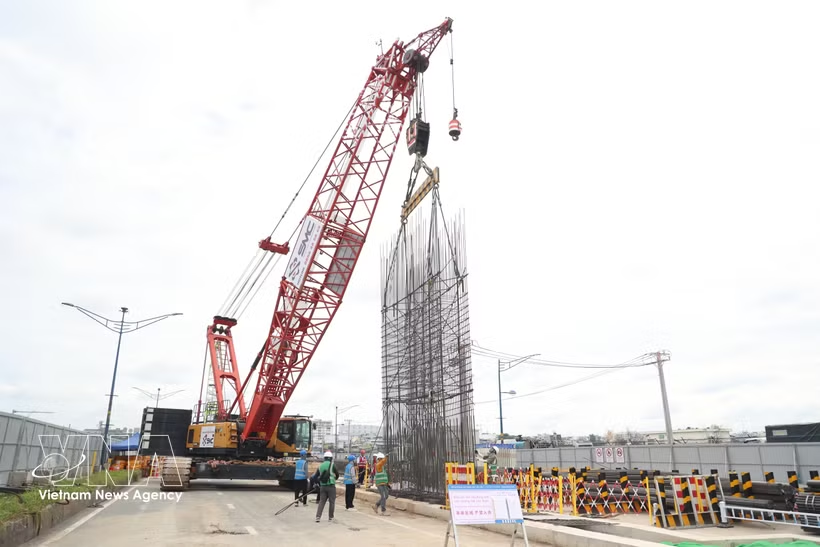
The first construction activity involves lowering a reinforced steel cage for the diaphragm wall at the underground ST10 (Pham Van Bach) station, one of the line's key stations.

A reinforced steel cage is lowered for the diaphragm wall at the underground ST10 (Pham Van Bach) station on July 2. (Photo: VNA)

Ho Chi Minh City (VNA) – Ho Chi Minh City officially began construction of the first major component of Metro Line No. 2 (Ben Thanh – Tham Luong) on July 2, marking the project's transition from the preparation phase to full-scale construction.

The first construction activity involves lowering a reinforced steel cage for the diaphragm wall at the underground ST10 (Pham Van Bach) station, one of the line's key stations. Diaphragm walls are deep reinforced concrete structures that support excavation and form the outer walls of underground stations.

The ceremony, organised by the city's Management Authority for Urban Railways (MAUR), coincided with the 50th anniversary of Sai Gon – Gia Dinh officially named after President Ho Chi Minh (July 2, 1976–2026).

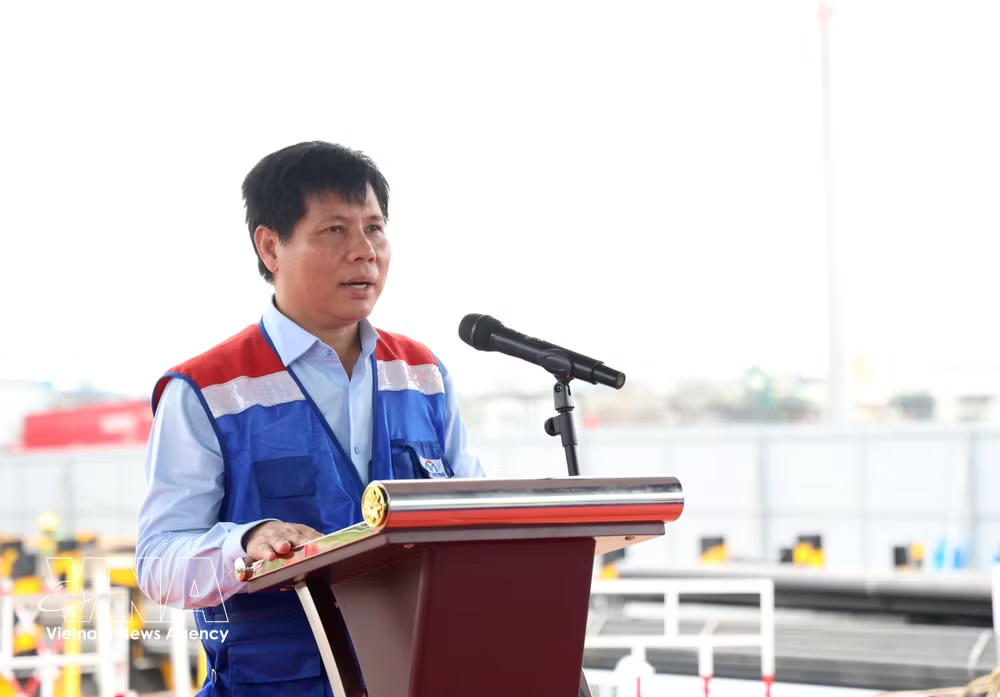
In his remarks, MAUR Director Phan Cong Bang described the event as an important step for both Metro Line No. 2 and the city's urban transport system.

He said that nearly three months after the engineering, procurement and construction (EPC) contract was signed on April 8, the project investor and the EPC consortium had completed key legal, technical and preparatory work despite various challenges, paving the way for construction to begin.
vnanet-potal-tp-ho-chi-minh-metro-so-2-chinh-thuc-chuyen-sang-giai-doan-thi-cong-truc-tiep-8862589.jpg
MAUR Director Phan Cong Bang speaks at the event. (Photo: VNA)

According to Bang, additional geological surveys along the route have largely been completed to support detailed engineering design. Technical solutions have also been finalised for the two most critical underground stations – ST5 (Le Thi Rieng) and ST10 (Pham Van Bach).

The contractor has established a material quality control system, selected qualified subcontractors for diaphragm wall construction, and coordinated with local authorities to widen sections of Cach Mang Thang Tam and Truong Chinh roads to facilitate traffic diversions during construction.

The official urged the EPC consortium to accelerate construction while ensuring absolute safety, particularly when handling oversized and heavy structural components. He also called for construction methods that minimise traffic congestion, dust and disruption to nearby residents.

Representing the EPC consortium, Director of the Metro Line No. 2 project Long Quoc Tuan said ST10 is one of the most technically challenging stations on the route because it is located close to the controlled airspace of Tan Son Nhat International Airport, where construction height is limited to 18 metres.

Despite those constraints, he said the consortium will adhere to the principles of "safety first, quality as the foundation and standards as the lodestar" while complying with both Vietnamese regulations and European technical standards.

According to MAUR, ST10 and ST5 will serve as the launch sites for two tunnel boring machines (TBMs) that will excavate the underground section of the metro line.

Construction of the 534-metre diaphragm wall at ST10 is expected to take around six months. Work is also underway at ST5. Meanwhile, construction at the remaining stations is scheduled to begin in July and August after traffic diversion plans and site preparation are completed.

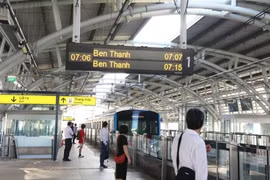
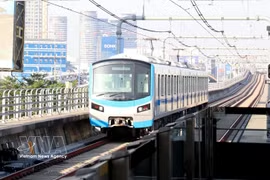
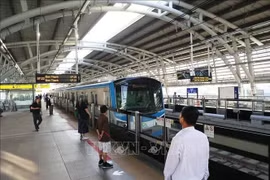
Once operational, Metro Line No. 2 is expected to help improve public transport capacity, ease road congestion and support transit-oriented urban development in Ho Chi Minh City./.​

VNA

See more

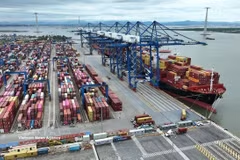
Cargo at Lach Huyen Container Terminal in Hai Phong city (Photo: VNA)

World Bank upgrades Vietnam to upper-middle-income status

According to the World Bank’s latest update released on July 1, Vietnam’s gross national income (GNI) per capita reached 4,970 USD in 2025, exceeding the institution’s 4,636 USD threshold for upper-middle-income economies.

Agricultural and OCOP products of Nhan Co commune in Lam Dong province have been digitally catalogued, equipped with QR codes for origin tracing, and listed on e-commerce platforms. (Photo: VNA)

New E-Commerce Law expected to create transparent digital market

With Vietnam’s e-commerce sustaining annual growth of around 20–25% and emerging as one of Southeast Asia’s most dynamic markets, further improving the legal framework, strengthening consumer trust and fostering a fair competitive environment will help make e-commerce one of the key drivers of Vietnam’s digital economy in the near future.

The Hoa Phat Dung Quat steel factory (Photo: VNA)

Vietnamese steelmakers find growth momentum despite export challenges

Vietnam's crude steel output is forecast to reach 27 million tonnes in 2026, up 10% year-on-year. Finished steel production is projected at 33 million tonnes, with domestic consumption of 28 million tonnes and exports of 6 million tonnes. Steel imports are expected to decline, signaling improving domestic production capacity and the growing bite of market management and trade remedy measures.

Farmers harvest coffee in the Central Highlands. Coffee is among the key foreign currency earner of Vietnam. (Photo: VNA)

Agro-forestry-fishery exports rise 6% in first half of 2026

Of the six-month total, agricultural products generated 18.59 billion USD, up 0.2% year-on-year; aquatic products 5.7 billion USD, up 11.4%; forestry products 9.2 billion USD, up 4.6%; livestock products 375.8 million USD, up 34.6%; and salt 7.7 million USD, up 39.8%.

A view of the Binh Xuyen Industrial Park in Phu Tho province. (Photo: VNA)

📝 OP-ED: A new mindset on FDI – Vietnam’s answer to unfounded doubts

The resolution sends a clear and forceful signal of the Party’s consistent policy that the foreign-invested sector is an integral component of the national economy – one that is encouraged to develop over the long term, treated on an equal footing and expected to work alongside other sectors in pursuit of the country’s development goals.

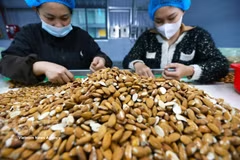
Workers sort and process almonds for export at the factory of Gold Tree Food Vietnam Co., Ltd., a wholly Chinese-owned company, in Tu Ha Industrial Park, Hue city. (Photo: VNA)

Vietnam moves to tackle double challenge in FDI attraction in next phase

The challenge was seen in the Politburo's Resolution No. 10-NQ/TW on developing the foreign-invested sector, which sets ambitious targets for the 2026–2030 period. Vietnam aims to attract 200–300 billion USD in registered FDI, equivalent to 40–50 billion USD annually, while disbursed capital is expected to reach 150–200 billion USD, or 30–40 billion USD each year.

Workers at the Lefaso Tra Vinh Industrial Production and Investment JSC in Tra Cu commune, Vinh Long province (Photo: VNA)

New decree details support for FTA ecosystem members

Decree No. 240/2026/ND-CP elaborates on the enforcement of mechanisms and policies to pool resources for building and running that ecosystem and a sectoral export promotion fund, following National Assembly Resolution No. 250/2025/QH15, dated December 10, 2025, that targets sharper global economic integration.

The Hateco Hai Phong International Container Terminal (Photo: VNA)

Hai Phong ports record 11% rise in six-month cargo throughput

A milestone came on June 23, when the MATZ MAERSK, a container vessel with a reduced deadweight of 213,970.8 DWT, safely arrived at Berths No. 5 and 6 of the Lach Huyen port area, operated by Hateco Hai Phong International Container Terminal (HHIT).

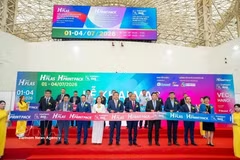
Participants in the opening ceremony of the HanoiPrintPack 2026 on July 1 (Photo: VNA)

Hanoi hosts industrial exhibitions showcasing global manufacturing

The events – HanoiPlas 2026, HanoiPrintPack 2026 and Intelligent Asia Hanoi 2026, are being held concurrently for the first time, creating an integrated industrial ecosystem spanning plastics and rubber, printing and packaging, automation, electronics, precision engineering and smart manufacturing.

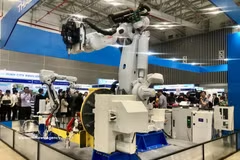
MTA Vietnam 2026 opens at the Saigon Exhibition and Convention Center (SECC) in Ho Chi Minh City on July 1, 2026. (Photo: VNA)

MTA Vietnam 2026 showcases latest precision engineering technologies

The event showcases advanced manufacturing technologies, equipment and solutions spanning the entire production value chain, including metalworking, sheet metal processing, mould and die manufacturing, welding, CNC machining, laser cutting, automation, metrology, heat treatment, pneumatic systems and next-generation industrial solutions.