Vietnam–Singapore QR payment link expands ASEAN’s digital economy infrastructure

According to the Vietnam National Authority of Tourism, the country welcomed around 10.6 million international visitors in the first five months of 2026, up nearly 15% year on year and the highest figure recorded in many years. Singapore remained one of Vietnam’s fastest-growing source markets during the period.

Delegates at the launching ceremony. (Photo: VNA)

Hanoi (VNA) – The National Payment Corporation of Vietnam (NAPAS), Singapore-based Liquid Group and Vietnam Joint Stock Commercial Bank for Industry and Trade (VietinBank) officially launched a cross-border QR payment service between Vietnam and Singapore on July 2.

The new connection is expected to facilitate tourism and trade while strengthening digital payment infrastructure in the Association of Southeast Asian Nations (ASEAN) region.

Under the new mechanism, users of payment applications within Singapore’s participating ecosystem can scan VietQRGlobal codes to make payments directly at participating merchants in Vietnam. Transactions are processed in real time, with the system automatically converting between the Singapore dollar (SGD) and the Vietnamese dong (VND), allowing users to pay without exchanging cash or relying on conventional payment methods.

The new service is also expected to benefit Vietnamese businesses. Retailers, hotels, restaurants and service providers will be able to serve international customers more conveniently without investing in dedicated payment terminals or handling multiple currencies. Instead, merchants can accept payments through the existing VietQRGlobal infrastructure. According to NAPAS, the service is expected to reach around 5 million users during the initial rollout through Liquid Group’s partner network in Singapore. The user base is expected to expand further as the Singaporean partner continues to grow its connected payment ecosystem.

Under the project, VietinBank serves as the settlement bank for QR payment transactions between the two countries. The new link also expands NAPAS’s cross-border QR payment network to six countries and territories, with Singapore becoming the fourth ASEAN market connected to Vietnam’s QR payment system.

As part of the cooperation roadmap, NAPAS and its partners plan to introduce outbound QR payments from Vietnam to Singapore later this year.

According to the Vietnam National Authority of Tourism, the country welcomed around 10.6 million international visitors in the first five months of 2026, up nearly 15% year on year and the highest figure recorded in many years. Singapore remained one of Vietnam’s fastest-growing source markets during the period.

A survey conducted by Changi Airport Group also found that three in five Singaporeans have visited Vietnam, with most expressing a desire to return. Singaporean travellers are regarded as relatively high-spending visitors who show a strong preference for electronic payment methods.

Against this backdrop, enabling visitors from Singapore to pay using the mobile payment applications they already use at home is expected to enhance the travel experience while reducing barriers to cross-border transactions./.

VNA

See more

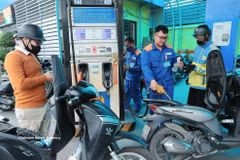
Customers purchase fuel at a Petrolimex service station. (Photo: VNA)

Petrol prices cut from 16:00 on July 2

Accordingly, the price of E5 RON92 petrol is capped at 19,730 VND (0.75 USD) per litre, down 1,055 VND, while E10 RON95-III is priced at no more than 20,415 VND per litre, down 788 VND.

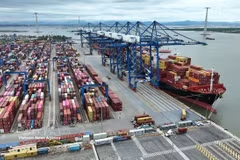
Cargo at Lach Huyen Container Terminal in Hai Phong city (Photo: VNA)

World Bank upgrades Vietnam to upper-middle-income status

According to the World Bank’s latest update released on July 1, Vietnam’s gross national income (GNI) per capita reached 4,970 USD in 2025, exceeding the institution’s 4,636 USD threshold for upper-middle-income economies.

Agricultural and OCOP products of Nhan Co commune in Lam Dong province have been digitally catalogued, equipped with QR codes for origin tracing, and listed on e-commerce platforms. (Photo: VNA)

New E-Commerce Law expected to create transparent digital market

With Vietnam’s e-commerce sustaining annual growth of around 20–25% and emerging as one of Southeast Asia’s most dynamic markets, further improving the legal framework, strengthening consumer trust and fostering a fair competitive environment will help make e-commerce one of the key drivers of Vietnam’s digital economy in the near future.

The Hoa Phat Dung Quat steel factory (Photo: VNA)

Vietnamese steelmakers find growth momentum despite export challenges

Vietnam's crude steel output is forecast to reach 27 million tonnes in 2026, up 10% year-on-year. Finished steel production is projected at 33 million tonnes, with domestic consumption of 28 million tonnes and exports of 6 million tonnes. Steel imports are expected to decline, signaling improving domestic production capacity and the growing bite of market management and trade remedy measures.

Farmers harvest coffee in the Central Highlands. Coffee is among the key foreign currency earner of Vietnam. (Photo: VNA)

Agro-forestry-fishery exports rise 6% in first half of 2026

Of the six-month total, agricultural products generated 18.59 billion USD, up 0.2% year-on-year; aquatic products 5.7 billion USD, up 11.4%; forestry products 9.2 billion USD, up 4.6%; livestock products 375.8 million USD, up 34.6%; and salt 7.7 million USD, up 39.8%.

A view of the Binh Xuyen Industrial Park in Phu Tho province. (Photo: VNA)

📝 OP-ED: A new mindset on FDI – Vietnam’s answer to unfounded doubts

The resolution sends a clear and forceful signal of the Party’s consistent policy that the foreign-invested sector is an integral component of the national economy – one that is encouraged to develop over the long term, treated on an equal footing and expected to work alongside other sectors in pursuit of the country’s development goals.

Workers sort and process almonds for export at the factory of Gold Tree Food Vietnam Co., Ltd., a wholly Chinese-owned company, in Tu Ha Industrial Park, Hue city. (Photo: VNA)

Vietnam moves to tackle double challenge in FDI attraction in next phase

The challenge was seen in the Politburo's Resolution No. 10-NQ/TW on developing the foreign-invested sector, which sets ambitious targets for the 2026–2030 period. Vietnam aims to attract 200–300 billion USD in registered FDI, equivalent to 40–50 billion USD annually, while disbursed capital is expected to reach 150–200 billion USD, or 30–40 billion USD each year.

Workers at the Lefaso Tra Vinh Industrial Production and Investment JSC in Tra Cu commune, Vinh Long province (Photo: VNA)

New decree details support for FTA ecosystem members

Decree No. 240/2026/ND-CP elaborates on the enforcement of mechanisms and policies to pool resources for building and running that ecosystem and a sectoral export promotion fund, following National Assembly Resolution No. 250/2025/QH15, dated December 10, 2025, that targets sharper global economic integration.

The Hateco Hai Phong International Container Terminal (Photo: VNA)

Hai Phong ports record 11% rise in six-month cargo throughput

A milestone came on June 23, when the MATZ MAERSK, a container vessel with a reduced deadweight of 213,970.8 DWT, safely arrived at Berths No. 5 and 6 of the Lach Huyen port area, operated by Hateco Hai Phong International Container Terminal (HHIT).